
A password alone is a single lock, and passwords get stolen, guessed, and leaked all the time. Two-factor authentication, or 2FA, adds a second lock so that knowing your password is no longer enough to get in. On a crypto account, where a breach can drain real money in seconds, 2FA is one of the most important protections you can turn on. Here is what it is, the common types, and how to use it well.
What 2FA actually is
Authentication factors come in three kinds: something you know (a password), something you have (a phone or a key), and something you are (a fingerprint or face). Two-factor authentication simply requires two of these instead of one. So after entering your password, you must also prove you hold a second factor — typically a code from your phone. An attacker with only your password is stopped cold.
The common types
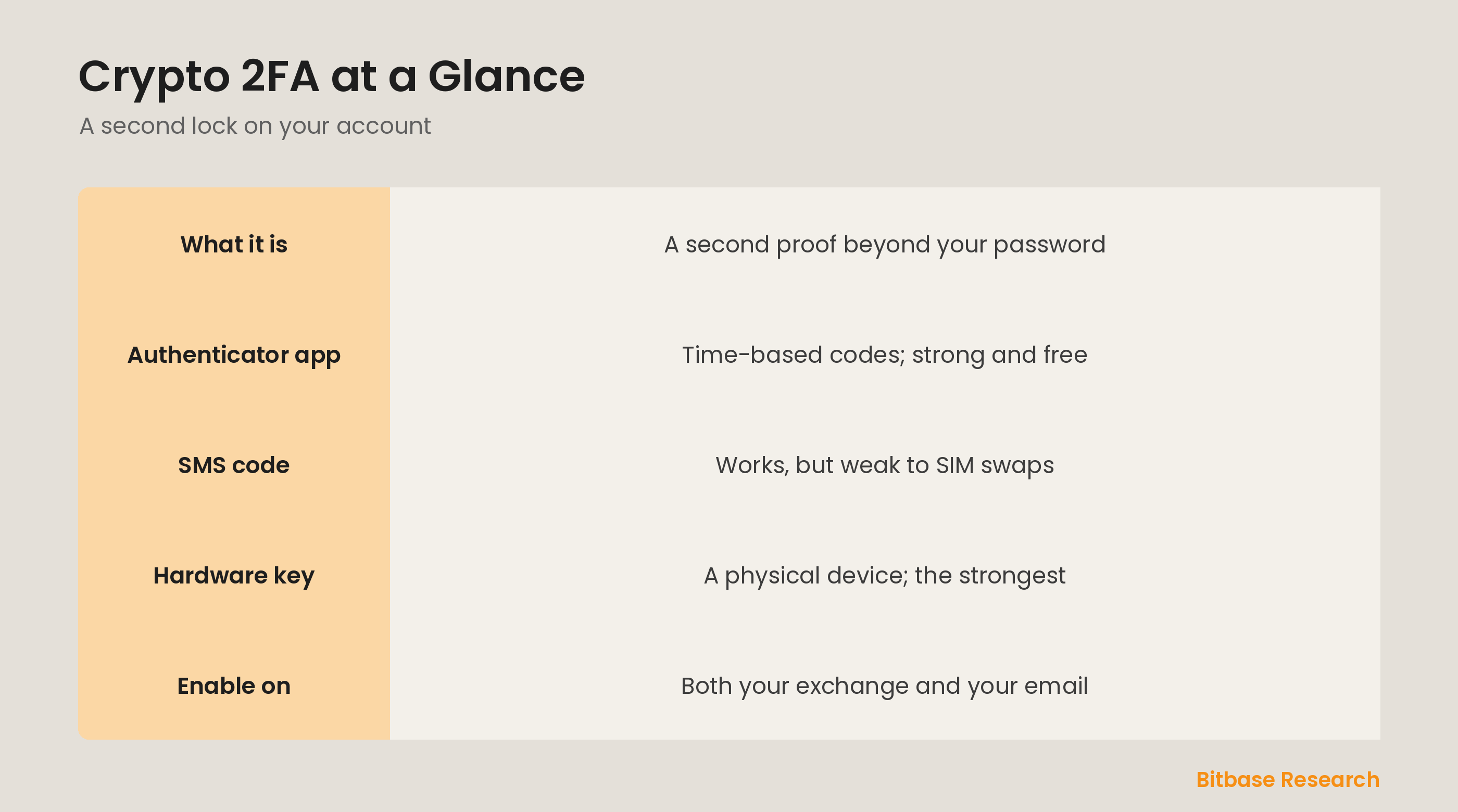
There are three you will meet most often. An authenticator app generates a fresh time-based code every 30 seconds, entirely on your device. An SMS code is texted to your phone number. A hardware security key is a small physical device you plug in or tap. All three work, but they are not equally safe — the method you choose matters as much as turning 2FA on at all.
Why an app beats SMS
SMS codes are better than nothing, but they have a real weakness: an attacker who tricks your mobile carrier into moving your number to their SIM — a SIM swap — can receive your codes. An authenticator app avoids this entirely because the codes never travel over the phone network. A hardware key is stronger still, since it also resists phishing. Where an exchange offers a choice, prefer an app or a key over SMS.
Setting it up right
Turn on 2FA not just on your exchange but also on the email account tied to it, since that inbox can reset your other logins. When you enable an authenticator app, save the backup codes it gives you somewhere safe and offline — they are your way back in if you lose the phone. Do not rely on SMS as your only factor, and never share a 2FA code with anyone who contacts you.
The bottom line
2FA adds a second proof on top of your password, so a stolen password alone cannot open your account. An authenticator app or a hardware key is far safer than SMS, which is exposed to SIM-swap attacks. Enable it on both your exchange and your email, keep your backup codes offline, and treat those few extra seconds at login as cheap insurance on everything you hold. To keep learning the fundamentals, follow more from Bitbase Academy.
Disclaimer: This article is educational content from Bitbase Academy, provided for information only. It does not constitute investment, trading, tax, or financial advice. Crypto assets are volatile; assess your own risk. Written as of June 2026; refer to the latest official information.
References
[1] Investopedia, "Two-Factor Authentication (2FA): Definition and How It Works" investopedia.com
[2] Investopedia, "Phishing: What It Is and How to Protect Yourself" investopedia.com
[3] CFTC, "Customer Advisory: Understand the Risks of Virtual Currency Trading" cftc.gov