You can stake the same tokens in very different ways. Solo staking gives you the most control and the least convenience; liquid staking flips that. The right choice depends on how much capital, skill, and flexibility you have.
Solo staking: full control
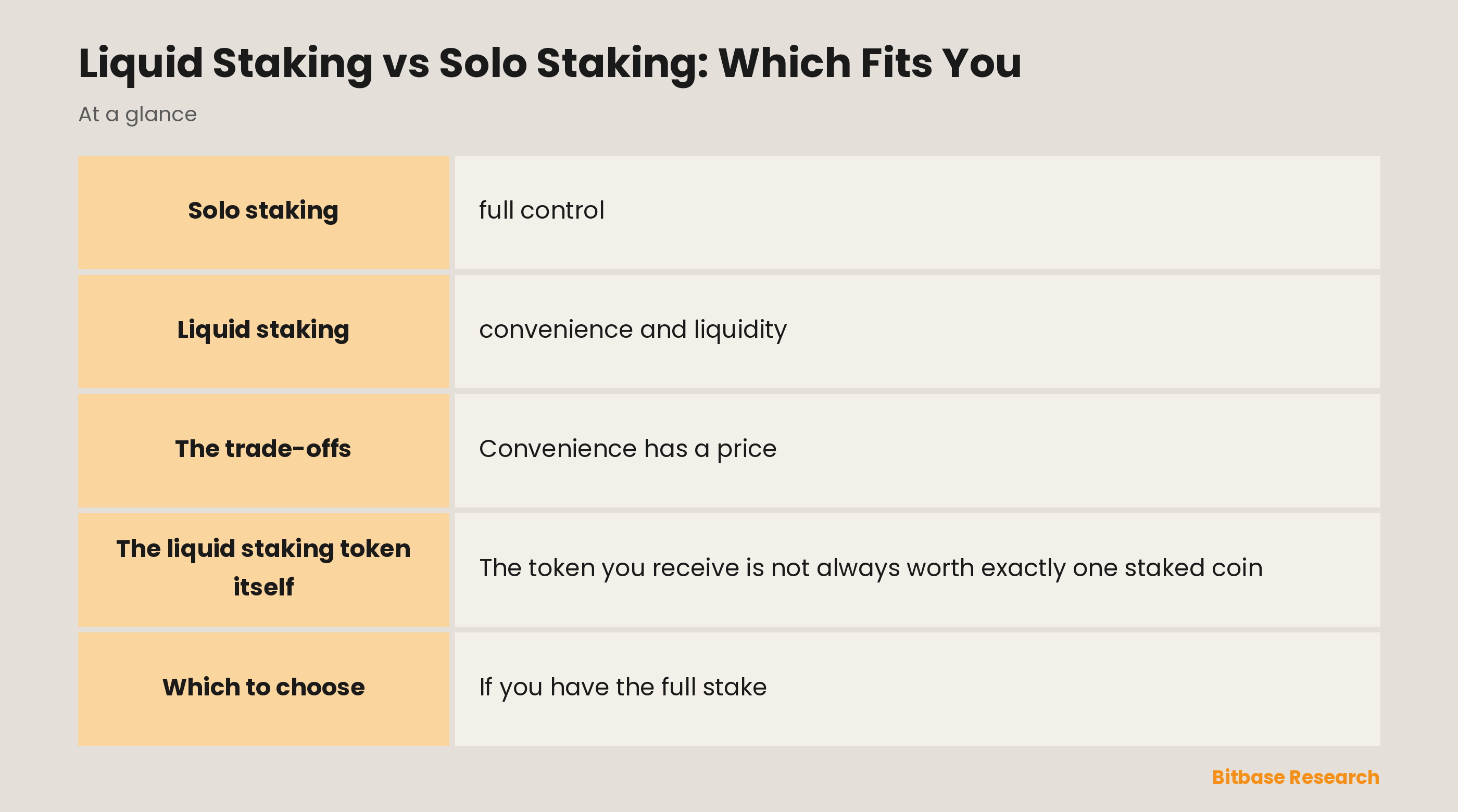
Solo staking means running your own validator with your own tokens. On Ethereum that requires 32 ETH and a reliable node you maintain yourself. The payoff is the purest form of staking: you earn the full reward, keep full custody, and strengthen decentralization by being an independent validator. The cost is responsibility. Downtime or mistakes can cost you, and your stake is locked, not something you can spend or trade.
Liquid staking: convenience and liquidity
Liquid staking pools many users' tokens and runs validators on their behalf. In return you receive a liquid staking token, such as stETH, that represents your stake plus its growing rewards. You can hold it, trade it, or use it elsewhere in DeFi while it keeps earning. There is no minimum of 32 ETH and no node to run. Lido is the largest provider, controlling a sizeable share of all staked ETH.
The trade-offs
Convenience has a price. Liquid staking usually takes a small fee and adds smart-contract risk: your tokens depend on the protocol's code and its operators. It also concentrates stake in a few big providers, which some see as a risk to the network's decentralization. Solo staking avoids those problems but demands capital, uptime, and technical care.
The liquid staking token itself
The token you receive is not always worth exactly one staked coin. It usually tracks close to it, but in a stressed market it can trade at a small discount, and its value depends on the pool remaining solvent and redeemable. Treat the liquid token as a claim on staked assets, not as the assets themselves.
Which to choose
If you have the full stake, the skills, and want maximum control and decentralization, solo staking is the gold standard. If you want to stake any amount, keep your funds usable, and avoid running infrastructure, liquid staking is the practical choice for most people. Many split the difference by using a reputable pool for convenience while accepting its risks knowingly.
Disclaimer: This article is educational content from Bitbase Academy, provided for information only. It does not constitute investment, trading, tax, or financial advice. Written as of July 2026; refer to the latest official information.
References
[1] Koinly, "Best Liquid Staking Protocols (2026)" koinly.io
[2] Spoted Crypto, "Ethereum Staking Yields: Solo, Lido, Restaking Compared" spotedcrypto.com