
The DeFi you have read about is permissionless — open to anyone with a wallet. But a parallel version is quietly growing: permissioned DeFi built for banks and institutions, wrapped in compliance and gated by identity. Understanding this "institutional DeFi" reveals where traditional finance and crypto are actually converging.
Two kinds of DeFi
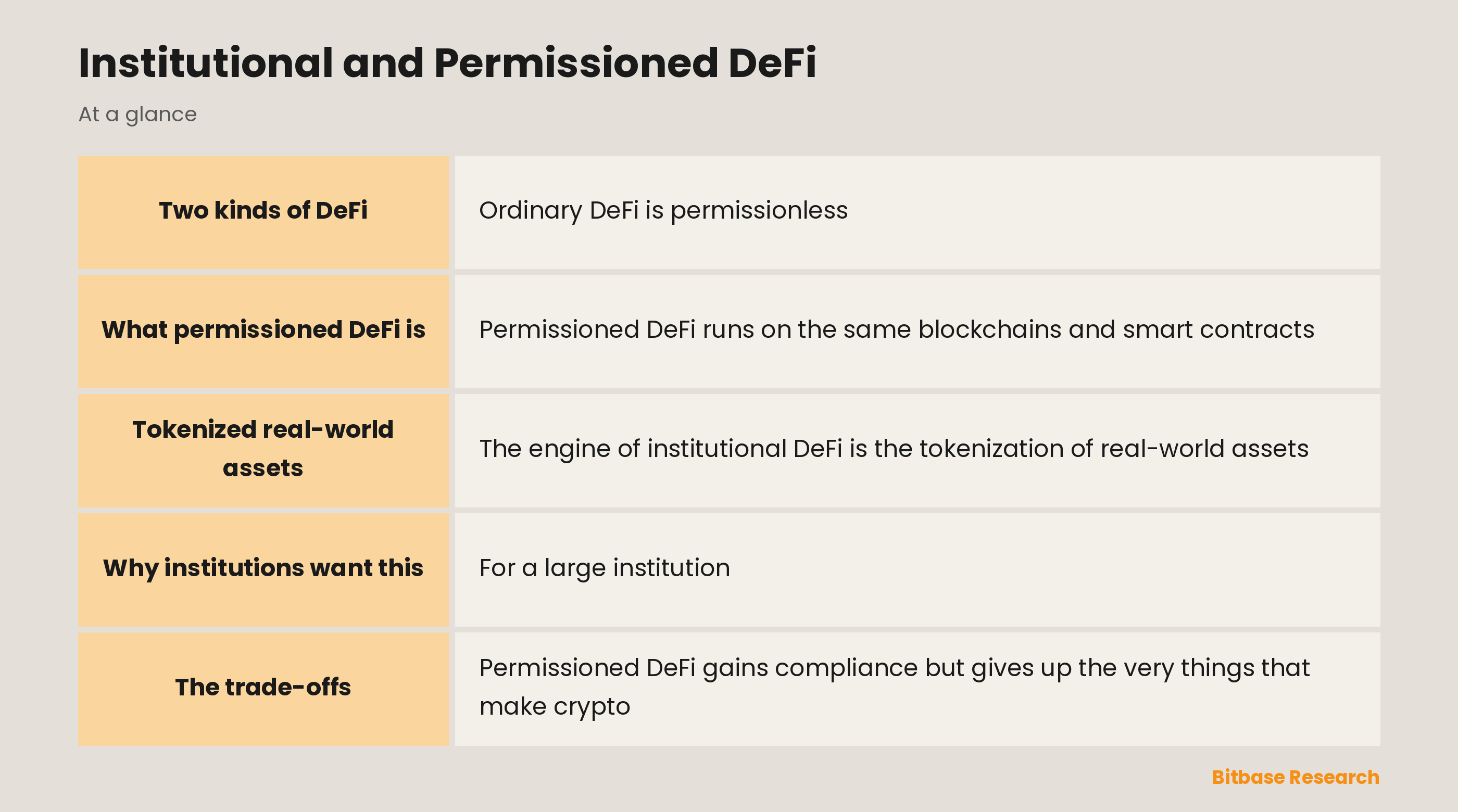
Ordinary DeFi is permissionless: anyone, anywhere, can use it pseudonymously with just a wallet, and that openness is its whole point. Institutions, though, operate under strict rules — they must know their customers, follow anti-money-laundering laws, and answer to regulators. They cannot simply pour billions into an anonymous pool, so a second, gated version of DeFi has grown up to meet them where the rules require.
What permissioned DeFi is
Permissioned DeFi runs on the same blockchains and smart contracts, but with an identity layer bolted on. Access is restricted to verified, whitelisted wallets that have passed know-your-customer and anti-money-laundering checks, so only approved participants can join a lending or trading pool. You get the efficiency of on-chain finance while staying inside the compliance boundaries institutions require.
Tokenized real-world assets
The engine of institutional DeFi is the tokenization of real-world assets, or RWA: putting things like government bonds, money-market funds, and credit on-chain as tokens. This trend has gone mainstream — BlackRock's tokenized treasury fund alone holds tens of billions in assets, and specialists like Ondo Finance command the majority of the tokenized-treasury market with billions locked. These tokens deliver traditional yields with on-chain, near-instant liquidity.
Why institutions want this
For a large institution, on-chain rails offer real advantages: settlement in seconds instead of days, markets that run around the clock, and programmable money that can automate what once took armies of back-office staff. Tokenized treasuries let idle cash earn yield with instant liquidity that a traditional money-market fund cannot match. It is traditional finance keeping its safeguards while borrowing crypto's speed and openness.
The trade-offs
Permissioned DeFi gains compliance but gives up the very things that make crypto distinctive. Gated access means it is not open to everyone; whitelists and issuers mean you are trusting named companies and custodians, not just code; and identity checks remove the pseudonymity many value. It is best understood as "DeFi rails with TradFi trust" — powerful, but a different bargain from permissionless DeFi.
The bottom line
Institutional and permissioned DeFi is where traditional finance and crypto are genuinely converging, bringing enormous capital and real, asset-backed yield onto blockchains. But it trades away the permissionlessness and censorship-resistance that define open DeFi in exchange for compliance and trusted issuers. Before judging any product by DeFi's promises, know which world it actually lives in — open and pseudonymous, or gated and institutional.
Disclaimer: This article is educational content from Bitbase Academy, provided for informational purposes only. It is not investment, trading, tax, or financial advice. Written as of July 2026; rely on the latest official information.
References
[1] RWA.xyz, "Tokenized real-world assets dashboard" rwa.xyz
[2] Ondo Finance, "Tokenized treasuries and USDY" ondo.finance