For years crypto lived in its own world of native tokens. Now some of the largest financial institutions are moving the opposite way — putting traditional assets like government bonds, funds, and stocks onto blockchains as tokens. This is real-world asset tokenization, or RWA, and it has quietly grown into one of crypto's most significant bridges to the mainstream economy. Here is how it works.
What RWA tokenization is
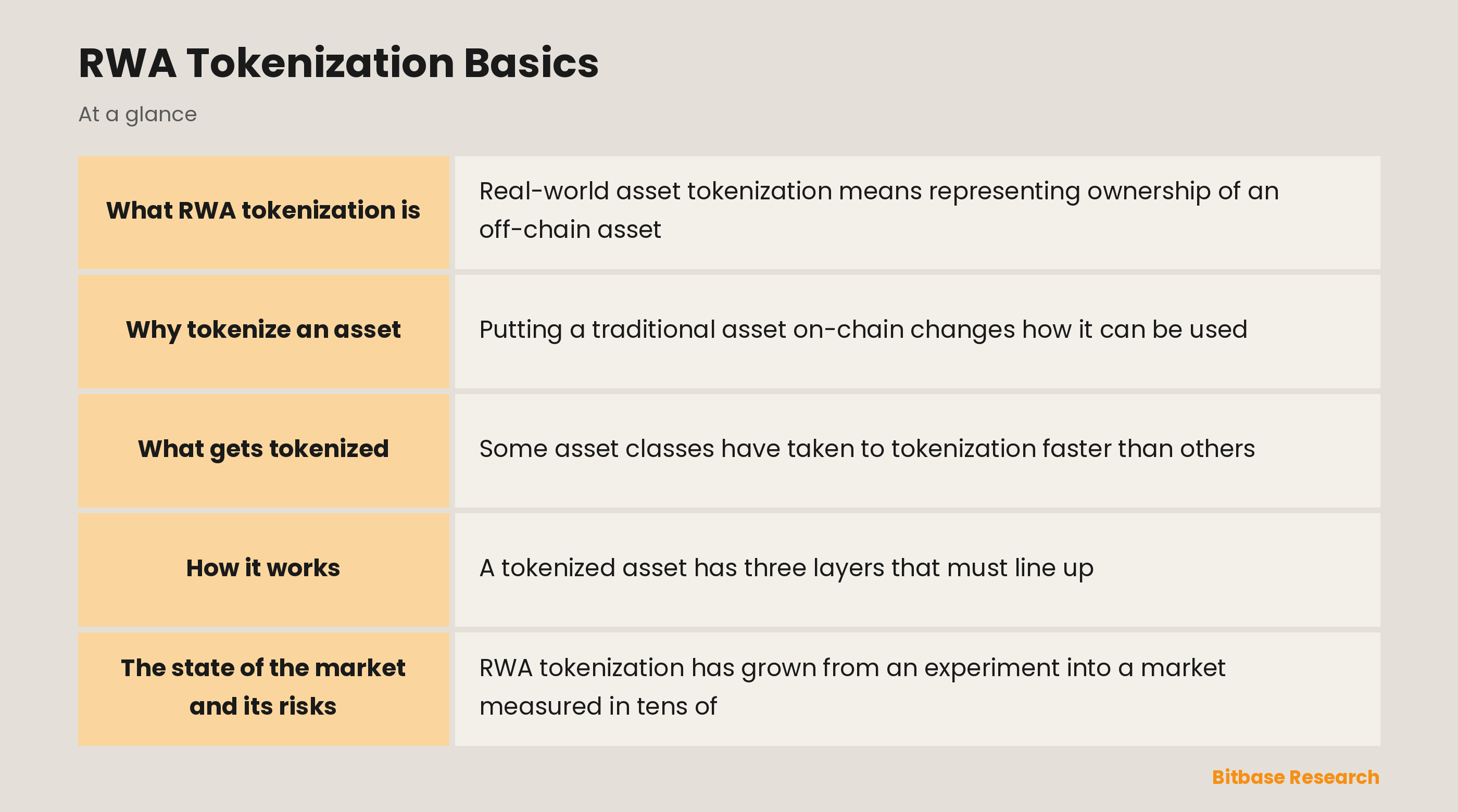
Real-world asset tokenization means representing ownership of an off-chain asset — a treasury bond, a share in a fund, a piece of property — as a token on a blockchain. The token is a digital claim on the underlying asset, backed by a legal structure that ties the on-chain token to the real thing. Instead of inventing new value from thin air, RWA brings existing, familiar assets onto crypto rails, letting them be held, moved, and traded with the speed and openness of a blockchain.
Why tokenize an asset
Putting a traditional asset on-chain changes how it can be used. Tokenized assets can trade continuously rather than only during market hours, settle in seconds rather than days, and be divided into tiny fractions so smaller investors can participate. Because they live on programmable rails, they can also plug directly into other applications, serving as collateral or building blocks in decentralised finance. The pitch is the efficiency, accessibility, and composability of crypto applied to the trusted assets of traditional finance.
What gets tokenized
Some asset classes have taken to tokenization faster than others. By far the largest is short-term government debt, where tokenized treasury funds let holders earn yield on-chain. Money-market and other investment funds have followed, along with private credit, tokenized stocks and exchange-traded funds, commodities such as gold, and, more slowly, real estate. The common pattern is that liquid, income-producing, well-understood assets tokenize first, while complex or illiquid ones remain harder to bring on-chain cleanly.
How it works
A tokenized asset has three layers that must line up. First, the real asset is held and safeguarded, usually by a regulated custodian. Second, a legal structure establishes that the token genuinely entitles its holder to that asset. Third, the token itself lives on a blockchain and can be transferred, while data feeds keep its value and status in sync with the off-chain reality. The whole system only works if each layer is sound, because the token is ultimately only as good as the legal claim and the custody behind it.
The state of the market and its risks
RWA tokenization has grown from an experiment into a market measured in tens of billions of dollars, led by tokenized government debt and driven heavily by large, established asset managers rather than crypto startups alone. That institutional involvement lends credibility, but real risks remain. A token depends on off-chain legal enforceability and on trusting the custodian and issuer, regulation still varies widely by asset and jurisdiction, and access is often limited to qualified or institutional investors. The blockchain does not remove these traditional dependencies; it wraps them.
The bottom line
RWA tokenization brings traditional assets — bonds, funds, stocks, and more — onto blockchains as tokens, combining the trust of established finance with the speed, fractionalisation, and composability of crypto. Tokenized government debt leads a market now measured in tens of billions, with major institutions participating. But a token is only a claim on something off-chain, so its safety rests on the legal wrapper, the custodian, and the regulator behind it. Treat RWA as a serious bridge between two financial worlds, not a way to escape the risks of either.
Disclaimer: This article is educational content from Bitbase Academy, provided for informational purposes only. It is not investment, trading, tax, or financial advice. Written as of July 2026; rely on the latest official information.
References
[1] RWA.xyz, "Tokenized real-world assets dashboard" rwa.xyz
[2] CoinDesk, "What is real-world asset tokenization?" coindesk.com