A blockchain is not a single computer but thousands of them, and not all of them do the same job. Some store everything, some verify without storing much, some produce blocks, and some just answer questions for apps. Understanding the types of nodes reveals how a network actually stays decentralised, and what "running a node" really means.
What a node is
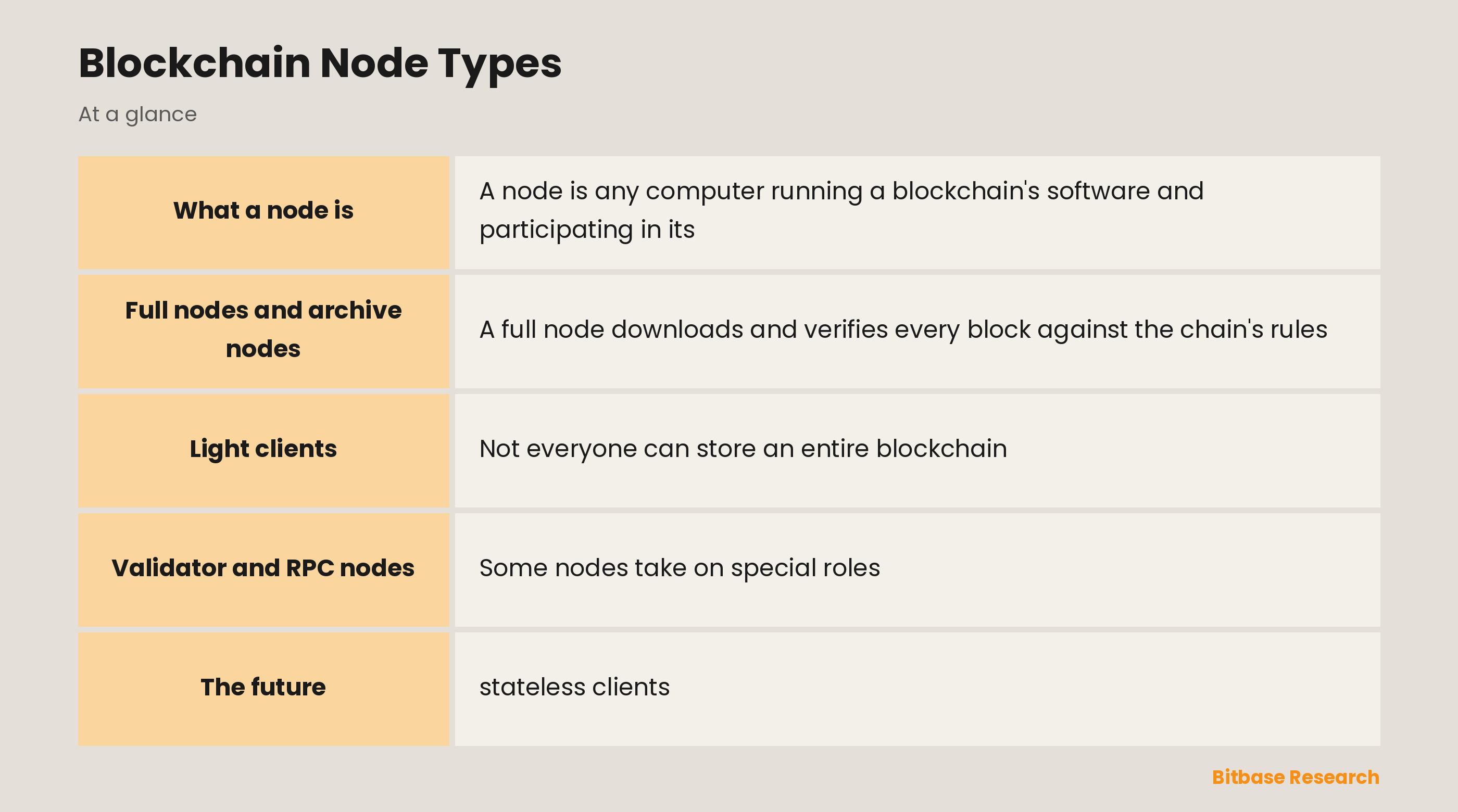
A node is any computer running a blockchain's software and participating in its network. At minimum a node knows the rules of the chain and keeps some copy of its data, so it can check that transactions and blocks are valid. The more independent nodes there are, the harder the network is to censor or rewrite — decentralisation is, in a very literal sense, just a large and diverse population of nodes. The differences between node types come down to how much they store and what role they play.
Full nodes and archive nodes
A full node downloads and verifies every block against the chain's rules, independently confirming the current state without trusting anyone. It typically keeps recent state and can discard old intermediate data, which keeps its storage manageable. An archive node goes further, retaining every historical state the chain has ever had, so it can answer questions about any past block. Archive nodes are heavy and mostly run by explorers and infrastructure providers; full nodes are the backbone that ordinary users and businesses run.
Light clients
Not everyone can store an entire blockchain, so light clients (also called light nodes) download only block headers rather than full contents. To check a specific transaction, a light client requests a compact cryptographic proof from full nodes and verifies it against the header it already trusts. This lets phones and small devices interact with a chain safely without holding all its data. The trade-off is a mild reliance on full nodes to supply information, though the proofs mean it does not have to trust them blindly.
Validator and RPC nodes
Some nodes take on special roles. A validator (or, on proof-of-work chains, a miner) is a full node that also proposes and attests to blocks, staking capital or spending energy to help secure the chain and earn rewards. An RPC node exposes an interface that lets wallets and applications read data and broadcast transactions without running their own node. Most apps you use quietly depend on RPC nodes, which is a subtle point of centralisation worth remembering.
The future: stateless clients
A long-standing problem is that full nodes must store an ever-growing state, raising the hardware bar and quietly pushing people toward centralised providers. The proposed fix is stateless clients, enabled by a switch to more efficient cryptographic structures such as Verkle trees. With them, a node could verify blocks using tiny witnesses instead of holding the entire state, shrinking proofs dramatically. The goal is to keep running a node cheap enough that decentralisation does not erode as the chain grows.
The bottom line
Node types are the division of labour that keeps a blockchain both trustworthy and usable: full nodes verify everything, archive nodes remember all history, light clients bring safety to small devices, and validators secure the chain while RPC nodes serve apps. Running any node strengthens the network's independence. And efforts like stateless clients aim to keep that participation open to as many people as possible, not just those with powerful hardware.
Disclaimer: This article is educational content from Bitbase Academy, provided for informational purposes only. It is not investment, trading, tax, or financial advice. Written as of July 2026; rely on the latest official information.
References
[1] Coinbase, "What is a blockchain node?" coinbase.com
[2] QuickNode, "Full nodes, light nodes and archive nodes" quicknode.com