Bitcoin's base layer is deliberately slow and small — it processes only a handful of transactions per second, on purpose. Layer-2 networks are how Bitcoin scales without touching that rock-solid core, adding speed and features on top. Here is the landscape, and what each approach really trades away.
Why Bitcoin needs a second layer
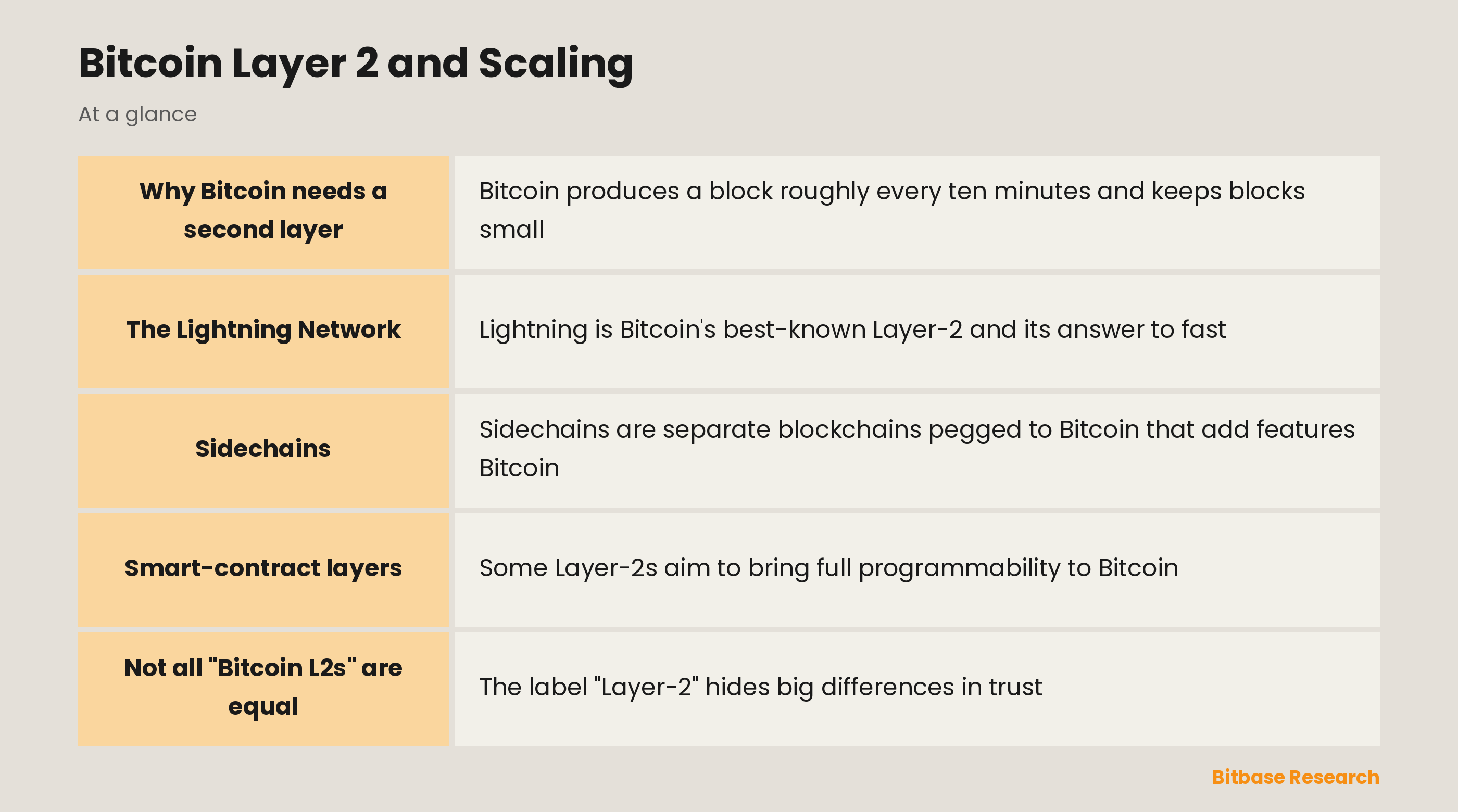
Bitcoin produces a block roughly every ten minutes and keeps blocks small, which caps it at only a few transactions per second and can make fees spike when demand rises. That is a choice for security and decentralization, not a bug — but it makes Bitcoin impractical as everyday cash on its own. Layer-2s take activity off the base chain, letting it settle there only when needed.
The Lightning Network
Lightning is Bitcoin's best-known Layer-2 and its answer to fast, cheap payments. It opens payment channels between users, letting them send near-instant transactions off-chain and settle the final balance on Bitcoin later. For small, latency-sensitive payments — a coffee, a tip, a stream of tiny amounts — it is the standard solution. The trade-off is managing channels and liquidity, which adds complexity.
Sidechains
Sidechains are separate blockchains pegged to Bitcoin that add features Bitcoin lacks. Rootstock runs Ethereum-style smart contracts and is secured by merge-mining, where Bitcoin miners also mine Rootstock at no extra cost. Liquid, a federated sidechain, targets faster settlement and asset issuance for traders. These add capability, but they lean on their own security models rather than Bitcoin's.
Smart-contract layers
Some Layer-2s aim to bring full programmability to Bitcoin. Stacks uses its own consensus tied to Bitcoin and hosts smart contracts along with the sBTC asset. Newer entrants like Botanix launched with working DeFi apps, while designs such as Citrea use the BitVM breakthrough to build rollup-style chains that verify back to Bitcoin. This corner of the ecosystem is the most experimental and the fastest-moving.
Not all "Bitcoin L2s" are equal
The label "Layer-2" hides big differences in trust. A Lightning channel is secured directly by Bitcoin; a federated sidechain trusts a group of operators; a merge-mined chain leans on miner participation; a new rollup depends on younger cryptography. Unlike Ethereum's rollups, most Bitcoin L2s do not fully inherit the base chain's security. Always ask what actually protects your BTC on a given layer.
The bottom line
Bitcoin scales by building outward, not by changing its careful core — Lightning for payments, sidechains and smart-contract layers for features. Each buys speed or programmability by accepting a different security trade-off, and the newest designs are still proving themselves. When you use a Bitcoin Layer-2, the key question is never just how fast it is, but what you are trusting to keep your coins safe.
Disclaimer: This article is educational content from Bitbase Academy, provided for informational purposes only. It is not investment, trading, tax, or financial advice. Written as of July 2026; rely on the latest official information.
References
[1] Bitcoin Foundation, "Best Bitcoin Layer 2 Projects 2026" bitcoinfoundation.org
[2] Crypto Adventure, "Bitcoin Layer 2s: Stacks, Rootstock, BitVM And Beyond" cryptoadventure.com