Every popular blockchain eventually hits the same wall: too many users, not enough room in each block. Rollups are the main answer Ethereum chose — a way to process far more transactions while still leaning on Ethereum for security. Understanding them is the key to understanding modern crypto fees.
The scaling problem
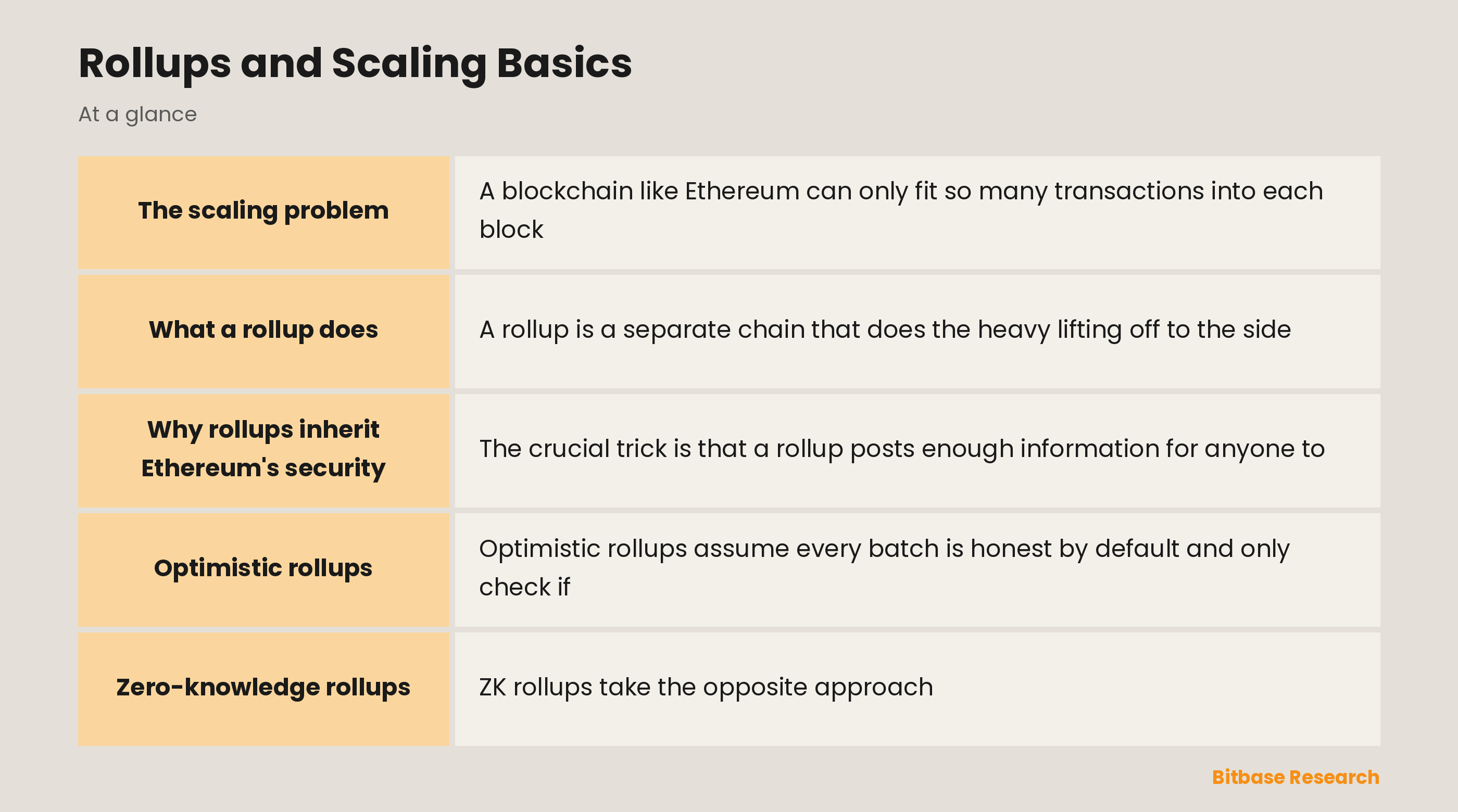
A blockchain like Ethereum can only fit so many transactions into each block, and blocks arrive at a fixed pace. When demand rises, users bid up fees to get in, and the network becomes expensive and slow. Simply making blocks bigger would help, but it forces every node to store and process more, which pushes out ordinary participants and weakens decentralization. This tension — security, decentralization, and scale pulling against each other — is why naive scaling fails.
What a rollup does
A rollup is a separate chain that does the heavy lifting off to the side. It executes transactions in its own environment, bundles hundreds or thousands of them together, and posts a compact summary back to Ethereum. Ethereum does not re-run every transaction; it stores the data and checks the result. You get far more throughput, while the final record still lives on Ethereum.
Why rollups inherit Ethereum's security
The crucial trick is that a rollup posts enough information for anyone to challenge or verify its results. Because the transaction data and proofs land on Ethereum, no rollup operator can secretly steal funds or forge balances — the base layer would reject an invalid state. This is what separates a real rollup from a mere sidechain: its safety comes from Ethereum, not from trusting the team.
Optimistic rollups
Optimistic rollups assume every batch is honest by default and only check if someone objects. They come with a challenge window — typically about seven days — during which anyone can submit a fraud proof to reverse a bad batch. Arbitrum, Optimism, and Base use this model. It is simple and cheap, though a direct withdrawal back to Ethereum can have to wait out that challenge period.
Zero-knowledge rollups
ZK rollups take the opposite approach: they attach a cryptographic validity proof to every batch, showing mathematically that the transactions are correct. Ethereum verifies the proof quickly, so there is no week-long wait and funds can move faster. Networks like zkSync, Starknet, Linea, and Scroll use this design. The proofs are harder to build, but the security guarantee is tighter.
The bottom line
Rollups let Ethereum stay small and secure at its base while pushing activity to faster layers on top — the core of its "rollup-centric" roadmap. Optimistic rollups trade a withdrawal delay for simplicity; ZK rollups trade engineering complexity for faster proofs. Either way, when you pay a low fee on a Layer-2, a rollup is the machinery quietly doing the work.
Disclaimer: This article is educational content from Bitbase Academy, provided for informational purposes only. It is not investment, trading, tax, or financial advice. Written as of July 2026; rely on the latest official information.
References
[1] L2BEAT, "Scaling summary" l2beat.com
[2] Optimism Docs, "Rollup protocol overview" optimism.io