This piece is part of Bitbase's "Countdown to Kickoff" short-form World Cup series (Episode 6). For Bitbase's long-form research, see our Market Insights and Deep Dive series.
There is no crypto company among the top-tier sponsors of the 2026 FIFA World Cup — Coca-Cola, Visa, Adidas, Hyundai and the rest of the usual roster fill every slot. But in the corner of the sponsor list, FIFA has created a brand-new category called Official Prediction Market Partner. Filling that new category is ADI Predictstreet — a Gibraltar-licensed product, run by an Abu Dhabi IHC subsidiary, built on an Ethereum L2 called ADI Chain [1].
Front Office Sports called it "an obscure Abu Dhabi blockchain project" [2]. FIFA has said no to crypto sponsors out loud, and yes to a crypto product in practice. That is the structural change at the heart of this World Cup's odds market — and it is only the opening note.
Act 1 — The Numbers Are Past ESPN
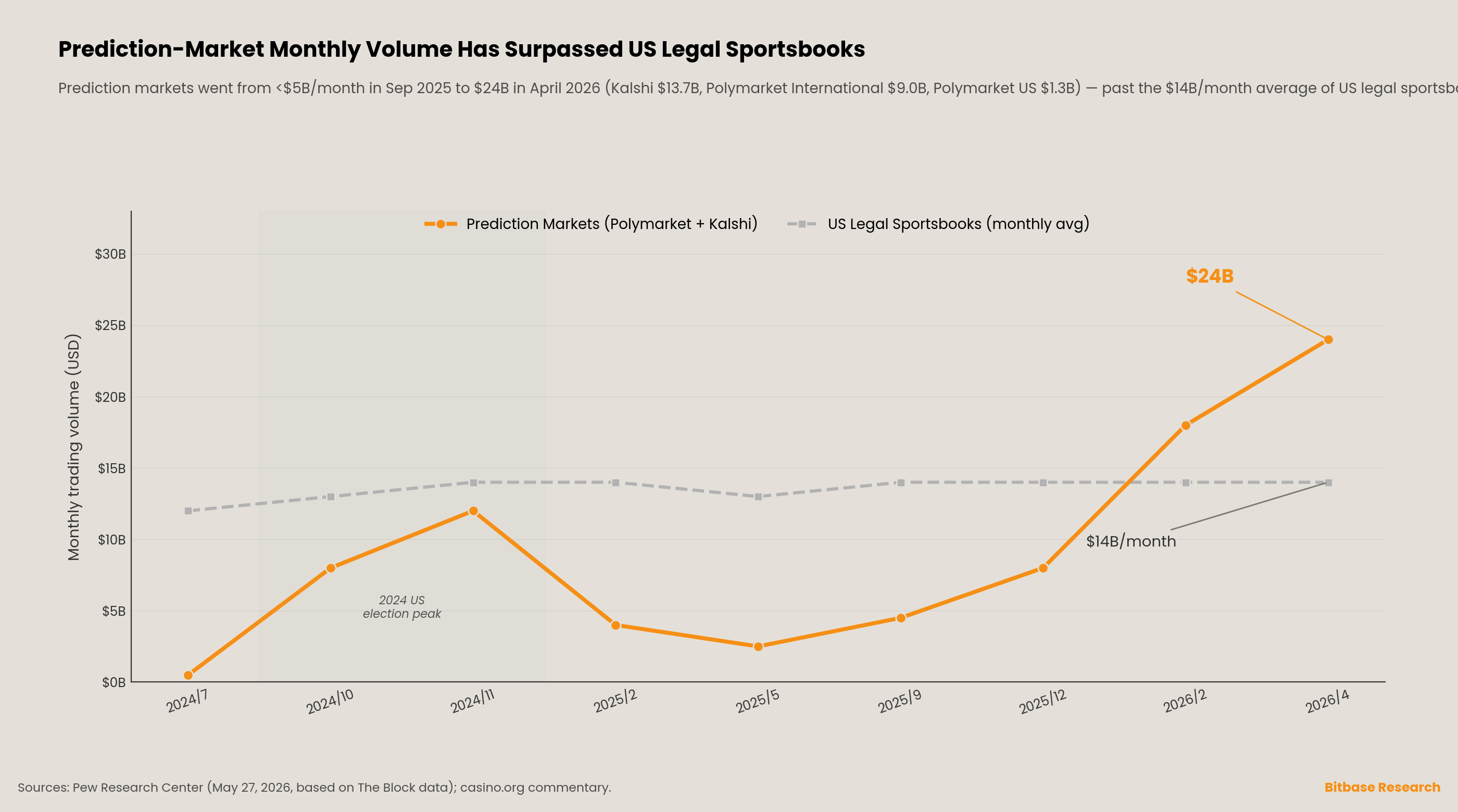
Two figures side by side:
-
Combined monthly volume on Polymarket + Kalshi globally, September 2025: under $5 billion
-
April 2026: $24 billion (Kalshi $13.7B, Polymarket International $9.0B, Polymarket US $1.3B) [3]
-
Average monthly volume on US legal sportsbooks in 2025: $14 billion [3]
In seven months, prediction markets went from sub-$5B to $24B — past the entire US legal sportsbook industry.
The World Cup winner contract alone, aggregated across Kalshi and Polymarket, has cleared $500 million in trading volume as of May 30 [4]. DeFi Rate's internal modeling projects the World Cup winner market will reach $250 million in final settled volume by tournament's end, with Kalshi alone accounting for $147–193 million [5].
Worth noting: Wintermute — a London-based algorithmic trading firm clearing $3.5 trillion in annual volume — began streaming two-sided quotes on prediction markets in 2026, treating Polymarket and Kalshi as the same kind of financial infrastructure as equity options [6]. The framing of prediction markets as "a niche crypto experiment" is, as of now, about seven months out of date.
Act 2 — The House Is No Longer the Counterparty
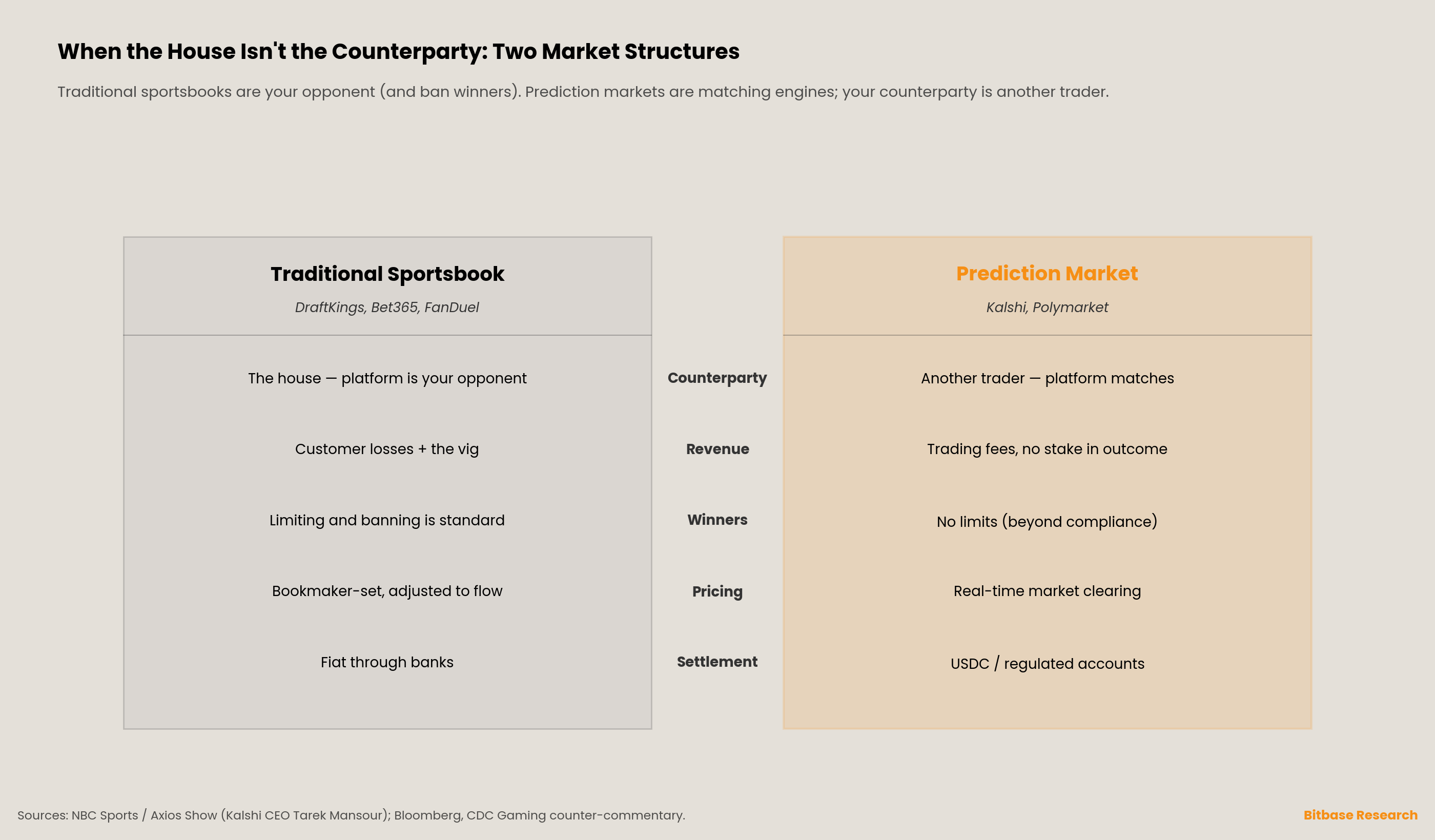
But the structural difference doesn't mean Kalshi is "better gambling." Bloomberg and CDC Gaming both pointed out that Mansour's argument is "half right": the structural difference is real, but the harm pattern of problem gambling does not depend on who the counterparty is — the user compulsively chasing losses on Kalshi is harmed the same way as the user compulsively chasing losses on DraftKings [8].
Bitbase doesn't take a side here. We just surface one observation: who is on the other side of your trade determines whether your winnings are the platform's business model. That is a question most football fans have never had to think about in fifty years.
Act 3 — CFTC or Crypto-Native
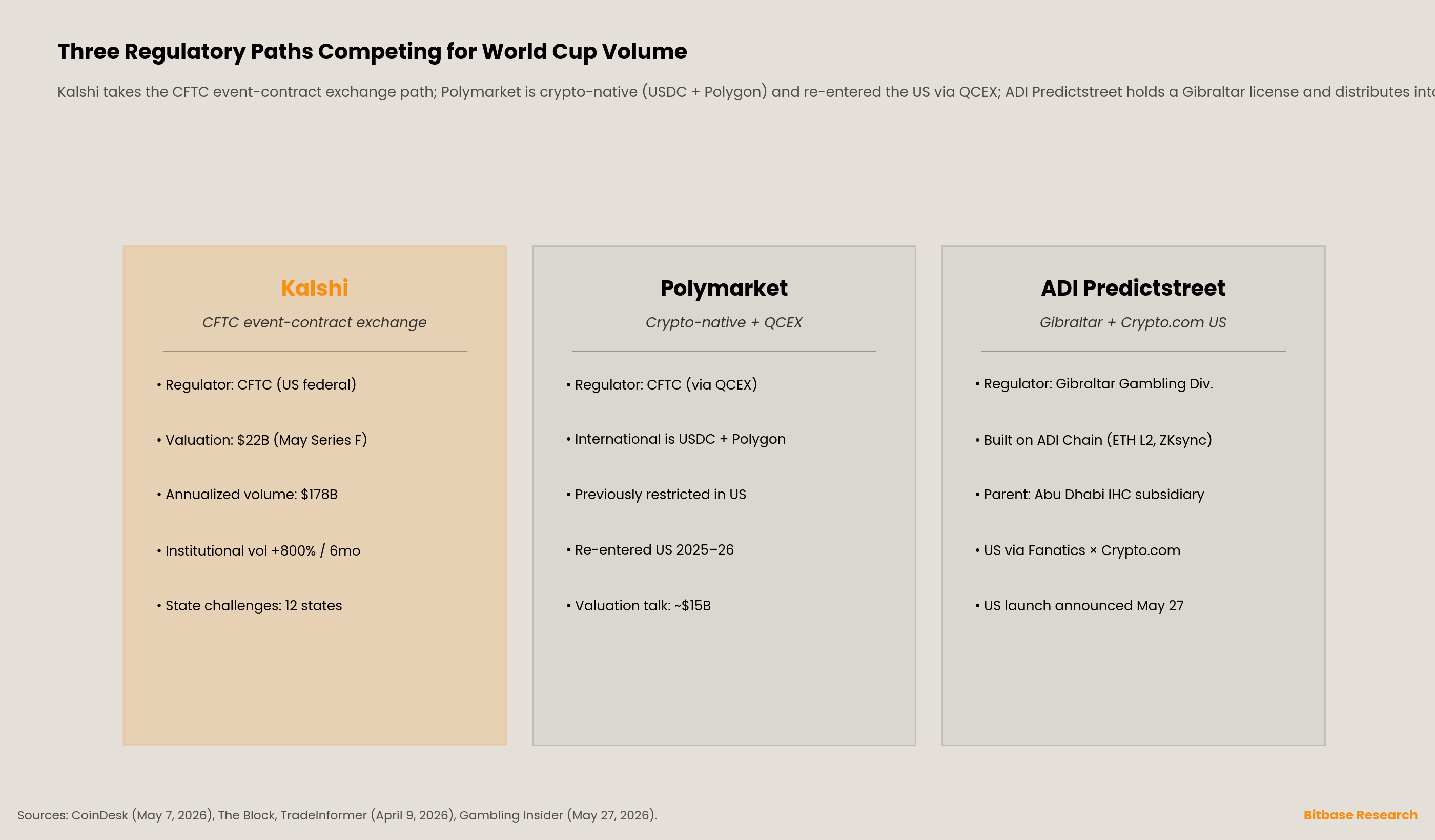
The two leading prediction markets take two completely different regulatory paths.
Kalshi's path: a CFTC-regulated "event contract exchange" — World Cup outcomes are defined as financial derivatives, not gambling. Three direct consequences:
-
On May 7, 2026, Kalshi confirmed a $1 billion Series F at a $22 billion valuation, led by Coatue, with Sequoia, a16z, Paradigm, Morgan Stanley and ARK Invest. Valuation doubled in five months [9]
-
Institutional trading volume up 800% over six months; annualized trading volume above $178 billion [9]
-
But 12 US states have moved against prediction markets — Arizona filed criminal charges against Kalshi's parent entities, Rhode Island's AG is suing Kalshi, New Jersey / Nevada / Illinois have issued cease-and-desist orders [9]. State law vs federal CFTC oversight is unresolved.
Polymarket's path: USDC + Polygon, crypto-native. Previously restricted from US users following a CFTC settlement; in 2025–2026 it re-entered the US by acquiring QCEX, a CFTC-regulated exchange [10]. Polymarket International remains fully crypto-native (USDC settlement, on-chain reconciliation); Polymarket US operates under CFTC oversight.
ADI Predictstreet's third path: a Gibraltar license (Predict Street Ltd was licensed by the Gibraltar Gambling Division on March 26, 2026, registered as a "betting intermediary" under the 2005 Gambling Act), plus a US-distribution deal announced May 27 — running through Fanatics Markets and listing contracts on Crypto.com's CFTC-regulated exchange [11][12]. FIFA used a crypto product to bypass the state-level sportsbook licensing regime in the US.
Three regulatory paths competing for the same World Cup audience, at the same time. The contest is not technical. It is the legal question of what World Cup outcomes are — gambling or derivatives?
Act 4 — Spread and Liquidity
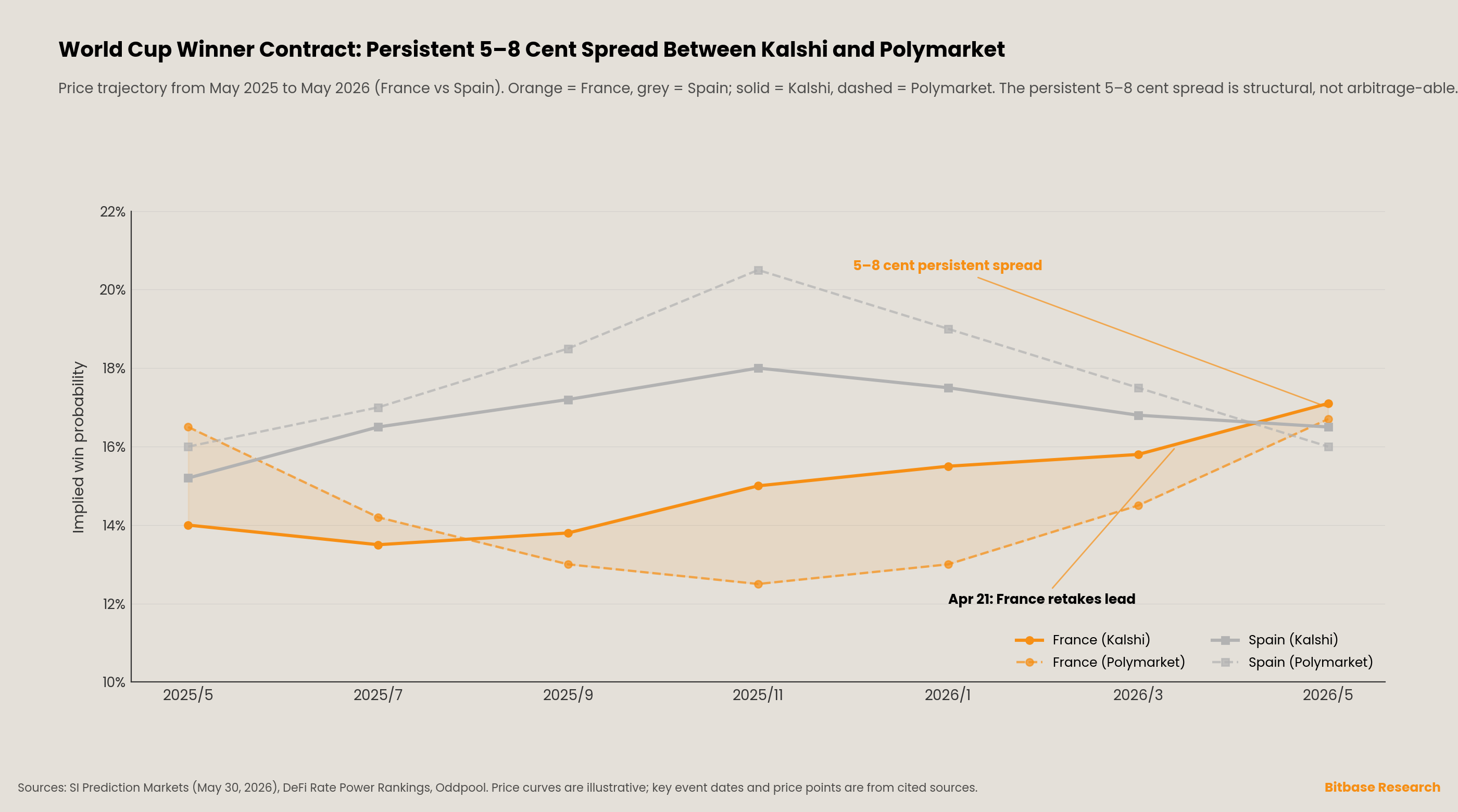
As of May 30, prediction market pricing on the World Cup winner (per DeFi Rate's aggregated VWAP tracker):
-
France: Kalshi 17.1% (+487) / Polymarket 16.7% — reclaimed the top spot from Spain on April 21
-
Spain: Kalshi 16.5% (+507) / Polymarket 16.0% — led for most of the year, lost the top on April 21
-
England: Kalshi 11.2% (+797) / Polymarket 11.1%
-
Brazil: ~9–10% / Argentina: ~7–8% [13]
Kalshi and Polymarket consistently trade the same contract at a 5–8 cent spread — that is, $0.05–$0.08 per $1 contract [14].
This looks like an arbitrage opportunity. It isn't — it's a structural spread that won't close:
-
Jurisdiction: Kalshi is US-compliant; Polymarket is international — many traders can't legally hold accounts on both
-
Settlement speed: USDC on-chain (seconds) vs CFTC-regulated accounts (T+1) — the carry cost during the spread window itself consumes the arbitrage margin
-
Liquidity depth: large arb trades collapse the spread quickly; arbitrageurs are stuck doing small notional
-
Currency friction: Polymarket uses USDC; Kalshi uses USD — FX conversion and compliance friction eat another layer
A 5–8 cent spread is not evidence of market inefficiency. It is the price of two infrastructure stacks that don't speak to each other. It persists because closing it requires regulatory coordination, not better tech.
Closing — When the House Is No Longer the Counterparty
Four things, one direction:
-
FIFA said no to crypto sponsors out loud, and yes to a crypto product in practice — through a brand-new category
-
Prediction-market monthly volume rose from $5B to $24B in seven months, passing US legal sportsbooks
-
The house is no longer the counterparty — the business model shifted from "winning the customer's money" to "charging the customer a fee"
-
A 5–8 cent spread is structural, not inefficient — it reflects two market infrastructures that don't connect
2026 is the first World Cup where traditional sportsbooks and crypto-native prediction markets compete head-to-head for the same audience. Bitbase doesn't judge which is better, doesn't recommend participation, doesn't predict who will win — just surfaces, in public data, what happens when the house is no longer the counterparty.
This article is informational and does not constitute investment advice, betting advice, or a recommendation to use any specific platform or contract. All data is from public sources as of May 31, 2026. This is a descriptive observation of market structure and regulatory frameworks; it does not predict 2026 World Cup outcomes, nor does it evaluate the legality, compliance, or profitability prospects of any prediction market or sportsbook.
The legality of prediction markets and sports betting varies materially across jurisdictions. Certain US states — including Nevada, New Jersey, Illinois, Arizona and Rhode Island — have filed suits, issued cease-and-desist orders, or initiated criminal proceedings against prediction-market operators. Mainland China prohibits all betting activities. The EU's MiCA framework for prediction markets is still evolving. Readers must verify the compliance requirements in their own jurisdiction; this article assumes no liability for the legal consequences of any reader's decision to participate or not participate in any activity.
All platforms, institutions and individuals are named factually as participants in public events; this article does not evaluate their business conduct or individual judgment.
References
[1] Predict Street ADI Chain technical brief, Company.gi blog. https://company.gi/blog/predict-street-fifa-world-cup-prediction-market
[2] Front Office Sports, "Why Did FIFA Do a Deal With an Obscure Prediction Market?" (April 8, 2026). https://frontofficesports.com/fifa-world-cup-abu-dhabi-blockchain-prediction-market/
[3] Pew Research Center, "Trading volume on prediction markets has soared in recent months", May 27, 2026. https://www.pewresearch.org/short-reads/2026/05/27/trading-volume-on-prediction-markets-has-soared-in-recent-months/
[4] DeFi Rate, "2026 World Cup Odds | Kalshi vs Polymarket Prediction Markets". https://defirate.com/prediction-markets/world-cup-odds/
[5] DeFi Rate, "Best Prediction Markets for May 2026" (includes World Cup volume modeling: $250M total, Kalshi $147–193M). https://defirate.com/prediction-markets/
[6] The Defiant, "Wintermute Starts Quoting Prediction Markets as Event-Contract Volume Tops $60B in 2026". https://thedefiant.io/news/markets/wintermute-starts-quoting-prediction-markets-as-event-contract-volume-tops-60b-in-2026
[7] NBC Sports, "Kalshi CEO outlines the difference between prediction markets and sportsbooks" (Tarek Mansour quote from Axios Show, host Dan Primack). https://www.nbcsports.com/nfl/profootballtalk/rumor-mill/news/kalshi-ceo-outlines-the-difference-between-prediction-markets-and-sportsbooks
[8] Bloomberg Opinion, "Kalshi CEO Tarek Monsour Is Half Right About Prediction Markets" (April 13, 2026); CDC Gaming Reports commentary. https://www.bloomberg.com/opinion/articles/2026-04-13/kalshi-ceo-tarek-monsour-is-half-right-about-prediction-markets
[9] CoinDesk, "Kalshi confirms $1 billion raise at $22 billion valuation amid prediction market boom" (May 7, 2026). https://www.coindesk.com/business/2026/05/07/kalshi-confirms-usd1-billion-raise-at-usd22-billion-valuation-amid-prediction-market-boom
[10] The Block, "Kalshi raises over $1 billion at $22 billion valuation in ongoing Coatue-led round" (also covers Polymarket QCEX acquisition background). https://www.theblock.co/post/394498/kalshi-raises-over-1-billion-at-22-billion-valuation-in-ongoing-coatue-led-round-reports
[11] TradeInformer, "ADI Predictstreet goes live with Gibraltar licence and FIFA World Cup deal" (April 9, 2026). https://tradeinformer.com/regulations/adi-predictstreet-fifa-world-cup-deal
[12] Gambling Insider, "Predictstreet's World Cup Gambit: A Gibraltar License, a FIFA Badge, and a US Launch in Record Time" (May 27, 2026). https://www.gamblinginsider.com/news/163636/predictstreet-world-cup-gibraltar-fifa-partnership
[13] SI Prediction Markets, "World Cup Kalshi vs Polymarket Odds: Who Offers the Best Value" (updated May 30). https://www.si.com/prediction-markets/world-cup-kalshi-vs-polymarket-odds-who-offers-the-best-value-01ksqev94hvt
[14] Oddpool, "All World Cup 2026 Markets | Kalshi & Polymarket" (includes 5–8 cent spread description). https://www.oddpool.com/explore/world-cup