The World Cup kicks off today. And on kickoff day, two things happened almost at once.
One was money. Going into the opener, the combined volume of Kalshi's and Polymarket's two "World Cup Winner" contracts has passed $2 billion — before a single match has been played [1]. The other was status. Two days before kickoff, the crypto exchange Kraken was named by FIFA an official crypto exchange supporter of the World Cup (Supporter tier, covering North America and Europe; financial terms undisclosed) [5][6][7].
But what this piece actually wants to ask is something more basic — something sports media won't touch: when the World Cup is actually played, how do these on-chain contracts "know" who won? How the price moves with the match, what happens to a contract when a team is eliminated, who adjudicates the result, and how much of those two-plus billion dollars is even real — this is the first day prediction markets move from "static pre-tournament numbers" into a running tournament.
Following the previous episode (the static, on-chain snapshot on kickoff eve), this one is about how the machine actually runs once play starts.
Figures current as of June 11, 2026. All prices and volumes change continuously and may differ at the time of reading. This article predicts no match results.
Act 1 — How $2 Billion Got Stacked Up — and Which $2 Billion
Start by taking that eye-catching number apart.
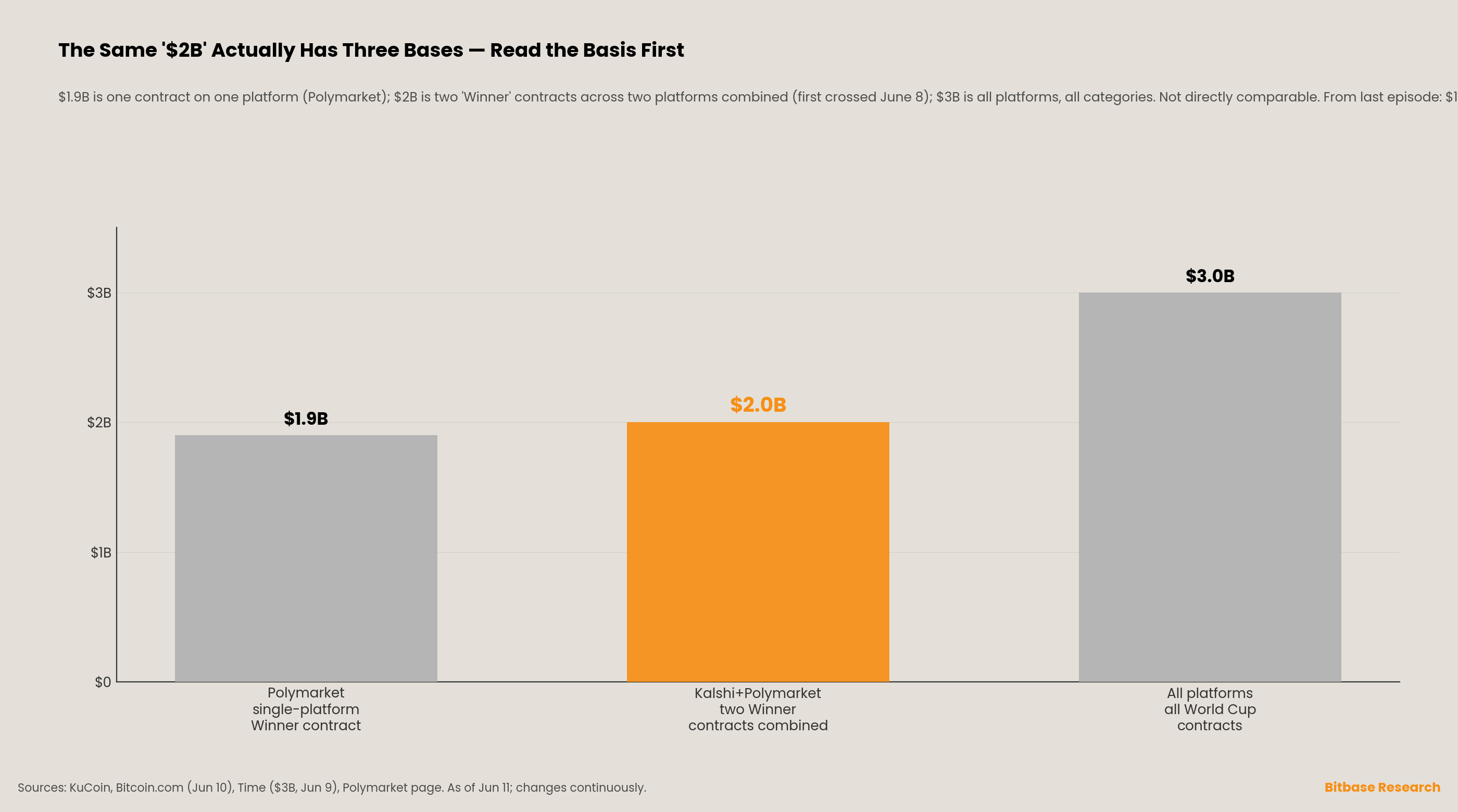
Going into the opener, Polymarket's single-platform "World Cup Winner" contract has done about $1.9 billion in cumulative volume (since it opened on July 2, 2025) [4]; Kalshi's version of the same contract has added about $132 million; together, the two crossed $2 billion for the first time on June 8 (two days before kickoff) [1]. Widen the lens to every platform and every World Cup contract — not just the "Winner" one — and the whole category has passed $3 billion [3].
Stop here for a moment, because the basis matters. For the same question — "how big is the World Cup prediction market?" — you'll see $1.9B, $2B, $2.37B, $3B in different places. They don't contradict each other; they use different bases: $1.9B is one contract on one platform, $2B is two "Winner" contracts across two platforms, $3B is every World Cup contract across every platform. With on-chain data, always read the basis before the number — it's the thread this whole series has held.
Connect it back to last episode: on June 5 we logged $1.6 billion on Polymarket's single platform. Six days later, on the same basis, it's $1.9 billion. Measured with the same ruler, the curve is continuous.
Zoom out to the sector: Pew Research Center data shows that the combined monthly volume of Kalshi and Polymarket rose from under $5 billion in September 2025 to about $24 billion in April 2026; for comparison, US legal sportsbooks averaged about $14 billion in monthly wagers last year. Prediction markets have already passed traditional sports betting in size [3].
As for how the market currently prices the title — as of June 10, Spain sits around 16.5% on Polymarket and 17.4% on Kalshi, France just behind near 16%, England and Portugal around 11% each, defending champion Argentina near 9%, Brazil near 8% [1]. These are just the market's prices right now — not predictions, and certainly not this article's view.
Act 2 — Per-Match Contracts: How the Machine Runs Once Play Starts
The $2 billion is one long-horizon contract — "who wins the whole thing." But what actually comes alive each day once play starts are the per-match contracts covering every game.
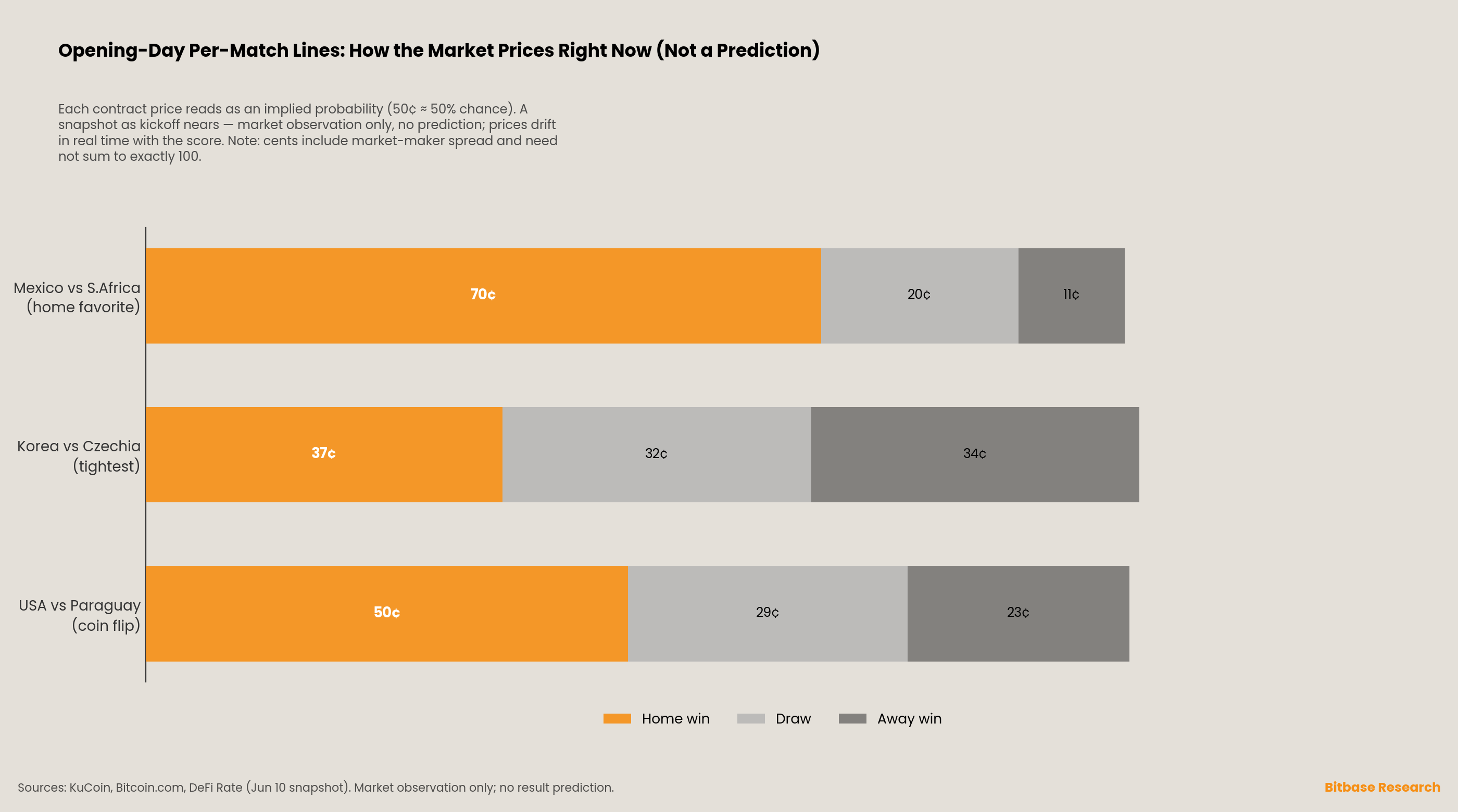
The opening-day lines are already posted (the following are the market's prices right now, offered as a snapshot only, not as any prediction): in the opener's moneyline, home side Mexico is priced as the heaviest single-match favorite of the day; the day's other game, South Korea vs Czechia, is seen by the market as the tightest of the four openers — Korea near 37 cents, Czechia near 34, the draw near 32, a near three-way split; and USA vs Paraguay is a coin flip — USA near 50 cents, Paraguay near 23, the draw near 29. The "total goals" contracts in all four openers lean toward the under, with "under 2.5 goals" carrying a 57–59% implied probability [2][8].
Every contract runs on the same logic: the price floats between 1 and 99 cents and reads directly as an implied probability — 50 cents means the market sees about a 50% chance. As the match plays out and the scoreline changes, the price moves.
And here's a mechanism that will happen over and over once play starts, yet is rarely explained: zeroing on elimination. When a team becomes mathematically incapable of winning the tournament, its "win — Yes" contract goes immediately to zero, resolving to "No" [4]. Deep into the group stage, the first teams will be eliminated — and that will be the first time these championship contracts zero out at scale, for real. It's one of the on-chain moments most worth watching during the tournament.
Act 3 — How an On-Chain Contract "Knows" Who Won: Two Paradigms
This is the thing on kickoff day that most deserves explaining — and almost no one explains it.
An on-chain contract is, in itself, just a piece of code. It doesn't watch the match. So when Mexico and South Africa finish playing, how does that on-chain "Mexico wins" contract "know" what actually happened in the real world, and then pay the people who got it right?
The answer is an oracle — the bridge that feeds real-world information to an on-chain contract. And right now, the industry has two different paradigms for answering this.
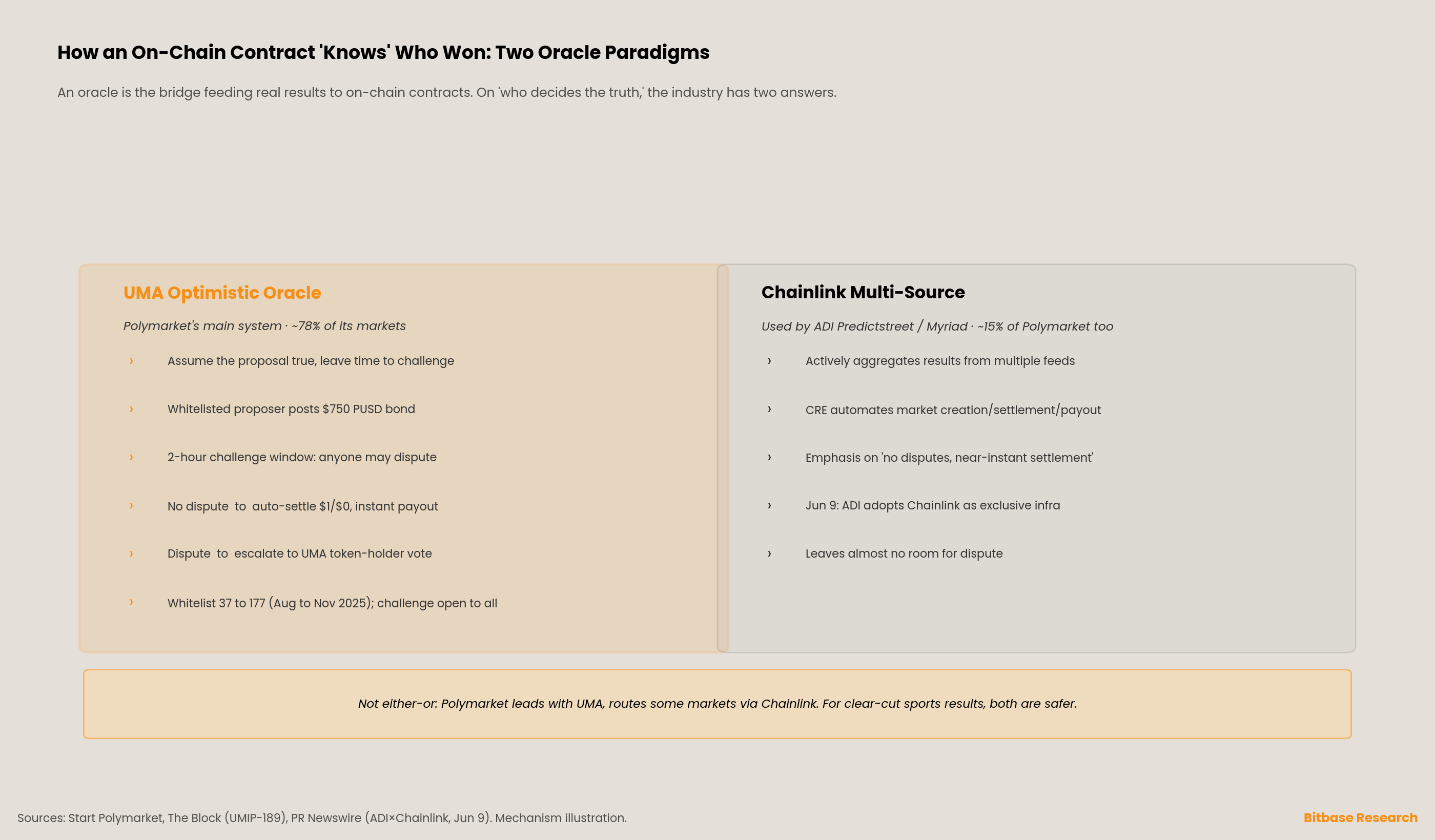
First: UMA's "optimistic oracle," which Polymarket mainly uses (about 78% of its markets). "Optimistic" means: assume the submitted result is correct first, then leave time for others to challenge it. The flow: a whitelisted proposer posts a $750 PUSD bond and submits a result — say "Mexico wins"; then there's a 2-hour challenge window in which anyone can post the same bond to dispute it; if no one does, the market settles automatically on that result, with each correct contract instantly paid $1 and wrong ones zeroed, no manual claim needed. If someone challenges, the dispute escalates to a vote of UMA token holders [9].
That whitelist has a backstory. In March 2025, a market called "Ukraine Minerals" suffered a governance attack affecting about $7 million, exposing the structural weakness of "anyone can submit a result." So in August, UMA passed proposal UMIP-189, restricting proposal rights to a whitelist — from an initial 37 addresses to 177 by November 2025, with a bar of at least 5 proposals and 95%+ accuracy over a rolling six months. But to be clear: the right to challenge remains open to everyone — you don't need to be whitelisted to dispute a result you think is wrong [10].
Second: Chainlink's "multi-source aggregation," used by FIFA official partner ADI Predictstreet and by Myriad (and by about 15% of Polymarket's own markets via Chainlink Data Streams). On June 9, ADI Predictstreet announced it would adopt Chainlink as its exclusive oracle infrastructure, actively aggregating results from multiple data sources and automating market creation, settlement, and payout, with an emphasis on "no disputes, near-instant settlement" [11].
Put the two paradigms side by side and the difference is clear: facing the question of "who decides the truth," UMA's answer is "trust first, leave a challenge window, vote if disputed," while Chainlink's is "aggregate from multiple authoritative feeds, settle automatically, leave almost no room for dispute." It isn't either-or — Polymarket leads with UMA but routes some markets through Chainlink; for events like a World Cup result that are clear and unambiguous, both paradigms are far safer than fuzzy political or geopolitical markets.
ESPN will tell you who won. But how an on-chain contract "knows" who won — that's two entirely different decentralized designs running underneath.
Act 4 — How Much of Those Two-Plus Billion Is Real
This series has spent its run on how prediction markets grew up. But as content that refuses the casino narrative, we have to add one cool-headed question to this "$2 billion" story.
First, how the money settles. These contracts are all denominated in USDC, a dollar stablecoin, and settle on the Polygon chain [12]. One detail is telling: a contract that's nearly certain to win often trades at $0.995–$0.999 before formal settlement — because some traders would rather sell now at $0.999 and take the cash than wait a few hours for the oracle process to pay the full $1.00 [9]. That's the immediacy the stablecoin settlement layer provides.
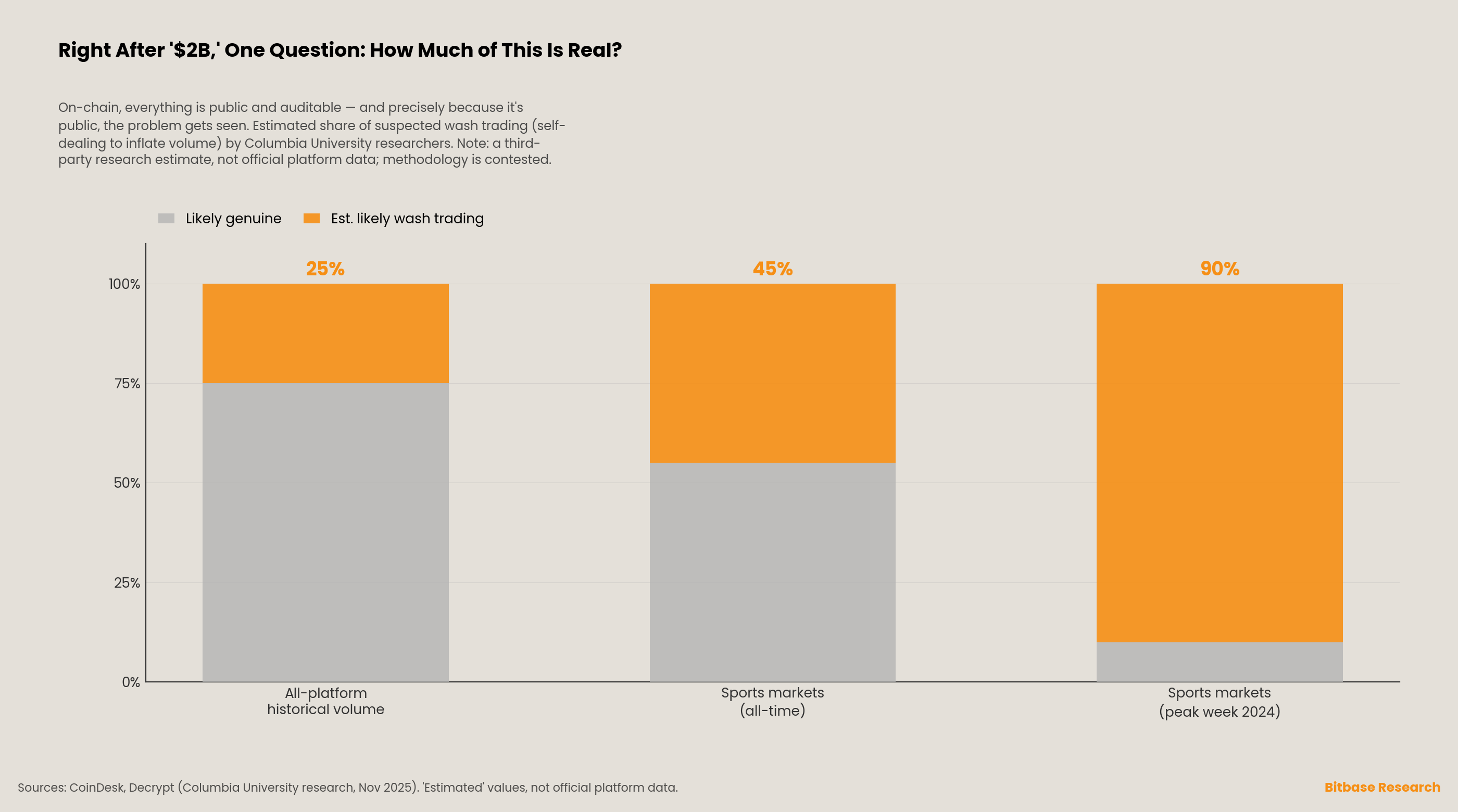
Now the cool-headed question. The upside of on-chain is that everything is public and auditable. But precisely because it's public, the problem gets seen too: Columbia University researchers, in one study, estimated that about 25% of Polymarket's historical volume may be wash trading (the same party buying and selling to itself to inflate the volume figure) [13]; and in sports markets specifically, that share runs about 45% across all time, spiking to as high as 90% in one week of 2024 [14].
It must be stressed that this is a third-party research estimate, not official platform data, and the methodology is contested — a statistics professor at Rutgers, for one, has argued the manipulation narrative is overblown and even politically motivated. But even discounting the estimate, it's a reminder of one thing: when you see "$2 billion," it measures the order of magnitude of activity — not two billion dollars of genuine, arm's-length turnover from distinct people.
Platforms are responding too. On June 10, Kalshi rolled out new anti-insider-trading rules — for markets with higher manipulation risk, it now asks traders to disclose their employer, and it introduced a market-risk scoring system [15]. It's a threshold prediction markets have to cross on the way to maturity.
Closing — Same Bet, Two Identities
Finally, back to the most fundamental thing — what these contracts even are, where you live.
Someone put it bluntly: putting $100 on France to win is, on a sportsbook like DraftKings, "gambling" — regulated state by state, geofenced within an inch of its life; while buying a "France wins" contract on Kalshi is "trading" — legal in all 50 states for any adult. Same bet, same scream at the same penalty kick — and a completely different legal identity [16].
This is the heart of the regulatory split this series covered last episode: prediction markets take the US CFTC's "event contract" path, sportsbooks take the state-licensing path. And in these kickoff days, states including Minnesota, New Mexico, and Nevada are still arguing that these so-called prediction markets are, in substance, "backdoor sportsbooks." The fight over "what it actually is" is far from over.
The same World Cup contract can be entirely legal in one jurisdiction and not in another. Check the rules where you live.
The opening whistle blows, and this machine — two-plus billion dollars down, denominated in stablecoins, adjudicated by oracles, watched by regulators — starts truly running. Over the next month we'll see it settle for real for the first time, zero out for real for the first time, and after the July 19 final, look back at whether the market or those supercomputer models actually called it.
And how it runs may be more worth watching than who ultimately lifts the trophy.
What's visible, what's verifiable, what hasn't been decided — it's all in the public record.
This article is informational and does not constitute investment, trading, betting, or financial advice, nor a recommendation to use any platform, contract, or token. All data is from public sources as of June 11, 2026; prediction-market volumes, prices, and probabilities change continuously and may differ at the time of reading. Here "$2 billion" is the combined volume of Kalshi's and Polymarket's two "World Cup Winner" contracts, "$1.9 billion" is Polymarket's single-platform version of that contract, and "$3 billion" is all World Cup contracts across all platforms — three different bases, not directly comparable, and distinct from last episode's $1.6 billion (single-platform, June 5). On volume authenticity, the Columbia University researchers' figure is a third-party research estimate, not official platform data. This article does not predict 2026 World Cup outcomes, nor evaluate the accuracy, legality, or profitability of any platform, contract, or token.
The legality of prediction markets and sports betting varies materially across jurisdictions: certain US states (Minnesota, New Mexico, Nevada) are litigating their classification under state law or arguing they are "backdoor sportsbooks"; mainland China prohibits all betting; the EU's MiCA framework is still evolving; some countries have blocked the platforms. Readers must verify the rules where they live.
All platforms, institutions, tokens, and individuals are named factually as participants in public events; this article does not evaluate their conduct or judgment.
References
[1] KuCoin, "Spain and France Split Favorite Tag as World Cup Prediction Markets Cross $2B" (Polymarket $1.9B single-platform + Kalshi $132M; first crossed $2B June 8; top-team probability snapshot). https://www.kucoin.com/news/flash/spain-and-france-split-favorite-tag-as-world-cup-prediction-markets-cross-2b
[2] Bitcoin.com News, "Spain and France Split the Favorite Tag as World Cup Prediction Markets Cross $2B" (independent second source). https://news.bitcoin.com/spain-and-france-split-the-favorite-tag-as-world-cup-prediction-markets-cross-2b/
[3] MEXC News (Pew monthly volume $5B→$24B; comparison with $14B sportsbook wagers; per-match lines). https://www.mexc.com/news/1134831
[4] Polymarket, "World Cup Winner Predictions & Odds 2026" (single-platform $1.9B; opened July 2, 2025; zeroing-on-elimination rule). https://polymarket.com/event/world-cup-winner
[5] FIFA, "FIFA announces Kraken as Official Crypto Exchange Supporter of the FIFA World Cup 2026" (June 9; Supporter tier; Sethi quote). https://inside.fifa.com/media-releases/kraken-official-crypto-exchange-supporter-world-cup-2026
[6] Business Wire, "Kraken Named Official Crypto Exchange Supporter of the FIFA World Cup 2026" (official release; North America + Europe; 6 billion viewers). https://www.businesswire.com/news/home/20260609684502/en/Kraken-Named-Official-Crypto-Exchange-Supporter-of-the-FIFA-World-Cup-2026
[7] CoinCentral, "Kraken Named Official Crypto Exchange of FIFA World Cup 2026" (financial terms undisclosed; Kraken's existing sports deals). https://coincentral.com/kraken-named-official-crypto-exchange-of-fifa-world-cup-2026/
[8] DeFi Rate, "Mexico vs. South Africa: World Cup Prediction Markets" (opener per-match lines). https://defirate.com/prediction-markets/world-cup-odds/mexico/
[9] Start Polymarket, "How Polymarket Markets Resolve: UMA Oracle, Claims & Disputes" (UMA settlement; $750 PUSD bond; 2-hour window; $0.995–0.999 pre-settlement; whitelist criteria). https://startpolymarket.com/learn/how-markets-resolve/
[10] The Block, "UMA's oracle update to limit Polymarket resolution proposals to whitelisted parties" (UMIP-189; Aug 6; OOV2→MOOV2; contrast with Chainlink/Pyth multi-source aggregation). https://www.theblock.co/post/366507/polymarket-uma-oracle-update
[11] PR Newswire, "Official FIFA World Cup 2026 Partner ADI Predictstreet Adopts Chainlink as Exclusive Oracle Infrastructure" (June 9; CRE-automated settlement). https://www.prnewswire.com/news-releases/official-fifa-world-cup-2026-partner-adi-predictstreet-adopts-chainlink-as-exclusive-oracle-infrastructure-powering-prediction-markets-for-the-worlds-largest-sporting-event-302794475.html
[12] Circle, "Circle & Polymarket Partner to Bolster Onchain Financial Markets" (USDC/pUSD settlement). https://www.circle.com/pressroom/circle-and-polymarket-partner-to-strengthen-onchain-financial-markets
[13] CoinDesk, "Polymarket's Trading Volume May Be 25% Fake, Columbia Study Finds" (Columbia estimate). https://www.coindesk.com/markets/2025/11/07/polymarket-s-trading-volume-may-be-25-fake-columbia-study-finds
[14] Decrypt, "A Quarter of Polymarket Volume May Be Wash Trading, Columbia Study Finds" (sports markets 45%; one week 90%). https://decrypt.co/347842/columbia-study-25-polymarket-volume-wash-trading
[15] Al Jazeera, "Prediction platform Kalshi to collect job details to combat insider trading" (June 10 anti-insider rules). https://www.aljazeera.com/economy/2026/6/10/prediction-platform-kalshi-to-collect-job-details-to-combat-insider-trading
[16] Yahoo Finance, "Prediction Markets Are About to Have Their World Cup Moment" (DraftKings vs Kalshi legal-classification contrast). https://finance.yahoo.com/markets/options/articles/prediction-markets-world-cup-moment-182833981.html