Nine episodes of "how crypto worked its way into the World Cup" — from pitchside boards to shirt sponsorships, from fan tokens to on-chain collectibles, from player endorsements to prediction markets, to that data map spread across the chain on kickoff eve. Last episode, on opening day, we wrote that the machine had started running, and left a promise: during the tournament, we'd see a contract settle for the first time, and zero out for the first time.
Now the first match has been played. Mexico 2, South Africa 0 [1].
This is the first time in the series we can write not "how the machine will run," but how the machine actually ran a full lap — how one on-chain contract travels from the pre-match line all the way to settlement and zeroing after the final whistle.
But this episode is about more than recapping one settlement. The same match exposed two oracles in two different states: one has already quietly run its first game, the other is still in the press release. And that's exactly the ending this series should have — not a victory lap for "crypto won the World Cup," but a cooler question: crypto really did get in, but once inside, what actually works, and what is still just a promise.
Figures current as of June 12, 2026. All prices and volumes change continuously and may differ at the time of reading. This article states an already-played result and predicts no match not yet played.
Act 1 — The Life of One Contract: From 70 Cents to a Tenth of a Cent
Start with one contract that lived its whole life.
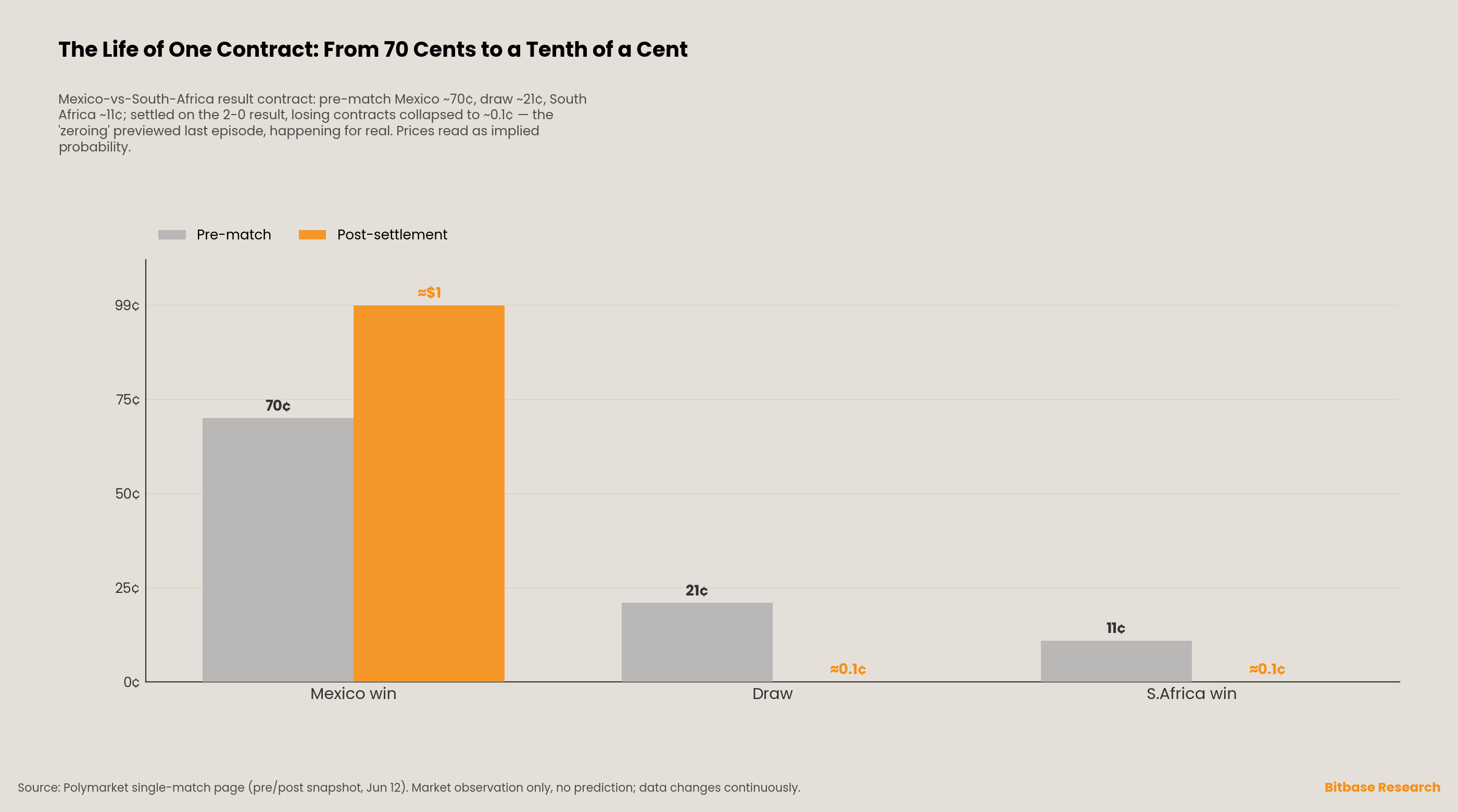
Before kickoff, Polymarket priced the Mexico-vs-South-Africa result contract like this: Mexico around 70 cents, the draw around 21, South Africa around 11. Each price reads directly as an implied probability — 70 cents means the market saw about a 70% chance Mexico would win. Of the four opening matches, this was one of the least suspenseful: hosts, at home, against the relatively weakest side in Pot 3.
The match was played. 2-0. Julián Quiñones scored in the 9th minute, Raúl Jiménez added a second in the second half [1]. Once the final score was locked, Polymarket's single-match page showed the game as FINAL and settled on the 2-0 result — the losing contracts' prices collapsed to about a tenth of a cent [4].
That's the "zeroing" we previewed last episode, happening for the first time in front of you. A contract on "Mexico wins" was redeemed by reality: holders who got it right took home close to a dollar, and anyone on the draw or South Africa went to nearly zero. From 70 cents to 0.1 cent, one contract's life ran its course alongside a 90-minute match.
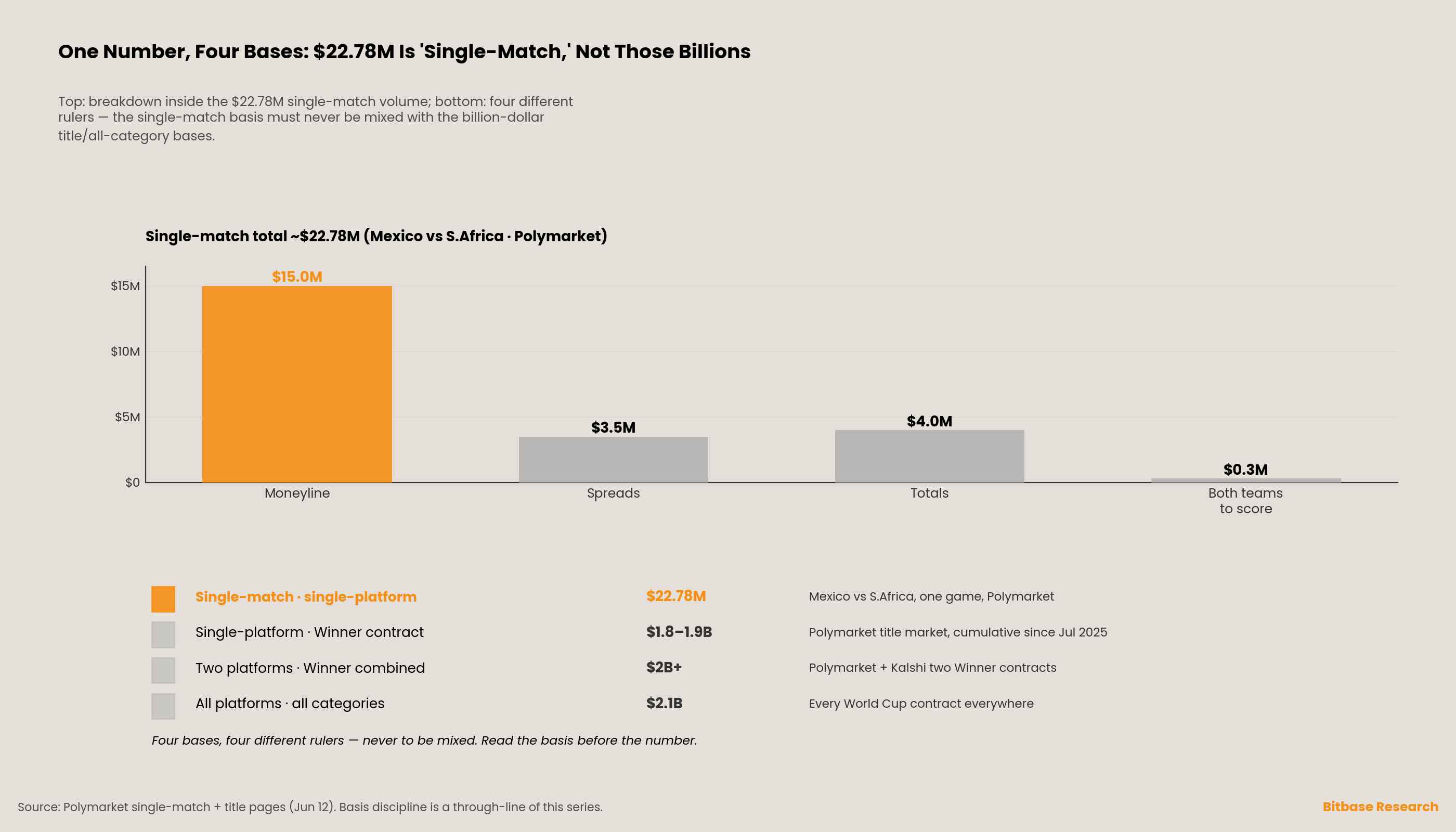
What's notable is how busy this single game was on-chain. On Mexico vs South Africa alone, Polymarket's cumulative volume was about $22.78 million — roughly $15.0M on the moneyline, $3.5M on spreads, $4.0M on totals, and $299K on both-teams-to-score [4].
A word here about basis, which matters. This ~$22.78M is the volume of a single match, on a single platform. It is a completely different thing from the billion-dollar figures we've cited in earlier episodes — last episode's ~$1.8–1.9 billion was Polymarket's single-platform "World Cup Winner" contract, accumulated across the whole title market since last July; all World Cup contracts across every platform total about $2.1 billion. Single-match, single-platform title contract, all-platform all-category — three different rulers, never to be mixed. With on-chain data, always read the basis before the number. It's the thread this series has held from start to finish.
And a slightly counterintuitive detail: Mexico's 70-cent line was the most "boring" of opening day, and it cashed out in the most uneventful way. The closer the odds are to the truth, the less suspense there is — and the duller the settlement. No dispute, no surprise, prices walking quietly toward 1 and 0.
Act 2 — After the Final Whistle, How a Contract "Settles"
The price collapsing to 0.1 cent is just the outcome. What's worth watching is the step in between: after the final whistle, how does an on-chain contract actually move the money from the losers to the winners?
These contracts all run on the Polygon chain, denominated and settled in pUSD, a stablecoin pegged 1:1 to the dollar. The rule is simple: each correct contract is worth $1, each wrong one worth $0. When the match ends, winners should be paid and losers zeroed.
One detail we described last episode, now playing out for real: a contract that's nearly certain to win often doesn't sit at a flat $1 before settlement — it trades between $0.995 and $0.999. The reason is practical: some traders would rather sell now at $0.999 and take the pUSD immediately than wait several hours for the oracle process to finish for that last $0.001 [6]. That's the immediacy the stablecoin settlement layer provides: the money doesn't have to wait for settlement.
As for the adjudication itself — what writes "Mexico won 2-0" onto the chain and triggers payout is an oracle. Polymarket uses UMA's optimistic oracle: assume a submitted result is correct, leave a challenge window, and settle automatically if no one disputes. For this specific match, the fact we can observe is this: Polymarket's single-match page shows the game settled on the 2-0 final score, with losing contracts collapsed to about 0.1 cent. The resolution rule is spelled out — the score after 90 minutes plus stoppage time, excluding extra time and penalties, with FIFA's official statistics as the primary source; if official stats aren't published within two hours, a consensus of credible reporting is used [4][5].
That said, this is only the settlement of one "result" contract. The weightier "title zeroing" — a team's "win — Yes" contract going to zero because it's mathematically eliminated — won't happen at scale until deep into the group stage. That'll be another on-chain moment worth watching.
Act 3 — The Same Match, Two Oracles in Two Different States
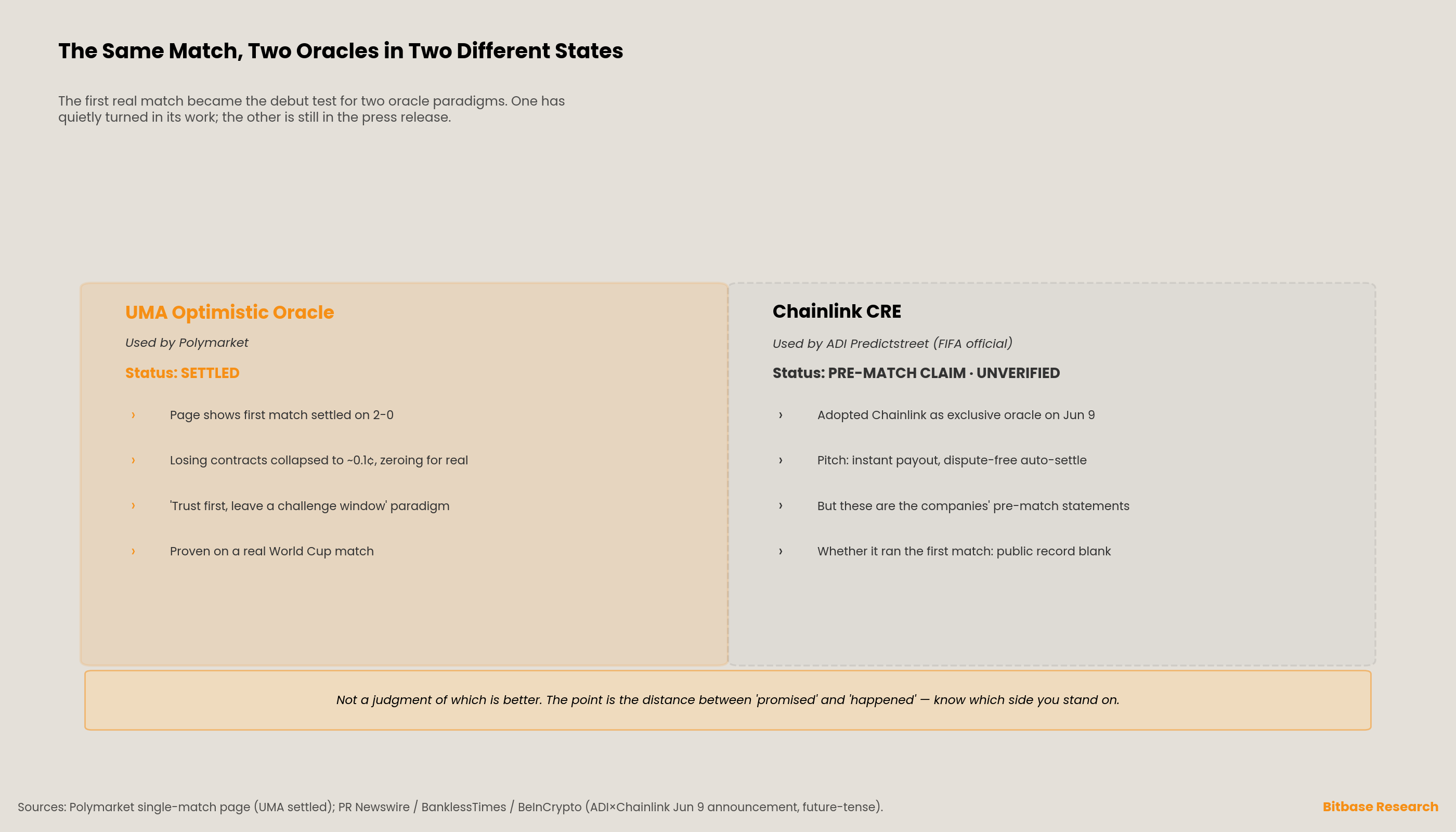
The first real World Cup match became, by accident, the debut test for two oracle paradigms at once. And right now, they are not in the same state.
On one side is the UMA optimistic oracle that Polymarket uses. Its logic is "trust first, leave a challenge window, vote if disputed" — a more decentralized paradigm with game theory built in. And on this first, suspense-free match, it has already quietly turned in its work: the page shows settlement complete, zeroing for real. Even if all it did was process an uncontested 2-0, it proved one thing — this mechanism does run, on a real World Cup match.
On the other side is this tournament's official prediction market partner, ADI Predictstreet. Just two days before kickoff, on June 9, it announced it had adopted Chainlink as its exclusive oracle infrastructure, using Chainlink's Runtime Environment (CRE) to automate market creation, resolution, and settlement — its headline selling point being exactly "instant payouts the moment the final whistle blows, no humans, almost no disputes" [7][8]. It sounds, on paper, like a smoother solution than UMA's "leave a challenge window."
But here we have to be honest — all of that "instant payouts, dispute-free automated settlement," as of this writing, is still only what ADI and Chainlink stated and set as goals in their June 9 announcement. Whether this FIFA-endorsed prediction market actually ran that through on the opening match — the first real game — whether a first automated payout actually happened, the public record is blank. We searched every report we could find, and they all stop at that launch announcement, all in the future tense: "will," "aims to," "is set to" [9].
So this first match exposed a subtle contrast: one has quietly proven itself — even if only by settling the least suspenseful game on the board; the other is louder, more heavily endorsed, with a shinier pitch, yet still sits in the press release, waiting for its first real turn.
This isn't to judge which is better. Chainlink's automated approach may well suit live sports better than UMA's. The point is only that there is always a distance between "promised" and "happened" — and when reading on-chain narratives, knowing which side of that distance you're standing on is a basic form of clarity.
Act 4 — Nine Episodes In, Where Crypto Landed at the World Cup
Pull the lens back and look at the whole series.
Nine episodes traced one clear line: from the history of how crypto companies walked into football (the sponsorship history), to how fan enthusiasm got minted into tokens and collecting became on-chain assets (fan tokens, NFTs), to how players signed endorsements with exchanges (player deals), to how prediction markets became the bookmaker's new rival and how a win probability gets produced (market structure, odds methodology), to that data map on kickoff eve and the running machine on opening day (on-chain data) — all the way to today, the first contract settling and zeroing for real.
Set 2026 against the last edition, 2022 in Qatar, and the fundamental change isn't that crypto is more visible — it's that crypto reached a deeper layer. The settlement layer went from an operator's balance sheet to smart contracts plus a regulated dollar stablecoin; the adjudication layer went from manual checking to decentralized or automated oracles; and the official relationship went from plain "sponsor" to the first-ever FIFA category for an "official prediction market partner."
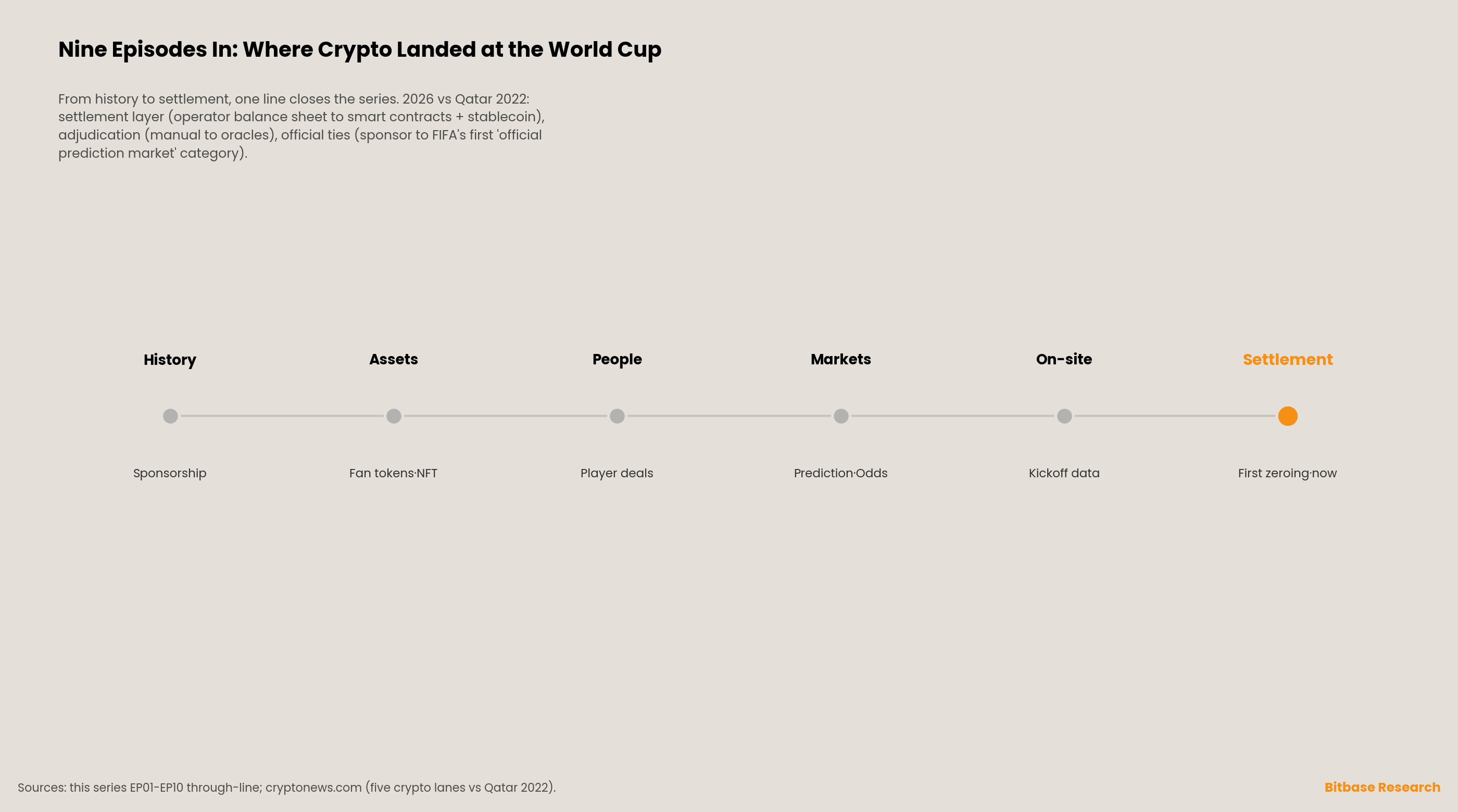
This edition, crypto ran five lanes on the pitch at once: an exchange (Kraken as official crypto exchange supporter [11]), oracle infrastructure (Chainlink), an official prediction market (ADI Predictstreet), fan tokens (Chiliz), and on-chain collectibles and ticketing (FIFA Collect on Avalanche) [10]. Four years ago in Qatar, crypto's footprint was essentially one blockchain partner and one exchange sponsor. This is the deepest crypto footprint any World Cup has had.
But as content that has refused the casino narrative throughout, the finale still owes one cool-headed reminder: opening-day volume really is surging, but don't forget that Columbia University researchers once estimated that within prediction markets, sports markets carry the highest share of wash trading [12][13]. The busier the number, the more worth asking: how much of this is real.
Closing — The First Match Settled, but the On-Chain World Cup Has Just Begun
A word on regulation to close, because it decides what all of the above even is, where you are.
Putting money on Mexico to win is "gambling" on a sportsbook — regulated state by state — and "trading" when you buy a contract on a prediction market; the former takes the state-licensing path, the latter the US CFTC's event-contract path, and their legal identity is still being argued over. The same World Cup contract can be entirely legal in one jurisdiction and not in another. Check the rules where you live.
This is the last piece of the Countdown to Kickoff series. But two things have only just begun: first, the weightiest "title zeroing" won't play out at scale until deep into the group stage, when a team is first mathematically eliminated; and second, once the July 19 final settles, we'll look back at one thing — the probabilities the market gave before kickoff, versus the ones Opta's supercomputer gave, and which came closer to the truth. That's the last hook this series leaves for the future.
The final whistle blew, and the first contract settled. Crypto really did get into the World Cup — but what actually works and what is still just a promise, we'll watch one match at a time.
This pre-tournament series ends here. The on-chain World Cup has only just played its first match.
What's visible, what's verifiable, what hasn't been decided — it's all in the public record.
This article is informational and does not constitute investment, trading, betting, or financial advice, nor a recommendation to use any platform, contract, or token. All data is from public sources as of June 12, 2026; prediction-market volumes, prices, and probabilities change continuously and may differ at the time of reading. The volume figures use different bases and are not directly comparable: ~$22.78 million is the Mexico-vs-South-Africa SINGLE-MATCH volume on Polymarket, ~$1.8–1.9 billion is Polymarket's SINGLE-PLATFORM World Cup Winner contract, and ~$2.1 billion is ALL World Cup contracts across all platforms — also distinct from this series' EP07 ($523M aggregated VWAP) and EP08 ($1.6B single-platform). Regarding ADI Predictstreet and Chainlink, the "instant payouts / dispute-free automated settlement" are the companies' public statements and design goals as of June 9; this article could not independently verify their actual settlement of the opening match. On volume authenticity, the Columbia University researchers' figure is a third-party research estimate, not official platform data. This article states the already-played public result of Mexico 2-0 South Africa, but predicts no match not yet played, and evaluates no platform, contract, or token for accuracy, legality, or profitability.
The legality of prediction markets and sports betting varies materially across jurisdictions: certain US states (Minnesota, New Mexico, Nevada) are litigating their classification or arguing they are "backdoor sportsbooks"; mainland China prohibits all betting; the EU's MiCA framework is still evolving; some countries have blocked the platforms. Readers must verify the rules where they live.
All platforms, institutions, tokens, and individuals are named factually as participants in public events; this article does not evaluate their conduct or judgment.
References
[1] CBS Sports, "Mexico vs. South Africa: World Cup 2026 score, result" (2-0; Quiñones + Jiménez; Montes suspended; opening ceremony Shakira/Maná). https://www.cbssports.com/soccer/news/mexico-vs-south-africa-live-updates-world-cup-2026-score-result/live/
[2] FOX Sports, "Mexico vs. South Africa - Final Score - June 11, 2026" (2-0; three red cards made World Cup history; Montes red card 90+2'). https://www.foxsports.com/soccer/fifa-world-cup-men-mexico-vs-south-africa-jun-11-2026-game-boxscore-647616
[3] ESPN, "Mexico 2-0 South Africa (Jun 11, 2026) Final Score" (three reds; 1998 South Africa-Denmark three-red precedent). https://www.espn.com/soccer/match/\_/gameId/760415/south-africa-mexico
[4] Polymarket, "Mexico vs. South Africa Odds & Predictions (Jun. 11, 2026)" (pre-match 70¢/21¢/11¢; post-match 2-0 FINAL; losing side ~0.1¢; single-match ~$22.78M; resolution rule). https://polymarket.com/sports/world-cup/fifwc-mex-rsa-2026-06-11
[5] DeFi Rate, "Mexico vs. South Africa: World Cup Prediction Markets" (title $1 / zero on elimination; Polymarket uses FIFA+ESPN as resolution source; settlement date July 20). https://defirate.com/prediction-markets/world-cup-odds/mexico/
[6] Polymarket Help Center, "How Are Prediction Markets Resolved?" (pUSD / $750 bond / 2-hour challenge window / $0.995-0.999 pre-settlement price; UMA optimistic-oracle mechanism). https://help.polymarket.com/en/articles/13364518-how-are-prediction-markets-resolved
[7] PR Newswire, "Official FIFA World Cup 2026 Partner ADI Predictstreet Adopts Chainlink as Exclusive Oracle Infrastructure" (June 9; CRE automated settlement; "instant payouts" as pre-tournament statement). https://www.prnewswire.com/news-releases/official-fifa-world-cup-2026-partner-adi-predictstreet-adopts-chainlink-as-exclusive-oracle-infrastructure-powering-prediction-markets-for-the-worlds-largest-sporting-event-302794475.html
[8] BanklessTimes, "Chainlink Powers FIFA World Cup 2026 Prediction Market With Instant Payouts" (CRE settles "once the final whistle blows"; Gibraltar license — all future-tense statements). https://www.banklesstimes.com/articles/2026/06/10/chainlink-chosen-to-run-fifa-world-cup-prediction-partner-with-real-time-payouts/
[9] BeInCrypto, "Chainlink Beat Polymarket and Kalshi to the World Cup" (ADI×Chainlink; Chainlink official post; Psarrakis quote — all pre-tournament announcement). https://beincrypto.com/chainlink-fifa-world-cup-2026-prediction-market-adi-predictstreet/
[10] CryptoNews.com, "Crypto FIFA World Cup 2026 Moment: Kraken, Chainlink, and Chiliz Are All In" (five crypto lanes; vs Qatar 2022). https://cryptonews.com/news/kraken-chainlink-chiliz-fifa-world-cup-2026/
[11] Kraken Blog, "Kraken named Official Crypto Exchange Supporter of the FIFA World Cup 2026" (Supporter-tier official supporter). https://blog.kraken.com/news/fifa-world-cup-2026-official-crypto-exchange
[12] Decrypt, "A Quarter of Polymarket Volume May Be Wash Trading, Columbia Study Finds" (Columbia estimate: ~25% all-platform, highest in sports). https://decrypt.co/347842/columbia-study-25-polymarket-volume-wash-trading
[13] Fortune, "Polymarket volume inflated by 'artificial' activity, study finds" (Columbia research, independent second source). https://fortune.com/2025/11/07/polymarket-wash-trading-inflated-prediction-markets-columbia-research/