Over seven episodes we followed one thread: how crypto companies moved from pitchside boards into the World Cup (the sponsorship history), how players signed endorsement deals with exchanges (five years of player deals), how clubs minted fan enthusiasm into tokens (fan tokens), how collecting moved from player cards to on-chain assets (Sorare and FIFA Collect), how prediction markets became the bookmaker's new rival (market structure), and how a "win probability" actually gets produced in the first place (the odds methodology).
All seven were about the same thing: how crypto worked its way into football, step by step. Now, six days before kickoff, we pull the lens back from history to the present moment and ask one question: by kickoff eve, how big have these on-chain markets actually become?
Figures current as of June 5, 2026. All prices and volumes change continuously and may differ at the time of reading.
Act 1 — One Platform, One Contract, $1.6 Billion
Start with one number.
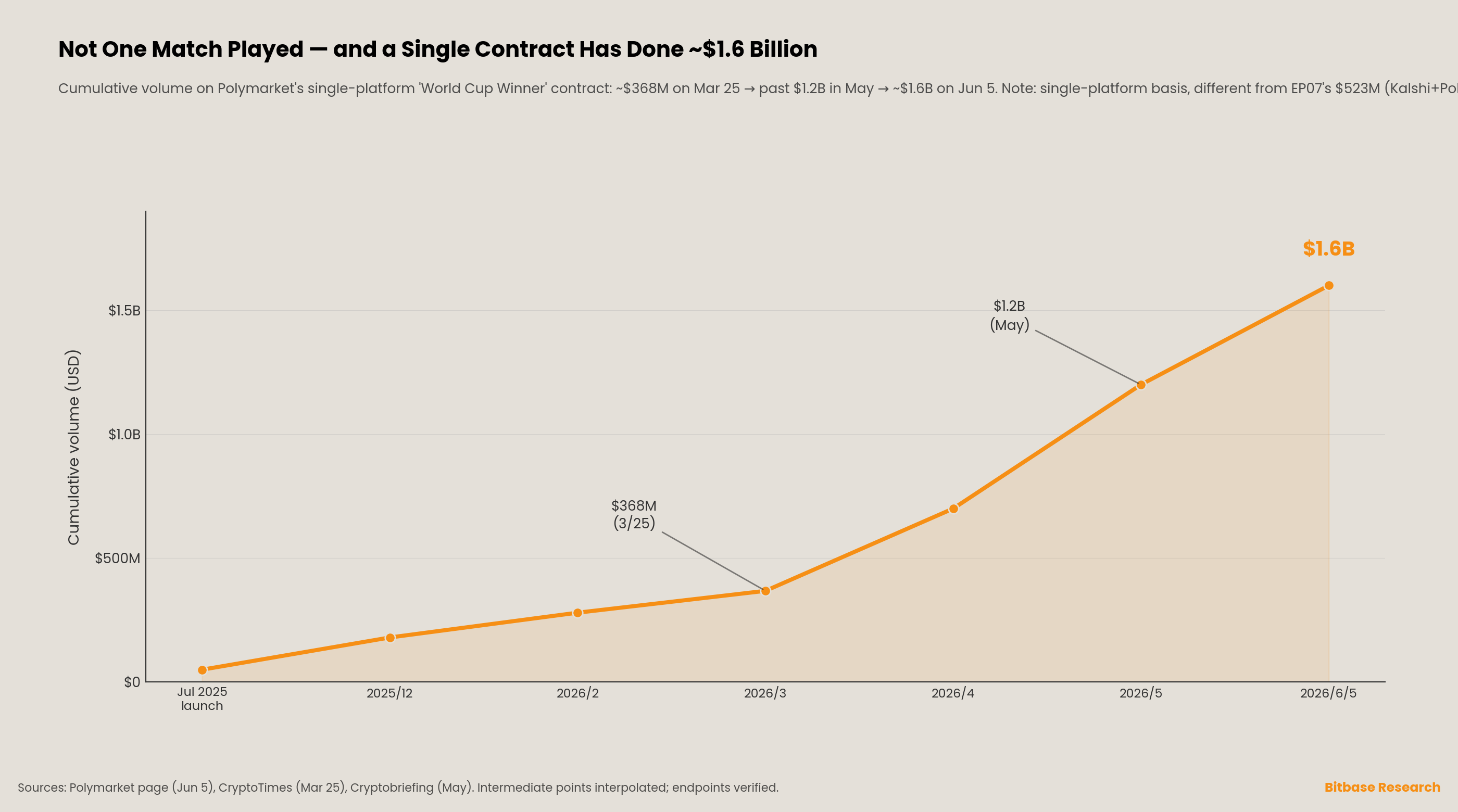
On a single platform — Polymarket — a single contract, "World Cup Winner," has done roughly $1.6 billion in cumulative trading volume as of June 5 (Polymarket's market page shows "$1.6 billion in total trading volume"; the contract launched in July 2025) [1].
Not a single match has been played.
This didn't appear overnight. It's a clean climb:
-
March 25: about $368 million [2]
-
May: crossed $1.2 billion [3]
-
June 5: about $1.6 billion [1]
The final two-plus months before kickoff are the steepest part of that curve — as the tournament nears, squads are announced, and friendlies deliver results, each new piece of information pushes volume higher.
One basis point needs to be made explicit here. The previous episode in this series (EP07), on odds methodology, cited a different figure: $523.2 million in cumulative volume on the World Cup winner contract. That number comes from DeFi Rate and is a Kalshi-and-Polymarket aggregate computed with a volume-weighted average price (VWAP) [4]. The ~$1.6 billion here is the cumulative volume of a single contract on a single platform, Polymarket. The two use different bases and can't be subtracted or compared directly — one is a multi-platform weighted figure, the other a single-platform cumulative total.
It's worth flagging because reading on-chain data means checking the basis before the number. The same fact, reported by different sources, can differ by several multiples — which is itself a sign of how unstandardized this young market still is.
Zoom out to the whole sector: annual prediction-market volume rose from about $16 billion in 2024 to about $64 billion in 2025, roughly fourfold [2]. Some analysts project 2026 could exceed $300 billion — a projection, not a realized figure [2].
Four years ago, the 2022 Qatar World Cup was the first tournament where Polymarket saw meaningful volume at all [5]. Four years later, one contract alone is in the $1.6 billion range. From niche experiment to a multi-billion-dollar market in the span of one World Cup cycle.
(One technical footnote: on-chain volume tends to overstate true turnover — the same collateral can be counted multiple times as it's minted, traded, and redeemed. A 2026 preprint showed that the nominal volume of the 2024 US election market shrinks materially once decomposed on-chain. So these figures reflect the order of magnitude of activity, not a precise "net turnover.")
Act 2 — How the Contracts Go Live with the Results
The $1.6 billion is one contract — "Winner." But what really comes alive once play starts are the per-match contracts covering every game.
Polymarket's World Cup category holds about 100 markets, covering all 104 matches; together with Kalshi, the two platforms have listed well over a hundred contracts — from the winner and the top scorer down to each group's qualifier and each match's result [6].
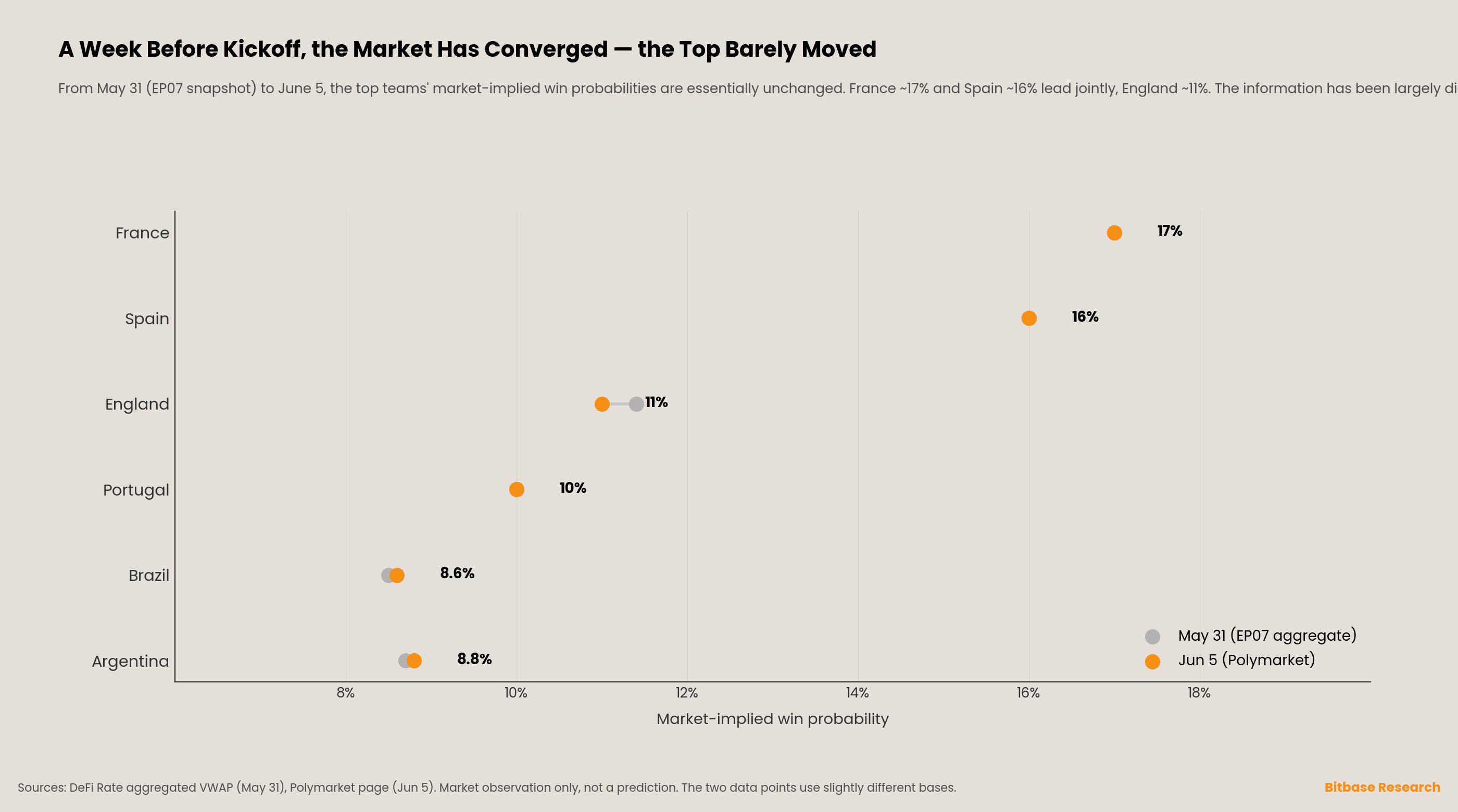
Group contracts are already trading. Group A, as of June 4: Mexico ~53%, South Korea ~23.5%, Czechia ~18.5%, South Africa ~6.3%; Group B: Switzerland ~56%, Canada ~31%; Group D: USA ~39%, Türkiye ~33% (these are market-implied probabilities, offered only as market observation, not predictions) [6].
The opening match is already listed: June 11, Mexico vs South Africa, at the Estadio Azteca in Mexico City (renamed Estadio Ciudad de México for the tournament), 3 p.m. ET. The contracts go beyond "who wins" — down to sub-markets like the first-half result [7].
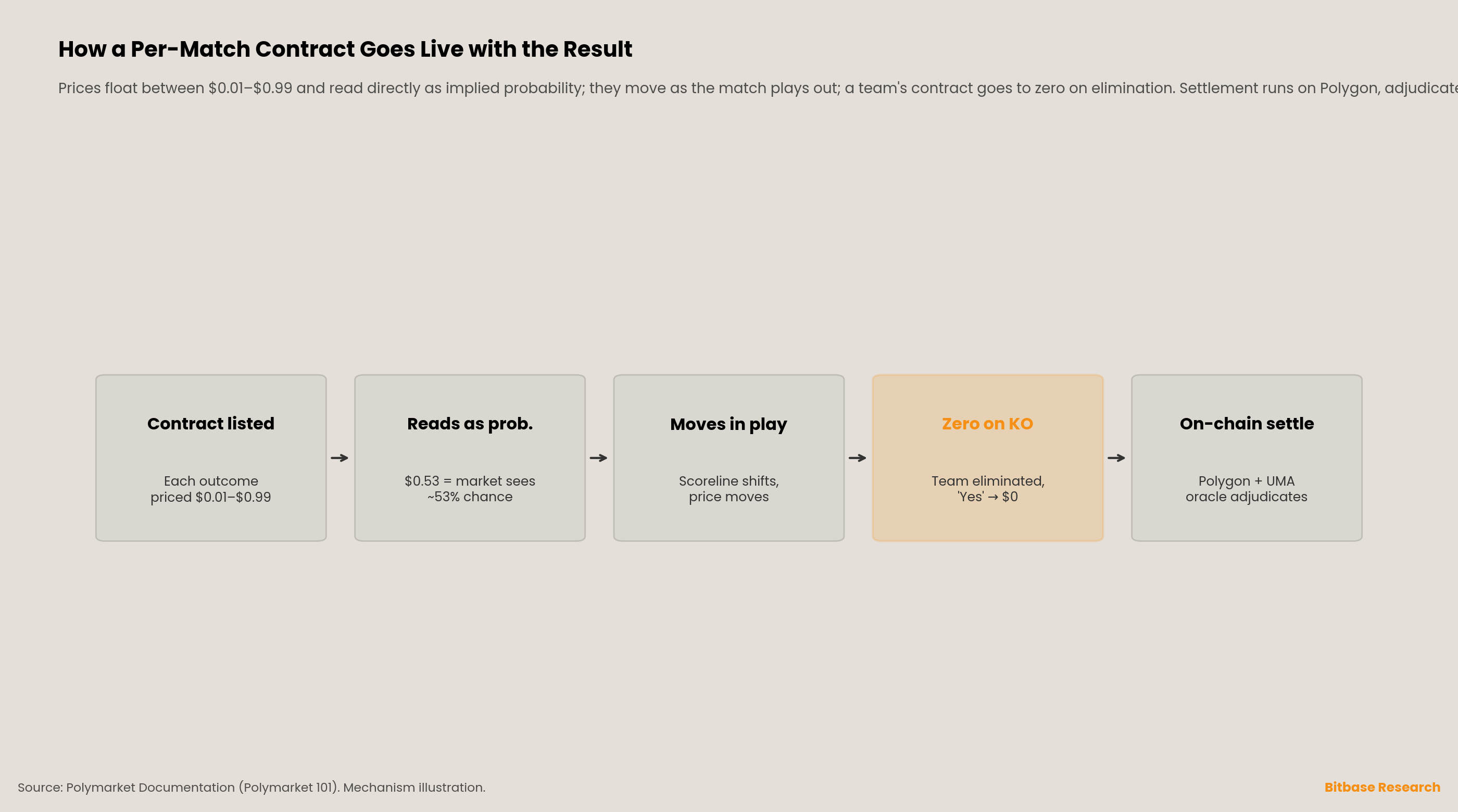
How do these contracts move with the results? The mechanism is straightforward: each contract trades between $0.01 and $0.99, and the price reads directly as an implied probability — $0.53 means the market sees about a 53% chance. As a match plays out and the scoreline changes, the price moves; the moment a team is mathematically eliminated, its "win — Yes" contract goes to zero, and the same logic applies to "advance — Yes." Settlement happens on-chain: the contracts run on Polygon, positions are recorded via Gnosis's conditional-token framework (a token standard called ERC-1155), and UMA's optimistic oracle adjudicates payout once the result is confirmed [8]. Each correct share redeems for $1; wrong ones go to zero.
This mechanism produces an angle traditional sports media simply won't have. Polymarket runs a contract asking: will Mexico's host matches be relocated for security reasons? That market opened in late February; about 96% of the money sits on "no," with roughly $116,000 in cumulative volume [6]. Pricing "tournament operational risk" itself as a tradable contract is something native to on-chain prediction markets — ESPN won't give you a "relocation probability."
Act 3 — Prediction Markets Are Being Absorbed
If volume is the "scale" story, several things that happened in the months before kickoff are the "this market is being absorbed by serious infrastructure and official institutions" story.
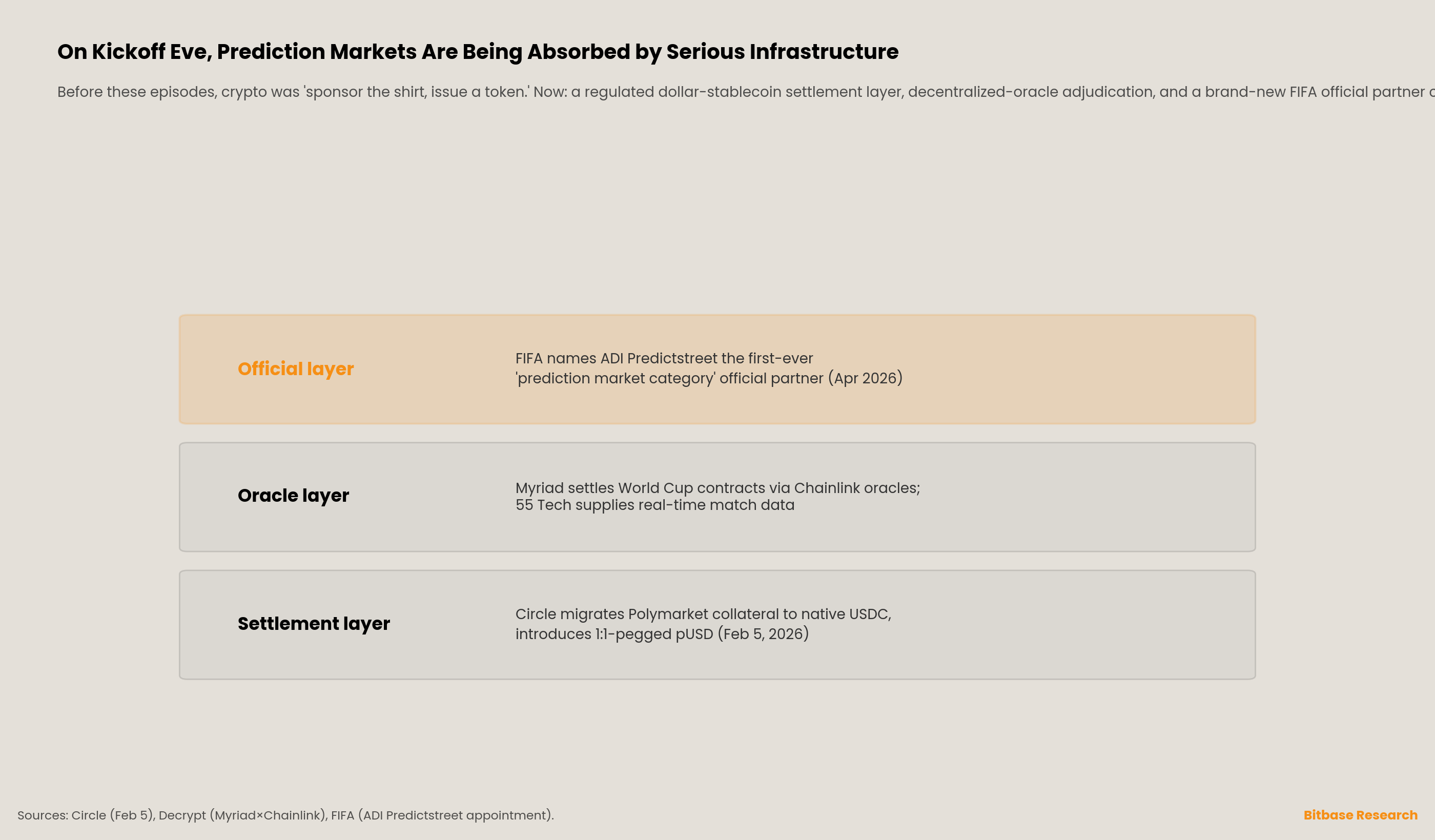
The settlement layer became a stablecoin. On February 5, stablecoin issuer Circle announced a partnership with Polymarket to migrate the platform's collateral from "bridged USDC" (USDC.e) to "native USDC," introducing a settlement unit called pUSD pegged 1:1 to USDC [9]. The difference: bridged versions rely on third-party cross-chain bridges to move between blockchains — and bridges have historically been the weak link that gets hacked — while native USDC is issued directly by Circle's regulated affiliates and is redeemable 1:1 for dollars. Polymarket founder Shayne Coplan called it an "infrastructure upgrade" [9]. In other words, the money in prediction markets now settles on a regulated dollar stablecoin.
The oracles arrived. Myriad (operated by Dastan, the parent of Decrypt) launched a World Cup market suite of 75-plus contracts covering every match ahead of kickoff, with results settled by Chainlink's oracles and real-time data from sports-data provider 55 Tech [10]. Oracles solve a plain but essential problem: how an on-chain contract "knows" the real-world result of a match — via this decentralized data feed and automated settlement.
FIFA itself signed on. In April 2026, FIFA named ADI Predictstreet — a Gibraltar-licensed prediction-market platform — the first-ever official partner in a "prediction market category" in World Cup history [11]. Because of US CFTC jurisdiction, ADI Predictstreet can't operate directly in the United States, so it reaches the US market through Fanatics Markets.
Put those three together and the close writes itself: before these seven episodes, crypto's place in football was still "sponsor the shirt, issue a token." Seven episodes on, on kickoff eve, it has reached the point where the settlement layer is a regulated dollar stablecoin, results are adjudicated by decentralized oracles, and even FIFA has opened a brand-new official partner category to absorb it. That's a fundamental change in where crypto sits in football.
A Kickoff-Eve Snapshot of the Assets
A quick look at the crypto assets tied directly to football, where they sit on kickoff eve (a snapshot only — no judgment, no prediction, prices change continuously):
-
Chiliz (CHZ, the chain behind fan tokens): about $0.033–0.035 (multiple sources in early June, with slight variation between them) [12]
-
National-team fan tokens: Argentina (ARG) ~$0.41, Portugal (POR) ~$0.37; Belgium (BELG) launched June 3 at $1 [12]
These numbers say nothing about direction on their own — they just record where these assets sit on kickoff eve. How they move during the tournament is something only the rear-view mirror will tell.
Closing — Not on the Sponsor List, but Already in the Plumbing
A word on regulation to close, because it determines whether any of the numbers above are legal where you are.
Two things must be kept strictly apart: prediction markets (like Kalshi and Polymarket, on the US CFTC's "event contract" regulatory path) and sports betting (on the state-licensing path) — their legal classification differs, which is exactly what EP06v2 in this series covered. On kickoff eve, that regulatory line is still moving violently: Massachusetts issued a cease-and-desist against Kalshi's sports contracts in January, Nevada brought an enforcement action against Polymarket's parent and Polymarket exited the state, and Arizona filed multiple criminal charges against Kalshi; meanwhile the Ninth Circuit is expected to rule by mid-2026, potentially creating a split with the earlier Third Circuit decision favoring Kalshi, and ultimately perhaps heading to the Supreme Court [13][14].
The same World Cup contract can be entirely legal in one jurisdiction and not in another. Some US states prohibit it, mainland China prohibits all betting, the EU's MiCA framework is still evolving, and some countries have blocked the platforms outright. Check the rules where you are.
Seven episodes on, the on-chain numbers on kickoff eve tell us one thing: at this World Cup, crypto companies are not on FIFA's list of top sponsors (those seats belong to Coca-Cola, Visa, Adidas, and — in the banking category — Bank of America). But crypto has already worked its way into this tournament's settlement layer, its prediction layer, and its official partner roster.
The World Cup kicks off on June 11. The on-chain markets have been playing for a year already.
What's visible, what's verifiable, what hasn't been decided yet — it's all in the public record.
This article is informational and does not constitute investment, betting, or any recommendation to use a specific platform, contract, or token. All data is from public sources as of June 5, 2026; prediction-market volumes, prices, and token prices change continuously and may differ at the time of reading. The "~$1.6 billion" figure is cumulative volume on Polymarket's single-platform "World Cup Winner" contract; it uses a different basis from the $523.2M cited in this series' EP07 (a Kalshi-and-Polymarket aggregated VWAP figure) and the two are not directly comparable. This is a descriptive observation of on-chain market data and contract mechanics; it does not predict 2026 World Cup outcomes, nor evaluate the accuracy, legality, or profitability of any market, platform, or token.
The legality of prediction markets and sports betting varies materially across jurisdictions: certain US states (e.g., Massachusetts, Nevada, Arizona, Minnesota) have legislated, sued, or issued cease-and-desist orders; mainland China prohibits all betting; the EU's MiCA framework is still evolving; some countries have blocked certain platforms. Readers must verify the rules in their own jurisdiction.
All platforms, institutions, tokens, and individuals are named factually as participants in public events; this article does not evaluate their business conduct or individual judgment.
References
[1] Polymarket, "World Cup Winner Predictions & Odds 2026" (June 5 page shows "$1.6 billion in total trading volume"; France 17%/Spain 16%; contract launched July 2025). https://polymarket.com/event/world-cup-winner
[2] CryptoTimes, "Polymarket Traders Pour $368M into 2026 FIFA World Cup Winner Market" ($368.4M on March 25; sector volume ~$16B in 2024 → ~$64B in 2025; analysts project $300B+ for 2026). https://www.cryptotimes.io/2026/03/25/polymarket-punters-pour-368m-into-2026-fifa-world-cup-winner-market/
[3] Cryptobriefing, "Bitget Wallet launches World Cup prediction campaign with Polymarket" (Polymarket winner contract "crossed $1.2 billion" in May). https://cryptobriefing.com/world-cup-prediction-campaign-bitget-polymarket/
[4] DeFi Rate, "2026 World Cup Odds | Kalshi vs Polymarket Prediction Markets" ($523.2M aggregated VWAP basis, used here for the basis comparison). https://defirate.com/prediction-markets/world-cup-odds/
[5] Laika Labs, "World Cup 2026: Polymarket Odds vs Sportsbooks Compared" (2022 Qatar was Polymarket's first tournament with significant volume — qualitative). https://laikalabs.ai/prediction-markets/polymarket-world-cup-odds-vs-sportsbooks
[6] Polymarket, "FIFA World Cup Prediction Markets & Live Odds 2026" (~100 markets; group contracts; relocation market). https://polymarket.com/fifa-world-cup
[7] DeFi Rate, "Mexico vs. South Africa: World Cup Prediction Markets" (June 11 opening-match contracts and sub-markets). https://defirate.com/prediction-markets/world-cup-odds/mexico/
[8] Polymarket Documentation, "Polymarket 101" (price-to-implied-probability; Polygon/ERC-1155/UMA optimistic-oracle settlement). https://docs.polymarket.com/polymarket-101
[9] Circle, "Circle & Polymarket Partner to Bolster Onchain Financial Markets" (Feb 5 announcement; USDC.e → native USDC; Coplan quote). https://www.circle.com/pressroom/circle-and-polymarket-partner-to-strengthen-onchain-financial-markets
[10] Decrypt, "Prediction Market Myriad Launches $100K World Cup Competition" (75+ contracts; Chainlink oracle settlement; 55 Tech data; operated by Dastan). https://decrypt.co/369291/prediction-market-myriad-launches-100k-world-cup-competition
[11] FIFA, "ADI Predictstreet named official prediction market partner of the FIFA World Cup 2026" (first-ever "prediction market category" official partner; Gibraltar-licensed; reaches US via Fanatics Markets). https://inside.fifa.com/tournament-organisation/commercial/news/adi-predictstreet-official-prediction-market-partner-fifa-world-cup-2026
[12] Bitget News, "Top World Cup 2026 Crypto Coins" (CHZ ~$0.033–0.035; ARG/POR/BELG token snapshots, early June — time-sensitive). https://www.bitget.com/amp/news/detail/12560605436693
[13] Lines.com, "U.S. Prediction Market Legal Status 2026: State-by-State Guide" (Massachusetts/Nevada/Arizona state actions). https://www.lines.com/guides/u-s-prediction-market-legal-status-state-by-state
[14] Fortune, "Kalshi's fight over prediction markets sports betting moves toward the Supreme Court" (Third Circuit vs Ninth Circuit; Supreme Court trajectory). https://fortune.com/2026/04/20/kalshi-supreme-court-sports-betting-prediction-markets/