Ahead of the 2026 World Cup, two authorities have published their "probability of winning" — and they disagree on the favorite.
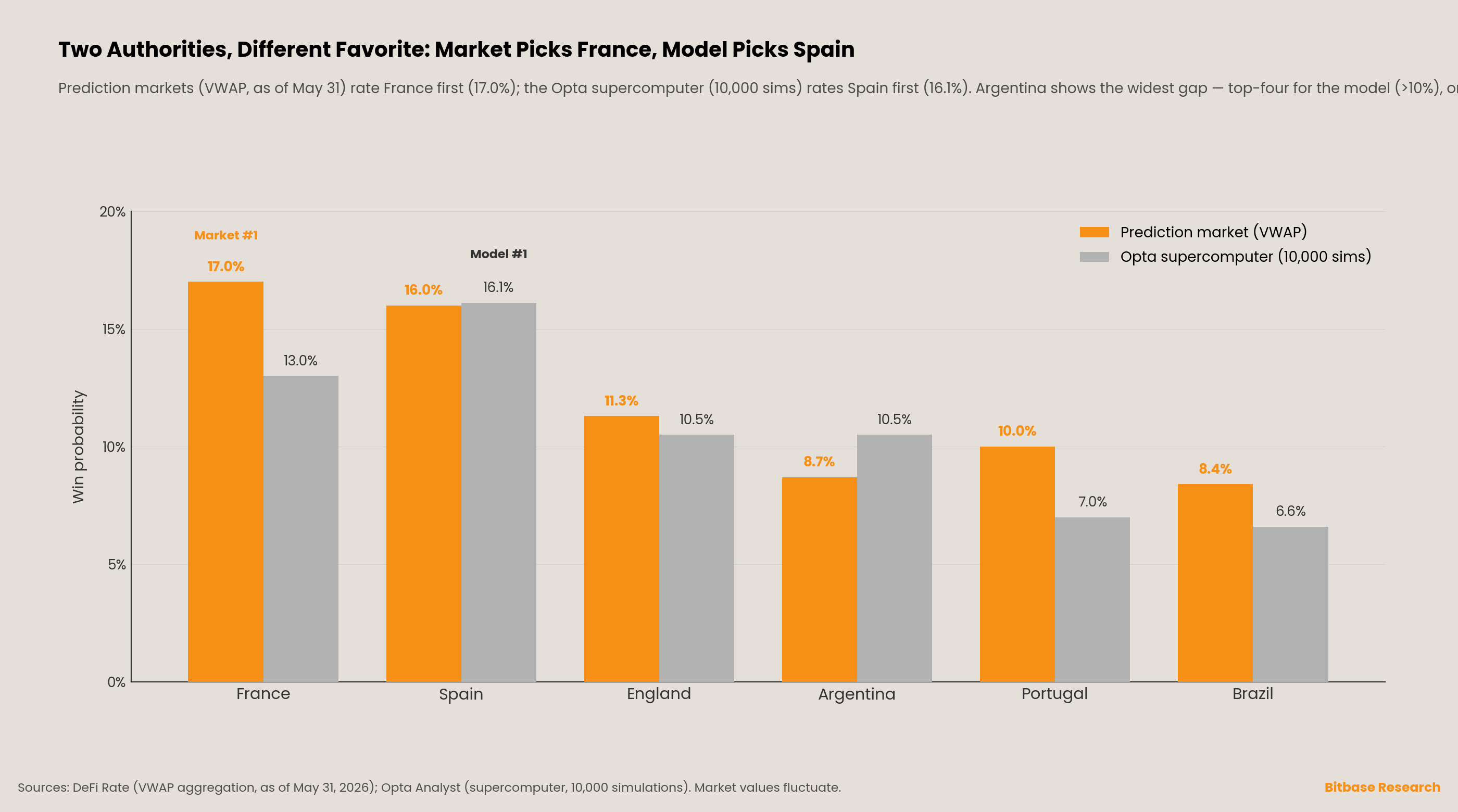
Prediction markets (the aggregated prices on Polymarket and Kalshi) rate France the top contender at about 17%. The Opta supercomputer rates European champions Spain the top contender at 16.1%.
Both numbers are called "probability." But they are produced in completely different ways — one is a price cleared by hundreds of millions of dollars in trading volume; the other is a frequency counted by simulating the entire tournament ten thousand times.
This piece doesn't predict who wins, and doesn't judge which method is more accurate. It answers one question: when you see "France 17%," where does that number actually come from — and how much should you trust it?
This is the next layer down from Episode 6. That piece covered how the market structure of prediction markets differs from traditional sportsbooks. This one covers how the probability inside the price is actually computed. Figures current as of May 31, 2026.
Act 1 — The Probability Inside the Price: How Markets Produce Probability
The prediction-market mechanism is clean: each outcome's contract is priced between 0 and 100 cents, and the price reads directly as an implied probability. France quoted at 17 cents means the market sees roughly a 17% chance France wins — correct holders are paid $1 per contract, incorrect ones get nothing.
But a single platform's price is noisy. Aggregators like DeFi Rate use volume-weighted average pricing (VWAP) to combine quotes from Kalshi, Polymarket, Polymarket US, Gemini and other venues on an hourly basis, producing a cross-platform implied probability. As of May 30, 2026, the World Cup winner contract had cleared roughly $523 million in cumulative volume, settling on July 20, 2026 — the day after the July 19 final.
That price doesn't appear from nowhere. It's the product of market makers continuously quoting two-sided prices and traders continuously transacting. And notably, the firms providing that liquidity are all crypto-native trading shops: Wintermute (over $3.5 trillion in annual volume, across 70-plus exchanges) began quoting two-sided markets on Polymarket and Kalshi in 2026; Jump Trading and Susquehanna are active market makers too.
Act 2 — The Probability Inside the Simulation: How Models Produce Probability
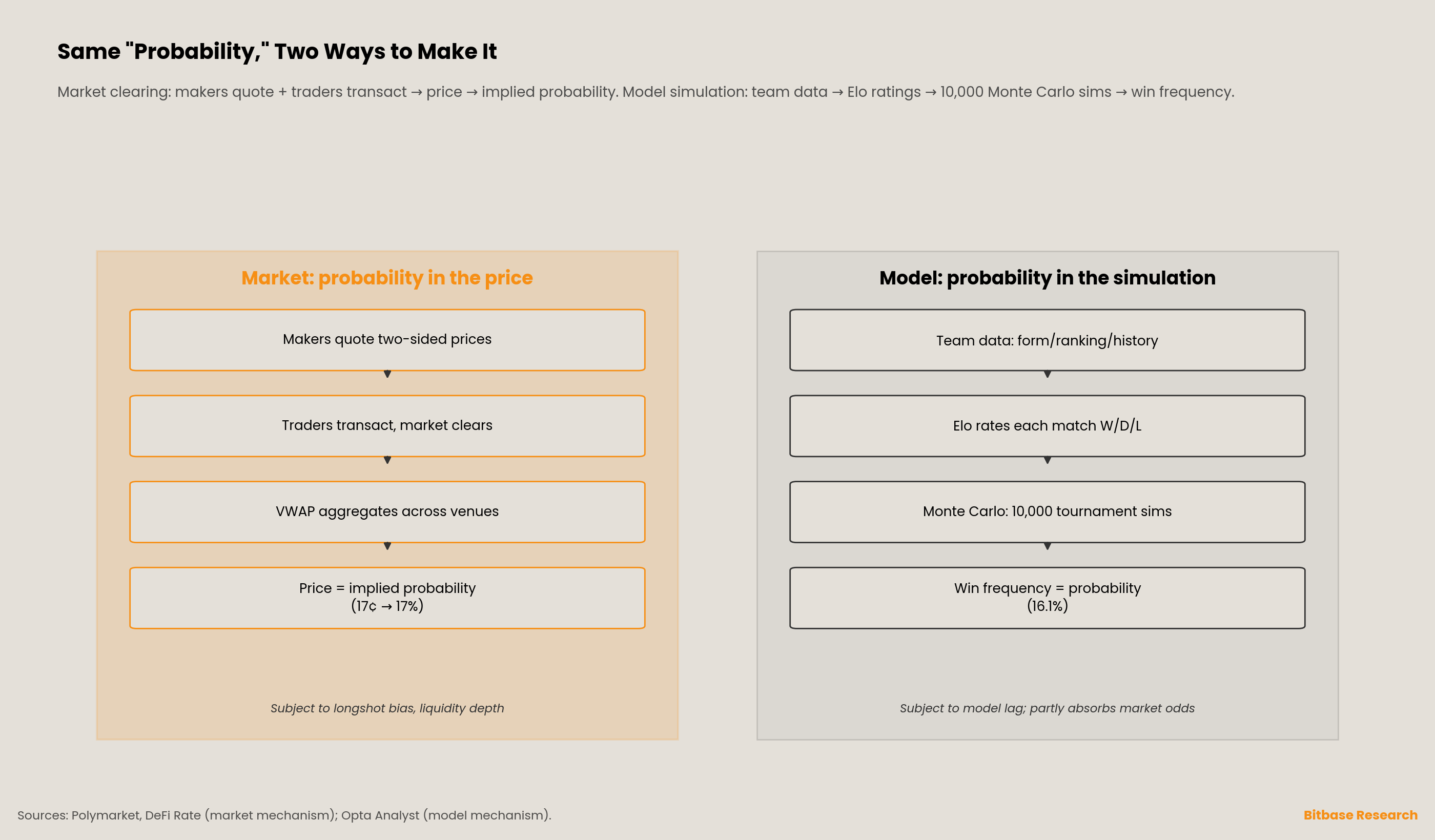
The Opta supercomputer takes the other route. It first uses team data — form, historical results, world ranking, recent international performances — to estimate each match's win/draw/loss probabilities via Power Rankings (an Elo-derived rating algorithm), then simulates the entire tournament 10,000 times and counts how often each team wins. That frequency is its "probability of winning."
The 2026 results (stated as fact, not as a prediction): Spain 16.1% (also the only team with a greater than 50% chance of reaching the quarter-finals, at 52.1%), France 13.0%, England above 10%, defending champions Argentina fourth and also above 10%, Portugal 7.0%, Brazil 6.6%.
There's a counterintuitive methodological detail worth flagging: one of the inputs to the Opta model is bookmaker odds. So "market vs model" isn't a contest between two fully independent systems — the model has already partly absorbed the market's information. When you compare a market price against an Opta probability, the gap you see is smaller than a comparison of two truly independent sources would be.
One timing note: the FiveThirtyEight soccer model (SPI) that many people remember as authoritative stopped being updated after founder Nate Silver's 2023 departure; the original site closed in September 2023, and 538 was shut down entirely by ABC in March 2025. This piece treats it only as historical methodology and as comparison material for 2018 and 2022 — not as a live 2026 source.
Act 3 — Which Is More Accurate? An Honest Gap
Market or model — which is more accurate?
The honest answer: no rigorous cross-tournament academic study has directly compared prediction markets against Opta/538 on Brier scores (the standard measure of forecast accuracy) across both the 2018 and 2022 World Cups. Platform-promoted figures like "90% accuracy" mostly come from the platforms themselves or non-peer-reviewed blogs and shouldn't be taken as independent conclusions. This piece states the gap plainly rather than fabricating an answer.
But one frequently mistold case is worth correcting. Many say "Argentina winning in 2022 was a big upset" — that's not accurate. Argentina went in as the second or third favorite: Opta gave them 13.1% (second), and bookmakers offered +500 (about 16.7%, second). The real story isn't "an underdog won." It's that nearly every major model and market favored Brazil, the second favorite Argentina won, and the one outlier that pushed Argentina down to about 8% was FiveThirtyEight. That's more precise than "upset" — and more revealing: so-called "authoritative probabilities" can differ between sources by a factor of two.
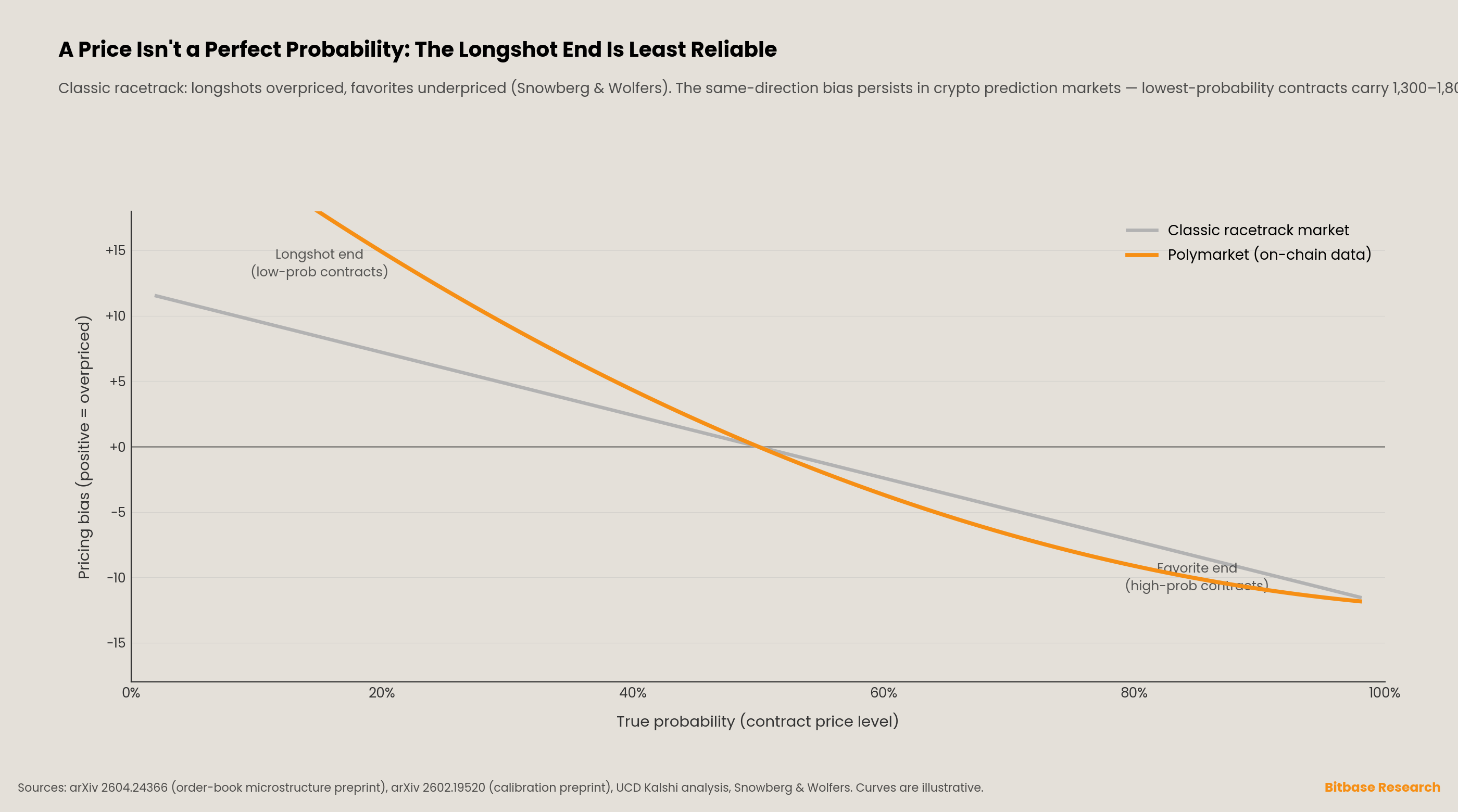
The price itself isn't a perfect probability either. There's a phenomenon documented for nearly a century called favorite-longshot bias: in classic racetrack markets, bettors systematically overbet longshots and underbet favorites — a longshot's true win rate is lower than its odds imply, so backing longshots loses more over the long run (the Snowberg and Wolfers work).
What's genuinely counterintuitive is that this bias does not disappear in the supposedly more rational, more efficient crypto prediction markets. Multiple studies on large Polymarket and Kalshi datasets find the same direction of bias: University College Dublin researchers analyzed over 300,000 Kalshi contracts and found low-priced contracts resolved less often than their price implied, while high-priced contracts resolved more often (i.e., longshots still overpriced); a calibration study of 292 million trades (arXiv preprint 2602.19520) likewise found long-horizon prices compressed toward 50%, understating favorites' true edge. A microstructure preprint of 30 billion order-book events over 52 days (arXiv 2604.24366) quantified the cost at the longshot end: quoted spreads on the lowest-probability contracts run 1,300 to 1,800 basis points — an order of magnitude wider than traditional markets — because market makers price the inventory risk of a bounded upside and an asymmetric downside.
Put plainly: a bias first recorded at the racetrack a century ago still holds in today's on-chain, multi-billion-dollar markets — the closer the "probability" inside a price is to the longshot end, the less reliable it is.
The Ledger Is Public
Here's something traditional sportsbooks can't do: Polymarket is built on Ethereum smart contracts, and every trade is on-chain and auditable by anyone. Those two studies above were only possible because researchers could reconstruct the direction of every trade directly from the on-chain record — impossible in a sportsbook's closed ledger. Settlement is on-chain too: USDC as collateral, smart contracts settling automatically, with no need to trust a centralized house to hold your funds.
But transparency isn't the same as un-manipulable. Thin order books mean small markets can be moved by modest capital. During the tournament (June 11 to July 19), per-match contract prices will drift in real time with the score — the most vivid live case of how a price forms.
Act 4 — The Variable Outside the Price: Regulation
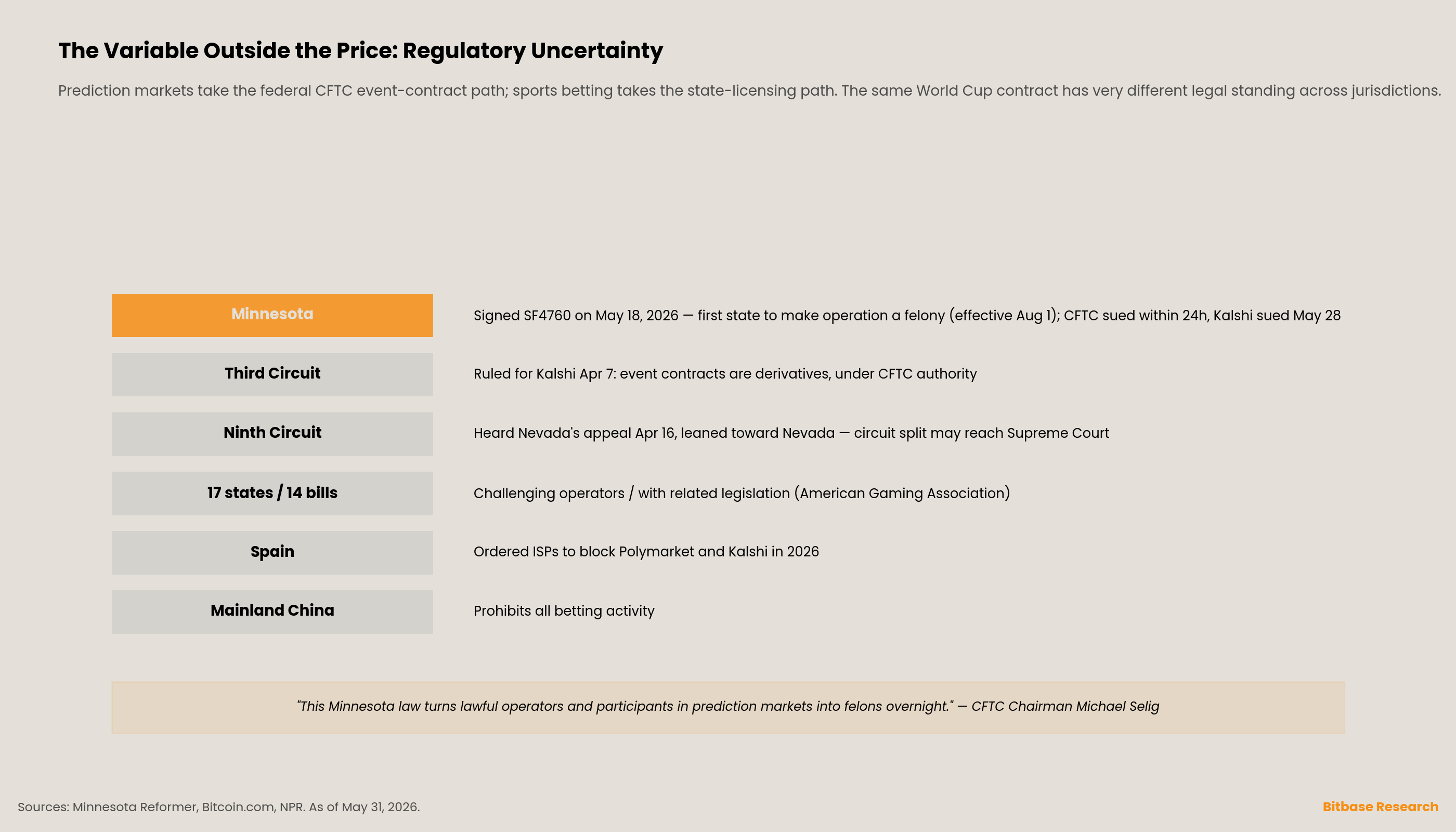
The price is also shaped by a non-market variable: regulatory uncertainty.
Behind this is an unresolved jurisdictional fight: the Third Circuit ruled for Kalshi on April 7 (event contracts are derivatives, under CFTC authority), while the Ninth Circuit, hearing Nevada's appeal on April 16, leaned toward Nevada — a circuit split that could ultimately reach the Supreme Court. As of now, 17 states are challenging prediction-market operators and 14 have related legislation; Spain ordered ISPs to block Polymarket and Kalshi in 2026.
The distinction matters: prediction markets take the federal CFTC event-contract path, while sports betting takes the state-licensing path — and the same World Cup contract has very different legal standing depending on the jurisdiction. The regulatory uncertainty is itself one of the variables behind the price.
Closing — Back to Those Two Numbers
Back to the opening — "France 17%" and "Spain 16.1%."
Now you know how those numbers are made: one is a price cleared by hundreds of millions in trading volume, subject to longshot bias and liquidity depth; the other is a frequency counted by simulating the tournament ten thousand times, subject to model lag — and partly absorbing the market's own information.
Which is more accurate? No rigorous cross-tournament comparison can answer that. Bitbase will publish a post-mortem after the World Cup ends and the contracts settle on July 20 — looking at what the market and the model each got right and wrong.
Until then, the next time you see any "probability of winning," it's worth asking one more question: how was this number actually produced?
What's visible, what's verifiable, what hasn't been decided yet — it's all in the public record.
This article is informational and does not constitute investment advice, betting advice, or a recommendation to use any specific platform or contract. All data is from public sources as of May 31, 2026. This is a descriptive observation of odds-pricing mechanisms and forecasting methodology; it does not predict 2026 World Cup outcomes, nor does it evaluate the accuracy, legality, or profitability of any prediction market, statistical model, or sportsbook.
The legality of prediction markets and sports betting varies materially across jurisdictions. Minnesota has enacted a law criminalizing prediction-market operation as a felony (effective Aug 1, 2026; currently under federal litigation); Nevada, Massachusetts and other states have imposed restrictions; Spain has ordered ISPs to block Polymarket and Kalshi; mainland China prohibits all betting activity. Readers must verify the compliance requirements in their own jurisdiction; this article assumes no liability for the legal consequences of any reader's decision to participate or not participate in any activity.
All platforms, institutions and individuals are named factually as participants in public events; this article does not evaluate their business conduct, model methodology, or individual judgment.
References
[1] Polymarket, "World Cup Winner Predictions & Odds 2026" (price-to-implied-probability mapping). https://polymarket.com/event/world-cup-winner
[2] DeFi Rate, "2026 World Cup Odds | Kalshi vs Polymarket Prediction Markets" (VWAP aggregation, $523M cumulative volume, July 20 settlement). https://defirate.com/prediction-markets/world-cup-odds/
[3] The Defiant, "Wintermute Starts Quoting Prediction Markets as Event-Contract Volume Tops $60B in 2026" (Ostrovskis quote). https://thedefiant.io/news/markets/wintermute-starts-quoting-prediction-markets-as-event-contract-volume-tops-60b-in-2026
[4] Decrypt, "Wintermute Is Providing Liquidity on Kalshi and Polymarket, Linking Two Giants." https://decrypt.co/369475/wintermute-liquidity-kalshi-polymarket-prediction-markets
[5] Opta Analyst, "Who Will Win the 2026 FIFA World Cup? The Opta Supercomputer Predictions" (Spain 16.1%, France 13.0%, 10,000 simulations). https://theanalyst.com/articles/who-will-win-2026-fifa-world-cup-predictions-opta-supercomputer
[6] Opta Analyst, "Football Predictions" (Power Rankings methodology; model inputs include bookmaker odds). https://theanalyst.com/articles/opta-football-predictions
[7] FiveThirtyEight, "How Our Club Soccer Projections Work" (SPI methodology; model stopped updating after 2023, shut down March 2025; used here for historical reference). https://fivethirtyeight.com/features/how-our-club-soccer-projections-work/
[8] arXiv 2604.24366, "The Anatomy of a Decentralized Prediction Market: Microstructure Evidence from the Polymarket Order Book" (30B events / 52 days; longshot spread 1,300–1,800 bps; on-chain OrderFilled trade-direction reconstruction). https://arxiv.org/abs/2604.24366
[9] arXiv preprint 2602.19520, Le (2026), "Decomposing Crowd Wisdom: Domain-Specific Calibration Dynamics in Prediction Markets" (292M trades; long-horizon prices compressed toward 50%); and University College Dublin's longshot-bias analysis of 300,000+ Kalshi contracts (as reported by Prediction News). https://arxiv.org/html/2602.19520v1
[10] Sports Illustrated, "2022 World Cup Odds" (Argentina +500, second favorite pre-tournament). https://www.si.com/betting/2022/11/16/odds-groups-2022-world-cup
[11] Polymarket, "FIFA World Cup Prediction Markets & Live Odds 2026" (in-tournament per-match contracts). https://polymarket.com/fifa-world-cup
[12] Minnesota Reformer, "Minnesota becomes first state to outlaw prediction markets, immediately sued by federal regulators" (SF4760 signed May 18, CFTC suit, Selig quote). https://minnesotareformer.com/2026/05/19/minnesota-becomes-first-state-to-outlaw-prediction-markets-immediately-sued-by-federal-regulators/
[13] Bitcoin.com, "Kalshi Sues Minnesota to Block First US Felony Ban on Prediction Markets" (Kalshi suit May 28, effective Aug 1, circuit split). https://news.bitcoin.com/kalshi-sues-minnesota-prediction-market-felony-ban-2026/
[14] NPR, "Minnesota becomes first state to ban prediction markets" (federal vs state jurisdiction). https://www.npr.org/2026/05/19/nx-s1-5821265/minnesota-ban-prediction-markets