KYC, or "Know Your Customer," is the identity-verification process exchanges use before you can trade. It confirms who you are to meet anti-money-laundering laws and protect users. This guide explains what KYC involves and why it exists.
What KYC means
KYC is a set of checks that confirm a customer's identity. It is a core part of anti-money-laundering (AML) rules that regulated financial businesses — including crypto exchanges — must follow [1]. In short, the platform verifies who you are before letting you deposit, trade, or withdraw.
What you provide
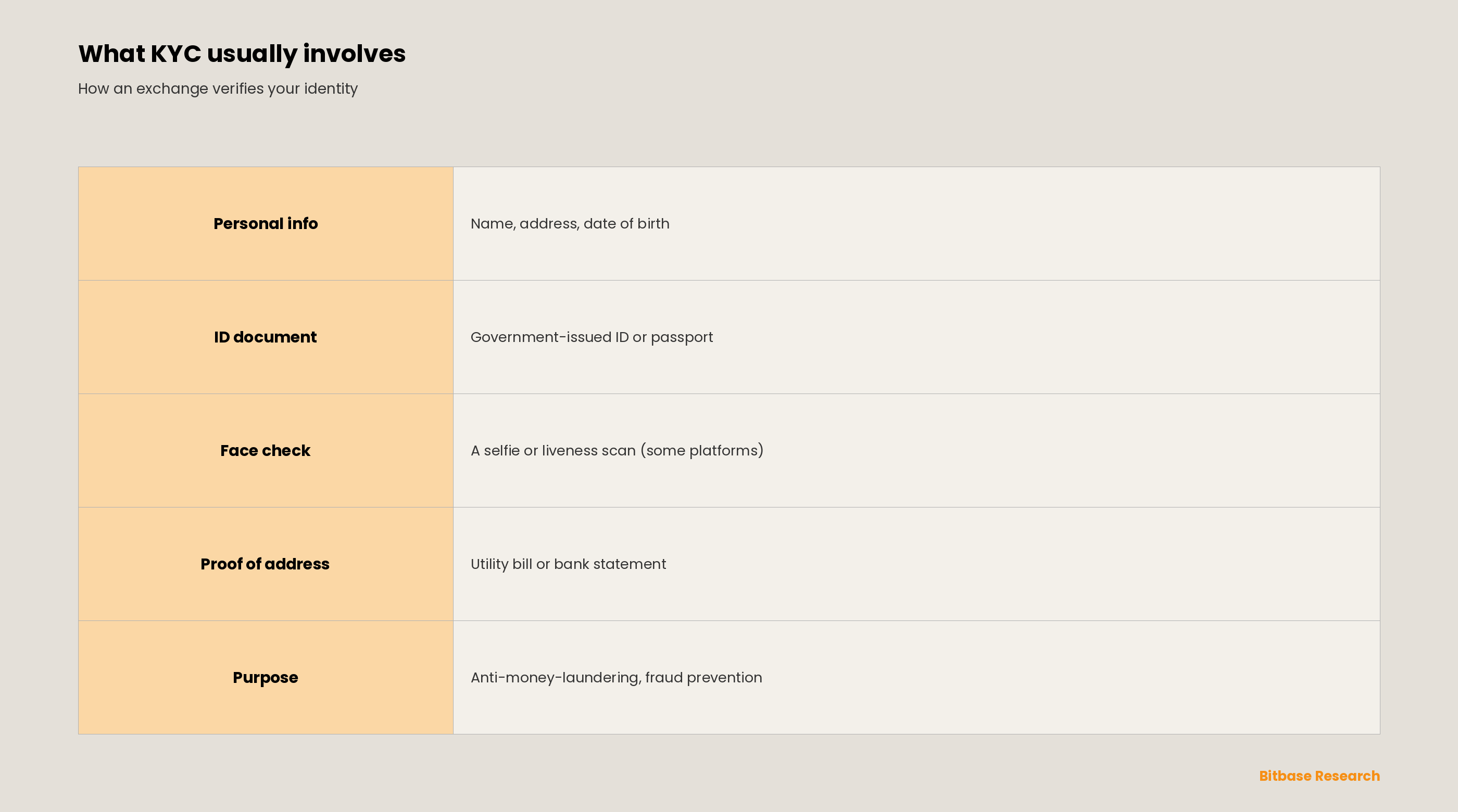
A typical KYC check asks for personal details (name, address, date of birth) and a government-issued ID such as a passport or driver's license [1]. Many exchanges add a selfie or "liveness" check to match your face to the ID, and some request proof of address like a utility bill.
What KYC usually involves
Why exchanges require it
KYC exists to keep crypto safe and lawful. It helps platforms detect fraud and prevent money laundering, protects you if someone tries to use your identity, and keeps exchanges compliant so they can operate across different countries [2]. A platform that skips KYC entirely is a red flag for an unregulated or risky service.
A note on your data
Because KYC means sharing sensitive documents, use exchanges that are regulated and transparent about how they store your data. Reputable platforms protect this information and only collect what regulations require.
The bottom line
KYC is the identity check that lets exchanges verify who you are, satisfy AML laws, and protect users. It is a standard, one-time step on any regulated platform. To keep learning the fundamentals, follow more from Bitbase Academy.
Disclaimer: This article is educational content from Bitbase Academy, provided for information only. It does not constitute investment, trading, tax, or financial advice. Specific KYC requirements vary by platform and jurisdiction; refer to the latest rules from the exchange and local regulations. Written as of June 2026.
References
[1] Trulioo, "Understanding KYC Crypto Requirements." trulioo.com
[2] GBG, "KYC, AML and what they mean for crypto." gbg.com