
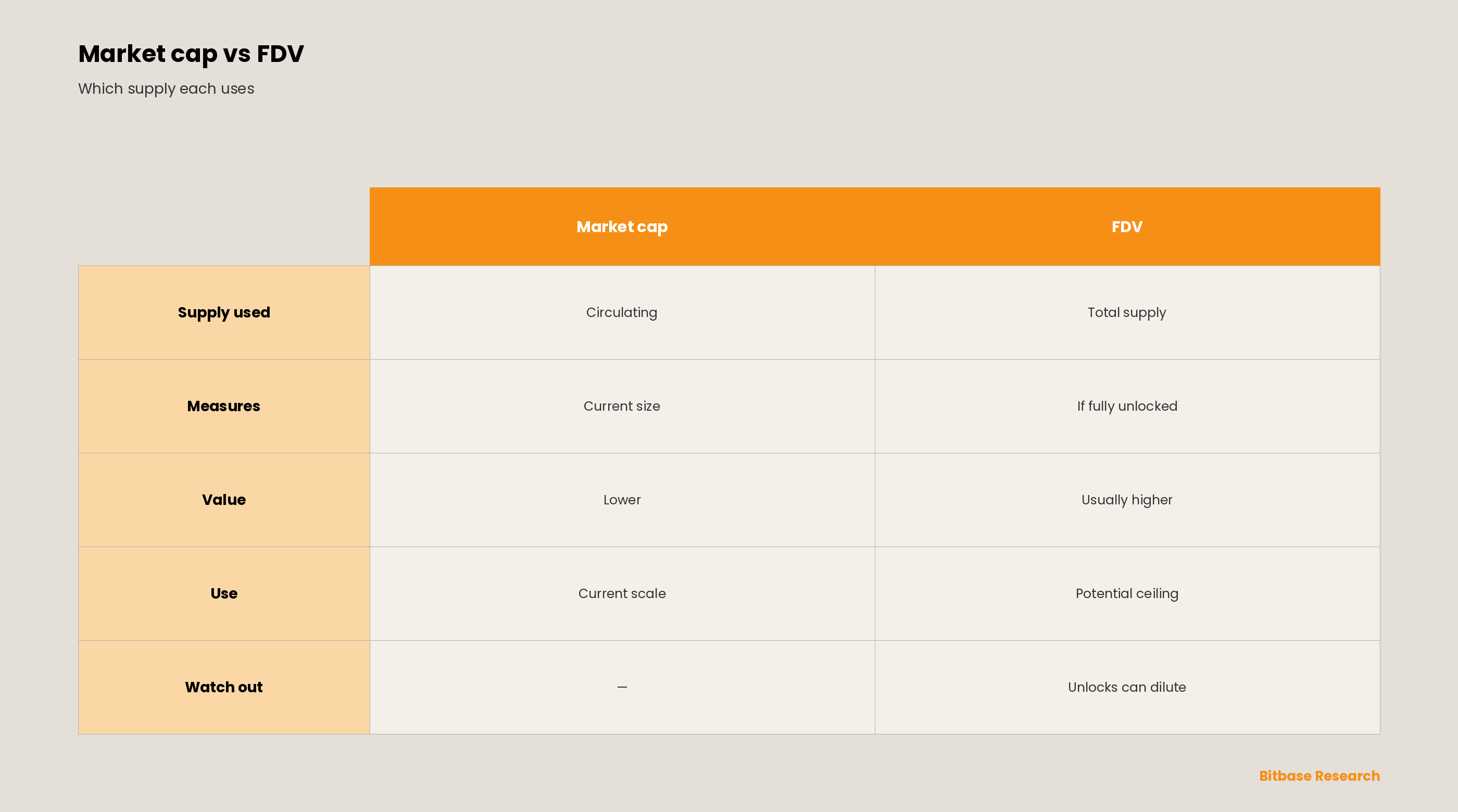
Fully diluted valuation (FDV) estimates a token's market cap as if its entire supply were already in circulation — price multiplied by total supply. Unlike market cap, which uses circulating supply, FDV is often much higher. This guide explains it.
How it's calculated
FDV = price per token × total supply [1]. For example, a token priced at $2 with a total supply of 100 million but only 20 million circulating has a current market cap of $40 million — while its FDV is $200 million [2].
Market cap vs FDV
Why it matters
FDV signals the potential size once all tokens are unlocked. If many tokens are still locked, future releases can dilute the price. So an FDV far above market cap is often a cue to check the token's release schedule (unlocks and vesting).
The bottom line
FDV uses total supply to estimate a token's market cap when fully circulating, and is usually higher than current market cap. It helps you see the potential supply ceiling and dilution risk — a key input when assessing a token. To keep learning the fundamentals, follow more from Bitbase Academy.
Disclaimer: This article is educational content from Bitbase Academy, provided for information only. It does not constitute investment, trading, tax, or financial advice. Written as of June 2026; refer to the latest official information.
References
[1] Coinbase, "What is a Fully Diluted Valuation (FDV) in crypto?" coinbase.com
[2] CoinGecko, "What Is Fully Diluted Valuation (FDV) In Crypto?" coingecko.com