
Cryptocurrency is digital money secured by cryptography and recorded on a blockchain, with no government or central bank in charge. Bitcoin launched the idea in 2009; by June 2026 the total crypto market was worth about $2.2 trillion across roughly 17,000 actively traded cryptocurrencies. This guide explains what crypto is, how it works, and what to watch.
What cryptocurrency is
Cryptocurrency ("crypto") is money that exists only digitally and is secured by cryptography. Instead of a bank keeping the records, transactions are recorded on a blockchain — a shared ledger maintained by a decentralized network. Bitcoin (BTC) was the first cryptocurrency, launched in 2009. As of June 2026, the total crypto market cap was about $2.2 trillion, spread across roughly 17,000 actively traded cryptocurrencies [1][2][3].
How cryptocurrency works
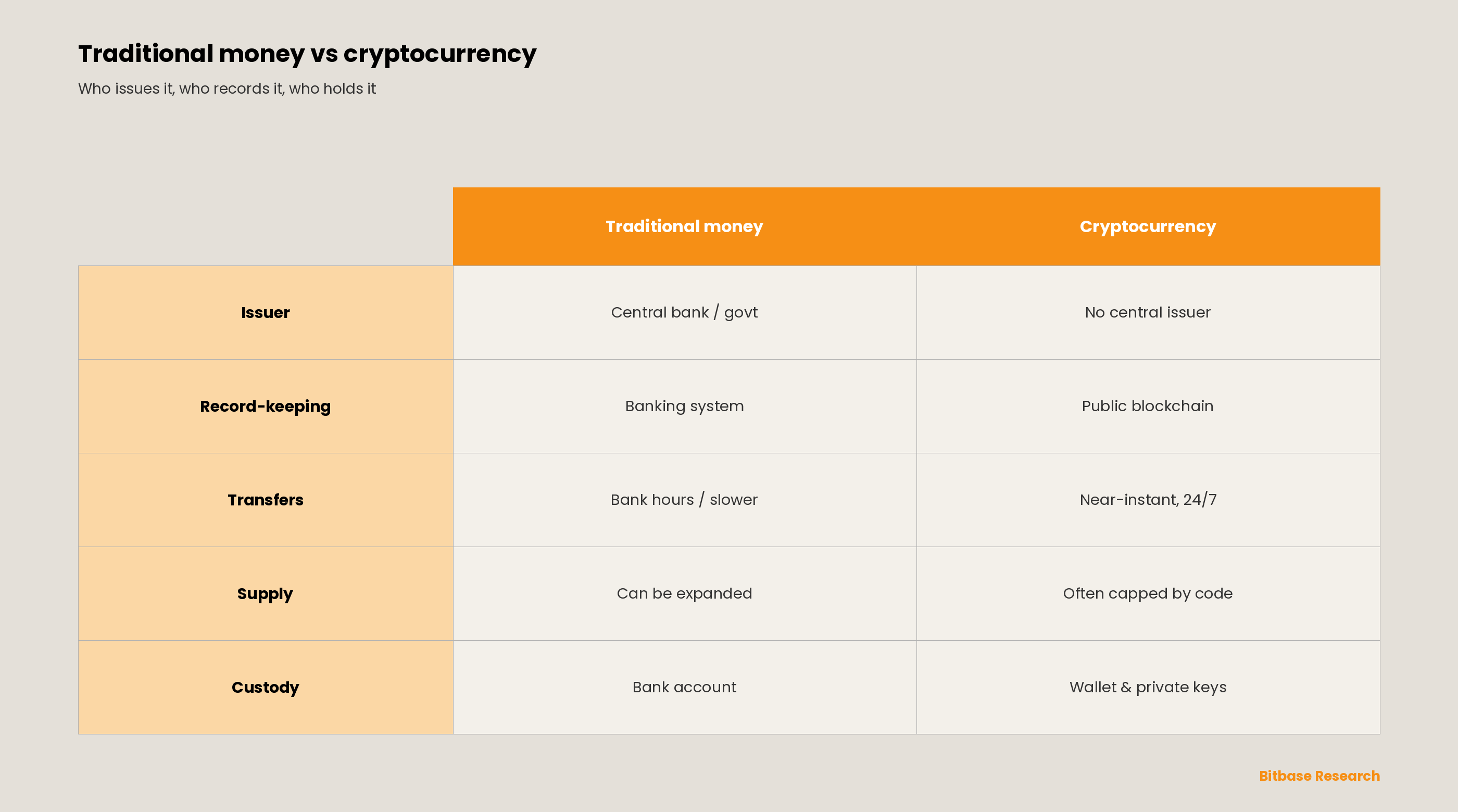
Crypto runs on blockchains. When you send crypto, the network verifies and records the transaction; you hold your coins through a wallet that stores your keys. There is no central authority — the rules and supply are set by code (Bitcoin, for example, is capped at 21 million coins).
Crypto vs traditional money
The main kinds
- Bitcoin (BTC). The first and largest, often seen as "digital gold." - Ether (ETH) and platform coins. Power the smart-contract networks where apps run. - Stablecoins. Pegged to a currency (usually the US dollar) to stay stable. - Altcoins and tokens. Thousands of other coins and project tokens.
Risks and what to know
Crypto is highly volatile, you are responsible for securing your own keys, scams are common, and rules differ by country (frameworks such as the US GENIUS Act and the EU's MiCA are catching up). Never put in more than you can afford to lose.
The bottom line
Cryptocurrency is internet-native money recorded on a blockchain rather than issued by a bank. Understanding the basics is the first step into the wider ecosystem. To keep learning the fundamentals, follow more from Bitbase Academy.
Disclaimer: This article is educational content from Bitbase Academy, provided for information only. It does not constitute investment, trading, tax, or financial advice. Crypto assets are highly volatile; assess your own risk tolerance before participating. Data is current as of June 2026 and may change; refer to the latest authoritative sources.
References
[1] Investopedia, "Cryptocurrency." investopedia.com
[2] The Motley Fool, "How Many Cryptocurrencies Are There in 2026?" fool.com
[3] CoinGecko, "Global Cryptocurrency Market Cap Charts." coingecko.com