
An altcoin is any cryptocurrency other than Bitcoin. The name combines "alternative" and "coin," and thousands exist — from stablecoins to platform coins. This guide explains what altcoins are and the main types.
The simple definition
"Altcoin" simply means any crypto that is not Bitcoin [1]. Because Bitcoin was the first cryptocurrency, everything that came after has been grouped as an "alternative." Some people also set Ethereum apart from the altcoin label given its size, but the broad definition is "not Bitcoin."
Why altcoins exist
Altcoins usually launch to do something Bitcoin was not designed for: run smart contracts, settle faster, charge lower fees, add privacy, or hold a stable value [1]. Many experiment with new technology, but most are far smaller and riskier than Bitcoin.
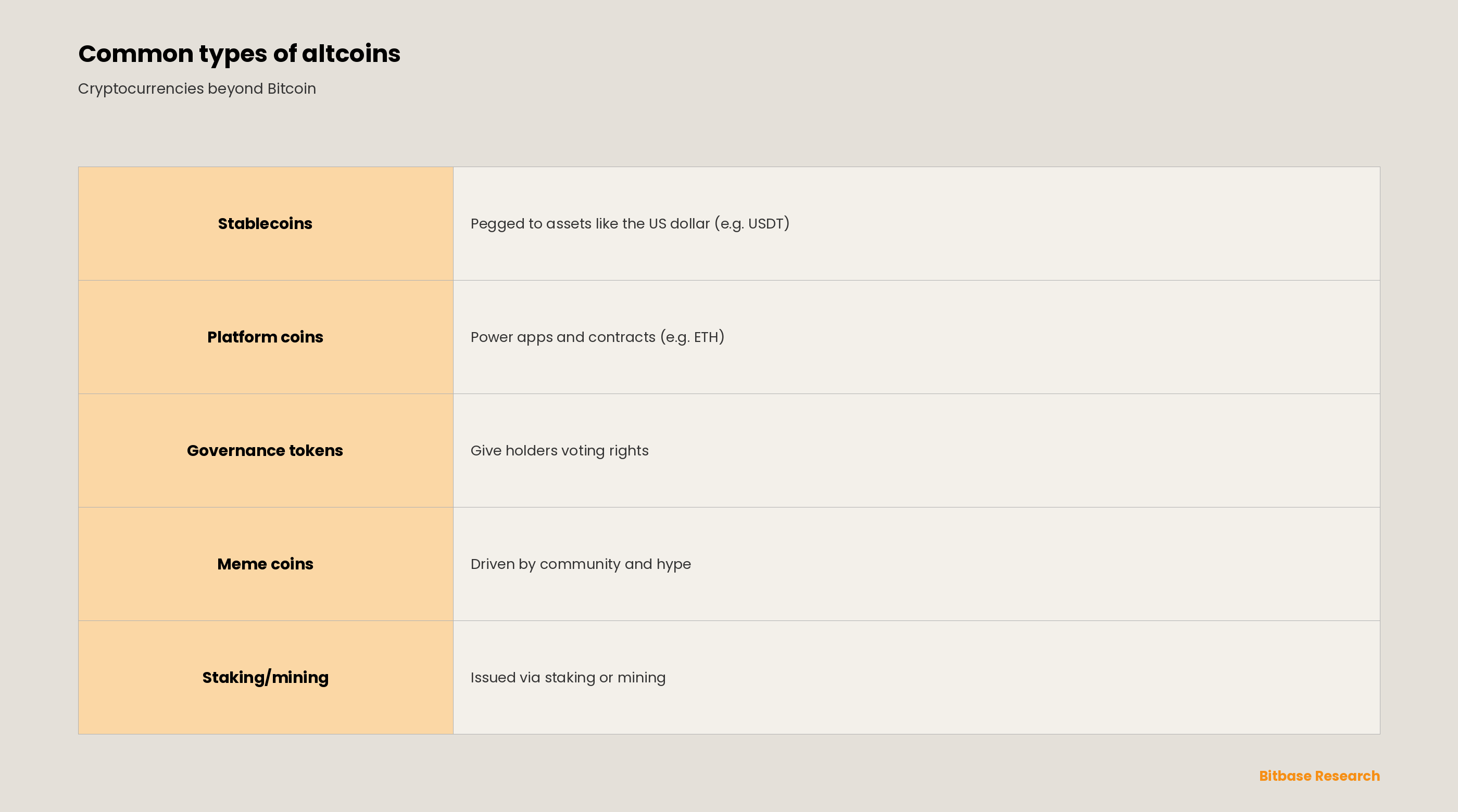
Main types of altcoins
What to keep in mind
The altcoin market ranges from established platforms to thousands of tiny, speculative tokens. Liquidity, track record, and real use vary enormously, and many altcoins lose most of their value over time [2]. Research a project's purpose and team before going near it, and treat smaller altcoins as high-risk.
The bottom line
An altcoin is any cryptocurrency besides Bitcoin, spanning stablecoins, platform coins, governance tokens, and more. Knowing the categories helps you tell a working project from pure speculation. To keep learning the fundamentals, follow more from Bitbase Academy.
Disclaimer: This article is educational content from Bitbase Academy, provided for information only. It does not constitute investment, trading, tax, or financial advice, and does not recommend any specific coin. Altcoins are generally volatile and higher-risk, which can lead to a large or total loss of capital. Written as of June 2026.
References
[1] The Motley Fool, "What Are Altcoins? Defined and Explained." fool.com
[2] Britannica Money, "What Are Altcoins, Coins, and Tokens?" britannica.com