
Gas fees are the payments you make to have a transaction processed on a blockchain like Ethereum. They compensate the network for the computing power your transaction uses, and they rise and fall with demand. This guide explains how gas fees work.
Why gas exists
Every action on Ethereum — sending ETH, swapping tokens, minting an NFT — uses computing resources. Gas is the unit that measures that work. You pay for it in ETH, usually quoted in gwei, where 1 gwei is one-billionth of an ETH [1]. Gas keeps the network from being overloaded and rewards those who process transactions.
What you actually pay
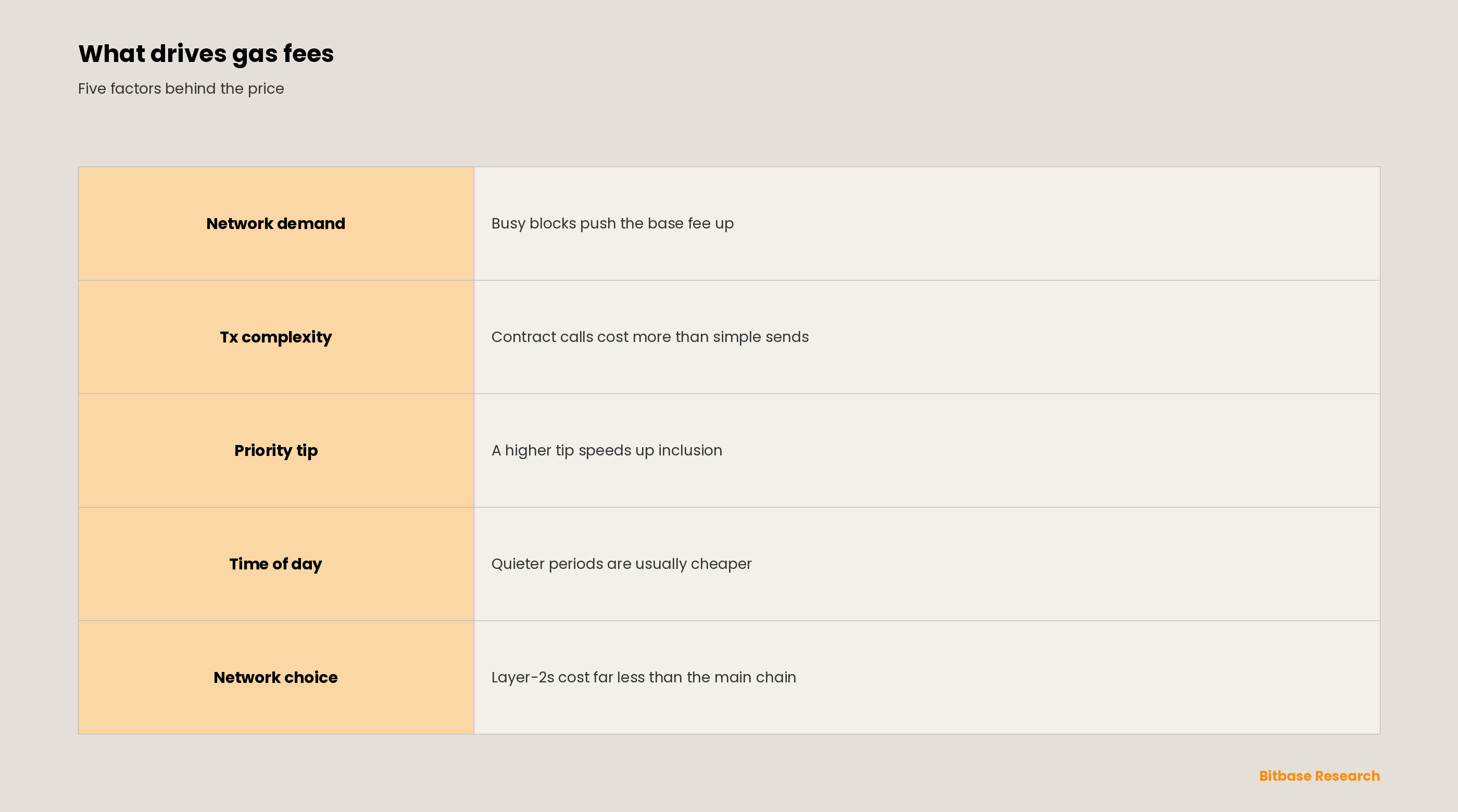
Since the EIP-1559 upgrade, a gas fee has two parts: a base fee set automatically by the network (and burned), plus an optional priority tip to have your transaction processed faster [2]. The base fee rises when blocks are busy and falls when they are quiet, which makes fees more predictable.
What makes gas fees go up
How to pay less
Fees are mainly driven by network demand, so transacting during quieter periods usually costs less. Layer-2 networks (see our Layer 1 vs Layer 2 guide) also process transactions far more cheaply than Ethereum's main chain. Always check the estimated fee before confirming.
The bottom line
Gas fees are the price of using blockchain space: they pay for computation and rise with demand. Knowing how they work helps you time transactions and avoid overpaying. To keep learning the fundamentals, follow more from Bitbase Academy.
Disclaimer: This article is educational content from Bitbase Academy, provided for information only. It does not constitute investment, trading, tax, or financial advice. Gas fees change in real time with network conditions; written as of June 2026, so rely on the live estimate in your wallet or a block explorer.
References
[1] ethereum.org, "Gas and fees." ethereum.org
[2] Coinbase Help, "What is EIP-1559?" help.coinbase.com