How do you use Bitcoin on Ethereum, or track a stock's price on-chain without a broker? The answer is wrapped and synthetic assets — two different tricks for making one asset behave like another on a blockchain. They look similar but work very differently, and confusing them can be costly.
The problem they solve
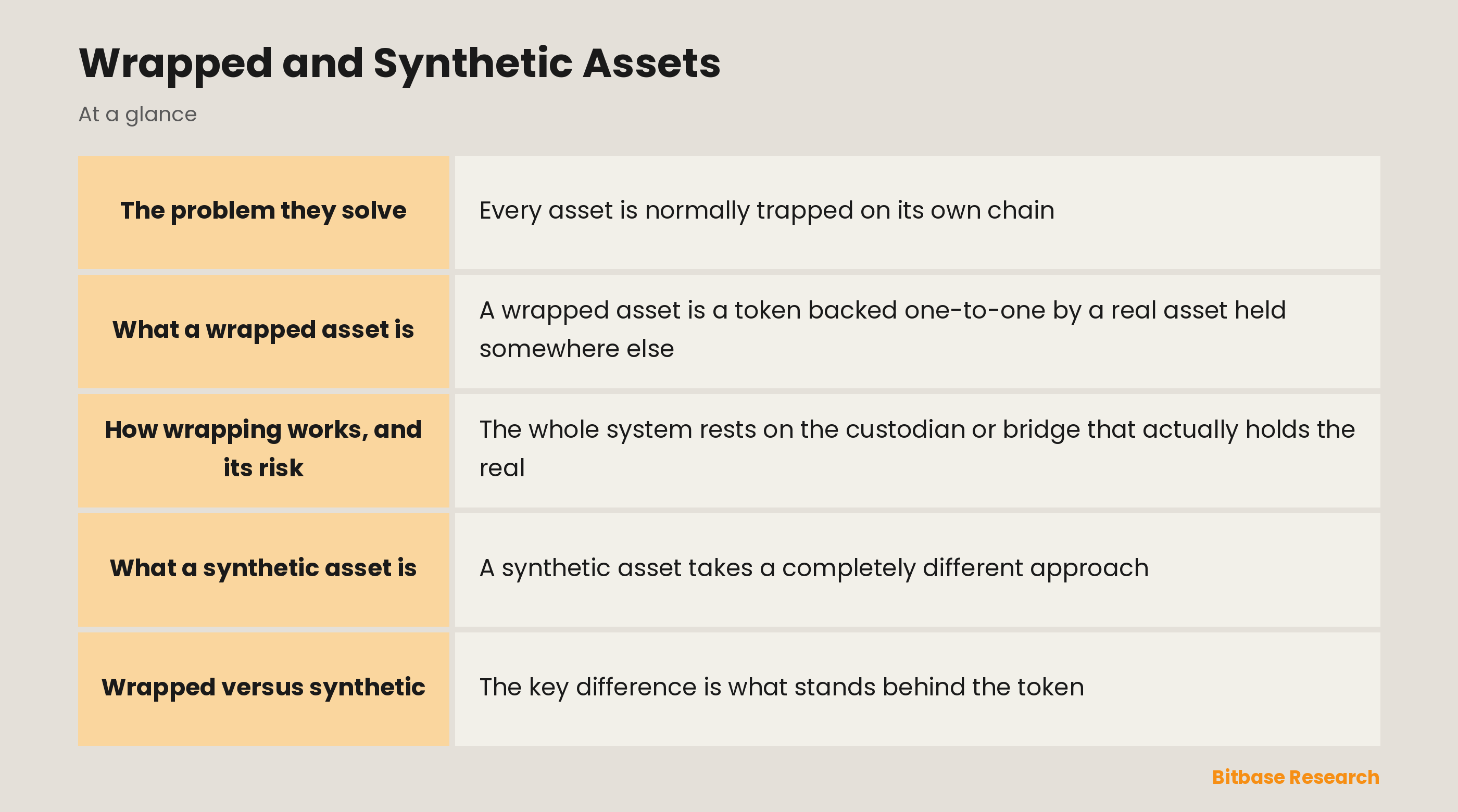
Every asset is normally trapped on its own chain. Bitcoin lives on Bitcoin and cannot natively join Ethereum's DeFi apps; and many assets people want exposure to — stocks, gold, currencies — do not exist on any blockchain at all. Wrapped and synthetic assets are two answers to the same question: how do you bring an outside asset onto a blockchain so it can be traded and used there?
What a wrapped asset is
A wrapped asset is a token backed one-to-one by a real asset held somewhere else. To create wrapped Bitcoin, for example, real BTC is locked with a custodian, and an equal amount of a wrapped token is minted on Ethereum. That wrapped token can move through Ethereum's DeFi and is redeemable for the underlying Bitcoin. Wrapped ETH works the same way, letting native ETH behave like a standard token.
How wrapping works, and its risk
The whole system rests on the custodian or bridge that actually holds the real asset. You are trusting that it truly has the reserves, keeps the peg one-to-one, and can be redeemed. That trust is exactly where the danger lives: if the custodian is dishonest, or the bridge is hacked, the wrapped token can lose its backing and its value. Reputable wrapped assets publish proof of their reserves so you can verify the real asset is there.
What a synthetic asset is
A synthetic asset takes a completely different approach: it tracks the price of something without ever holding it. Instead of locking real gold or a real share, a synthetic is backed by crypto collateral and uses a price oracle to mirror the target's value. You get exposure to the price movement of a stock or commodity, but you never own the underlying — you hold a collateralized bet on where its price goes.
Wrapped versus synthetic
The key difference is what stands behind the token. A wrapped asset is backed one-to-one by the actual asset, so its main risk is custody: whoever holds the real thing. A synthetic asset is backed by separate collateral and a price feed, so its risks are the collateral holding up and the oracle staying accurate. One is a claim on a real asset; the other is a mirror of a price.
The bottom line
Wrapped and synthetic assets both let you access things a blockchain could not otherwise reach — Bitcoin in Ethereum DeFi, or a stock's price without a brokerage. But they rest on different foundations: wrapped depends on whoever custodies the real asset, synthetic on collateral and reliable price feeds. Before holding either, know exactly what backs it, because that backing is the only thing keeping it worth what it claims.
Disclaimer: This article is educational content from Bitbase Academy, provided for informational purposes only. It is not investment, trading, tax, or financial advice. Written as of July 2026; rely on the latest official information.
References
[1] Synthetix, "How synthetic assets work" synthetix.io
[2] CoinDesk, "What is Wrapped Bitcoin (WBTC)" coindesk.com