Transaction ordering is the sequence in which transactions are placed inside a block. It sounds like a technical detail, but the power to decide that order is worth real money — it is the root of front-running and the wider phenomenon called MEV. Here is what ordering is, who controls it, why it matters, and the risks it creates.
What ordering is
When a block is built, it does not just contain a set of transactions — it contains them in a specific order, first to last. Because transactions can affect each other, especially in DeFi, that order can change the result: which trade executes at which price, which one succeeds, which one fails. Whoever assembles the block decides that sequence, so ordering is a quiet but powerful lever over what actually happens on-chain.
How producers order transactions
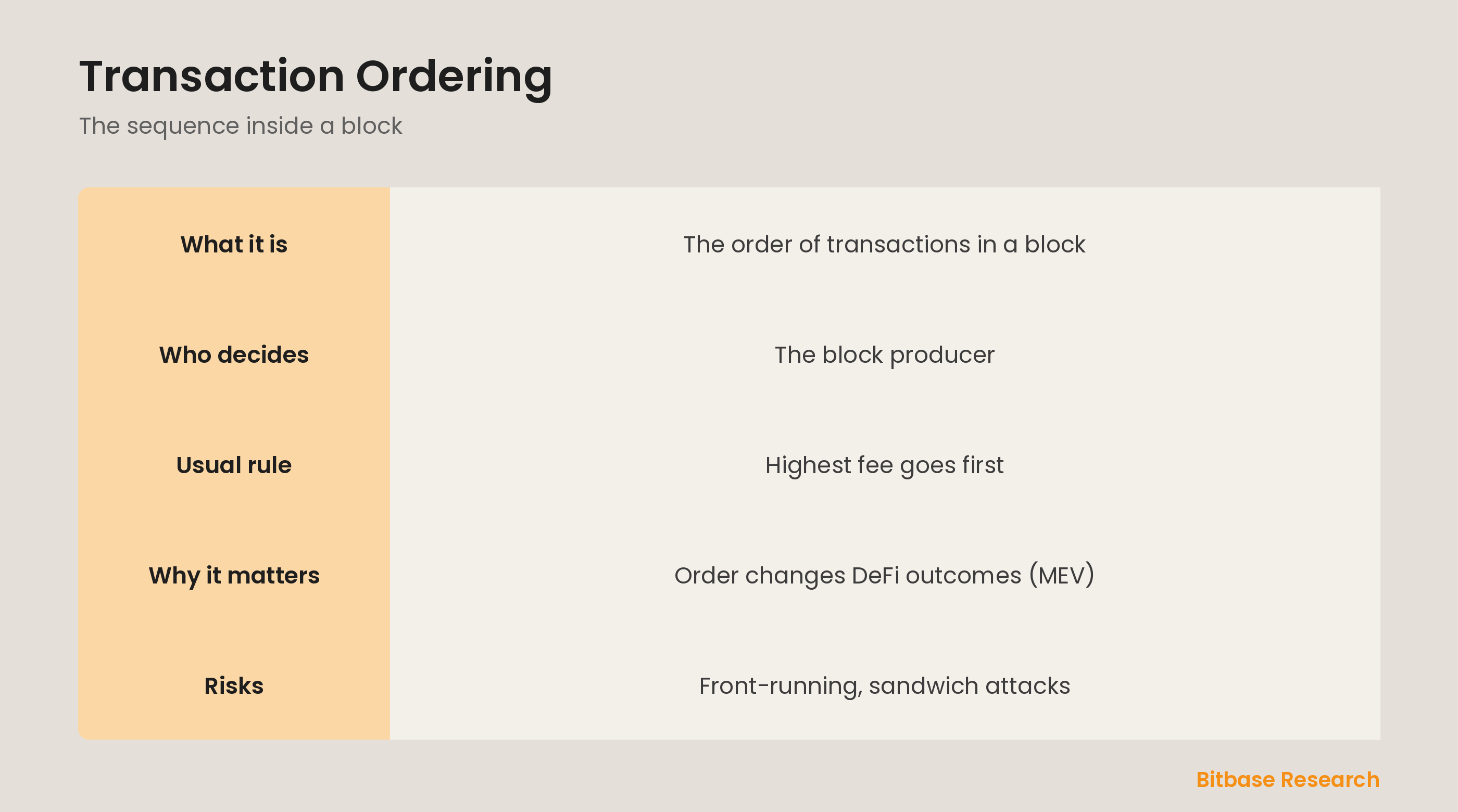
Left to the default, block producers usually order transactions by fee: the ones offering to pay the most go first, because that maximizes the producer's revenue. This is why raising your fee can get a transaction included sooner. But the producer is not forced to sort purely by fee — it can arrange, insert, or drop transactions however it likes within the rules, and that freedom is exactly what makes ordering exploitable.
Why order matters: MEV
The value a producer can capture just by choosing the order is called MEV, or maximal extractable value. In a busy DeFi market, a well-placed transaction can profit from another user's pending trade — buying just before a large order and selling just after, for example. Specialized actors called searchers hunt for these opportunities and pay producers to order things in their favour, turning the right to sequence a block into a marketplace of its own.
The risks it creates
The most visible harms are front-running, where someone jumps ahead of your transaction after seeing it waiting, and the sandwich attack, where a trade is wrapped by one order before and one after to skim value from it. These cost ordinary users worse prices, especially on public markets where pending transactions are visible. Responses include priority fees, private transaction channels, and separating who builds a block from who proposes it, all aimed at taming the power to order.
The bottom line
Transaction ordering is simply the sequence of transactions in a block, but that sequence is chosen by the block producer and can be highly valuable — which is why MEV, front-running, and sandwich attacks exist. Fees usually set the default order, yet the deeper point is that the right to order transactions is itself a source of profit and risk. Knowing this explains a lot about how on-chain trading really works. To keep learning the fundamentals, follow more from Bitbase Academy.
Disclaimer: This article is educational content from Bitbase Academy, provided for information only. It does not constitute investment, trading, tax, or financial advice. Crypto assets are volatile; assess your own risk. Written as of June 2026; refer to the latest official information.
References
[1] Ethereum.org, "Maximal Extractable Value (MEV)" ethereum.org
[2] Investopedia, "Front-Running: Definition and Example" investopedia.com
[3] Ethereum.org, "Transactions" ethereum.org