
Crypto mining is how new coins are created and transactions are verified on Proof-of-Work blockchains like Bitcoin. Miners use powerful computers to solve math puzzles and, in return, earn newly minted coins and fees. This guide explains how it works.
What mining does
On a Proof-of-Work blockchain, there is no central authority to confirm transactions. Instead, miners compete to validate and record them. Mining serves two jobs at once: it secures the network, and it releases new coins into circulation at a predictable pace [1].
How mining works
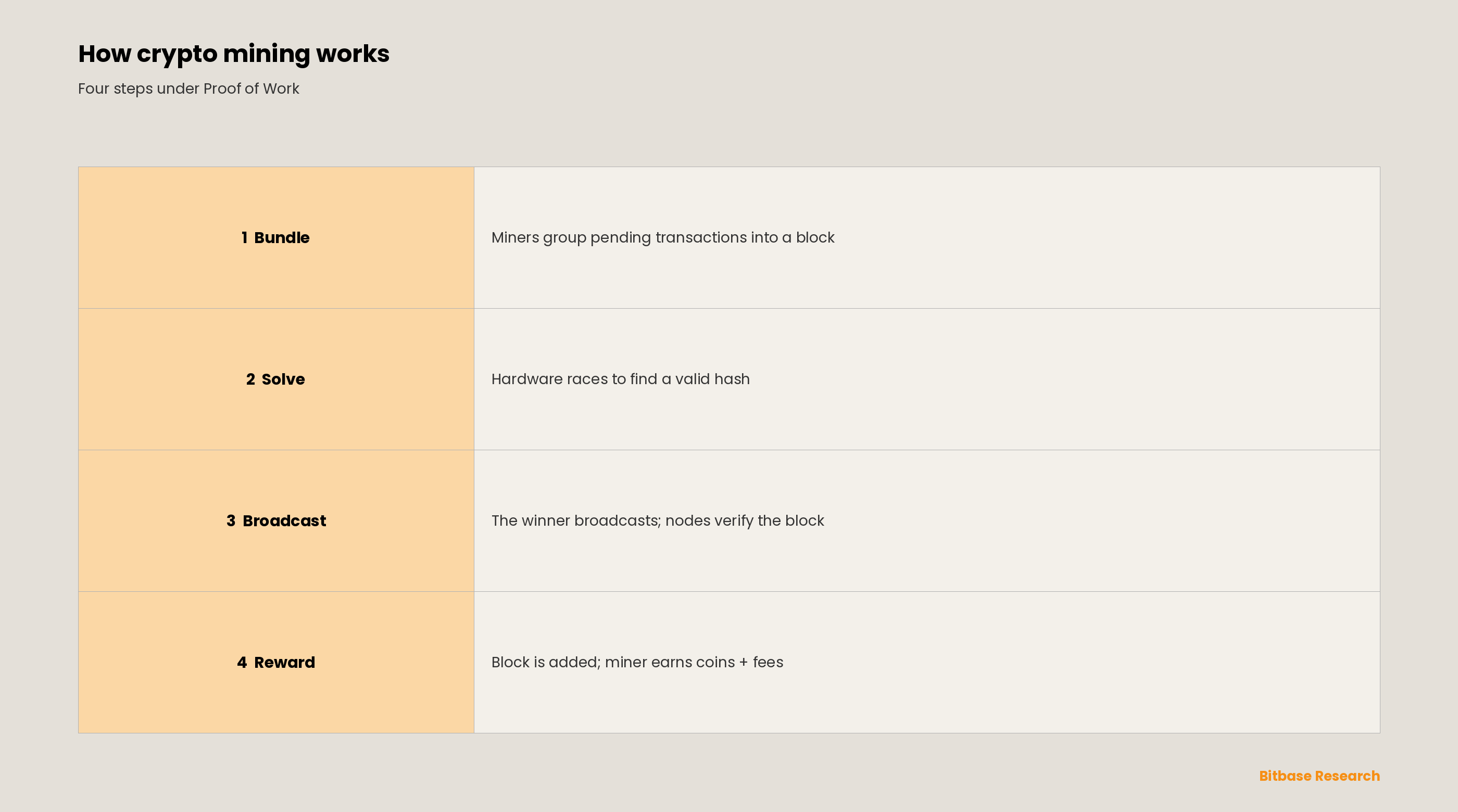
Miners gather pending transactions into a candidate block, then race to find a number (a "hash") that meets the network's difficulty target. Finding it takes enormous trial-and-error computation. The first to succeed broadcasts the block; other nodes verify it, add it to the chain, and the winner earns the block reward plus transaction fees [2].
How mining works, step by step
Costs and trade-offs
Mining consumes significant electricity and specialized hardware, which is why it is energy-intensive and increasingly industrial. That cost is also the source of its security: rewriting history would mean redoing all of that work. Proof of Stake is an alternative that secures networks without mining.
The bottom line
Mining is the engine behind Proof-of-Work crypto: it verifies transactions, secures the chain, and issues new coins. Knowing how it works clarifies why Bitcoin is described as "secured by energy." To keep learning the fundamentals, follow more from Bitbase Academy.
Disclaimer: This article is educational content from Bitbase Academy, provided for information only. It does not constitute investment, trading, tax, or financial advice. Mining involves hardware, electricity, and local-regulation costs, and returns are uncertain. Written as of June 2026; refer to the latest official information.
References
[1] Fidelity, "What is crypto mining?" fidelity.com
[2] Kaspersky, "What is Crypto Mining & How Does it Work?" kaspersky.com