Uncle blocks and orphan blocks are two names for the same basic situation: a valid block that got mined but did not make it into the main chain. What differs is how each network treats such a block. Here is what an orphan or stale block is, what an uncle block was on Ethereum, and why uncles disappeared after the Merge.
Both are blocks that lost
When two producers create a valid block at nearly the same height, only one can stay in the canonical chain; the other is left out. Both blocks were legitimate — they followed the rules and cost real work — but the network can keep only one at each height. The leftover block is the shared idea behind “orphan,” “stale,” and “uncle.” The difference is purely in what each protocol does with it afterwards.
Orphan or stale (Bitcoin)
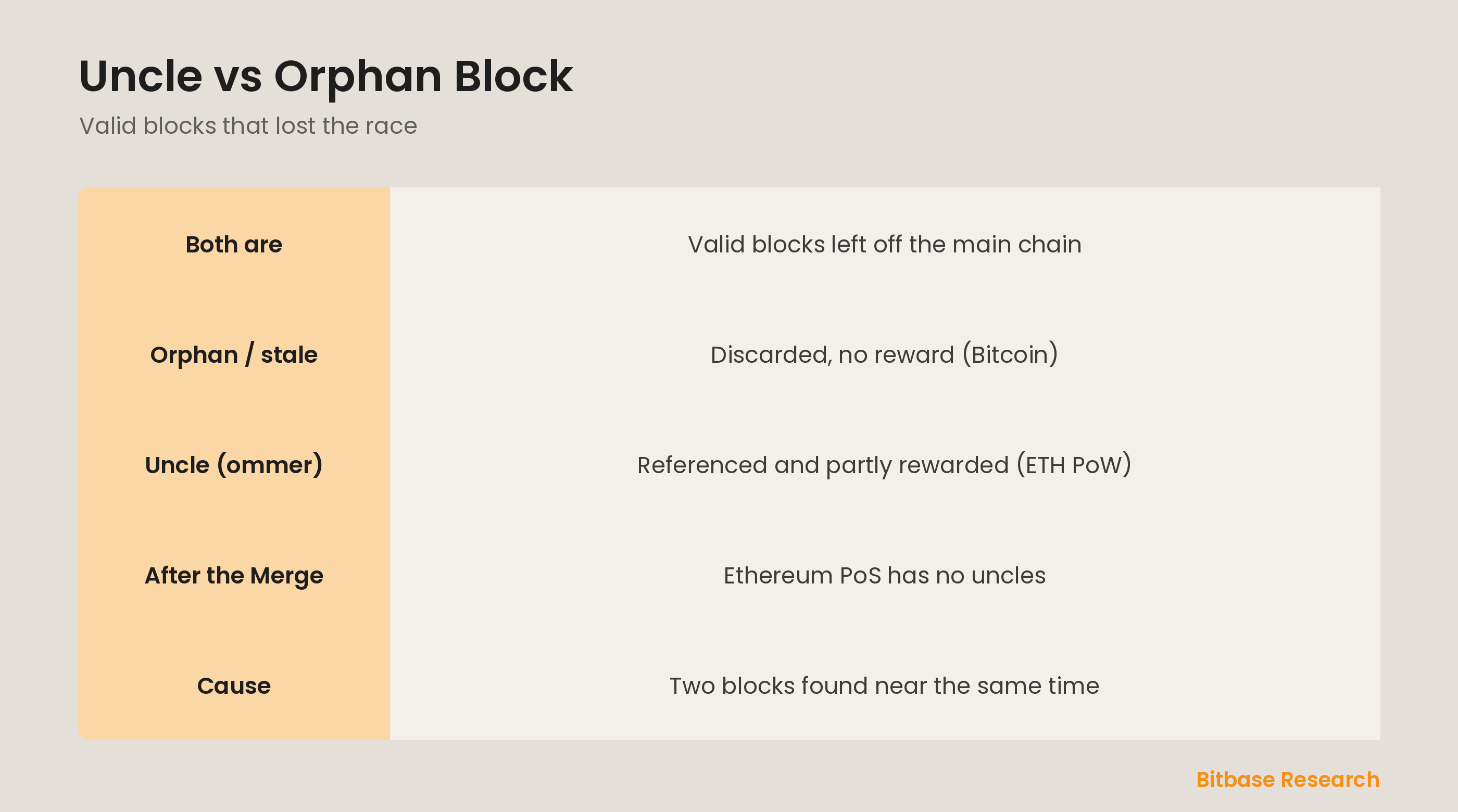
On Bitcoin, a block that loses this race is simply discarded. It is often called an orphan or stale block, and the miner who found it receives no reward — all that electricity produced a block the chain will not keep. Strictly, an “orphan” once meant a block whose parent a node had not yet seen, but in everyday use it names any valid block that ended up off the main chain and earns nothing.
Uncle block (Ethereum's old way)
Ethereum, while it used proof of work, handled these leftovers differently. A stale block could be referenced by a later block as an “uncle” (formally an ommer) if it was recent enough — within a few blocks — and its miner still received a partial reward. The point was fairness and security: fast blocks caused many stale blocks, and rewarding them reduced the advantage of large, well-connected miners and discouraged centralization.
After the Merge
This is the key update: uncles were a proof-of-work feature, and Ethereum no longer has them. When Ethereum switched to proof of stake in the 2022 Merge, the uncle mechanism was removed at the protocol level, and a valid block's list of ommers must now be empty. Proof-of-stake block production does not create the same racing forks, so there is nothing to reward. Uncle blocks are now a piece of Ethereum's history, not its present.
The bottom line
Orphan and uncle blocks both describe a valid block that lost its slot in the chain; the split is in the reward. Bitcoin discards the loser with nothing, while Ethereum's old proof-of-work system paid a partial “uncle” reward to keep mining fair — a mechanism that ended with the move to proof of stake. If you see “uncle block” today, it almost always refers to Ethereum before the Merge. To keep learning the fundamentals, follow more from Bitbase Academy.
Disclaimer: This article is educational content from Bitbase Academy, provided for information only. It does not constitute investment, trading, tax, or financial advice. Crypto assets are volatile; assess your own risk. Written as of June 2026; refer to the latest official information.
References
[1] Ethereum.org, "The Merge" ethereum.org
[2] Investopedia, "Orphan Block: What It Is and How It Works" investopedia.com
[3] Ethereum.org, "Blocks" ethereum.org