Burning shrinks a token's supply — emissions do the opposite. Every new token created dilutes the ones already out there, and how fast that happens is one of the most important and most overlooked parts of tokenomics. Understanding emissions tells you whether a token is being quietly inflated away.
What emissions are
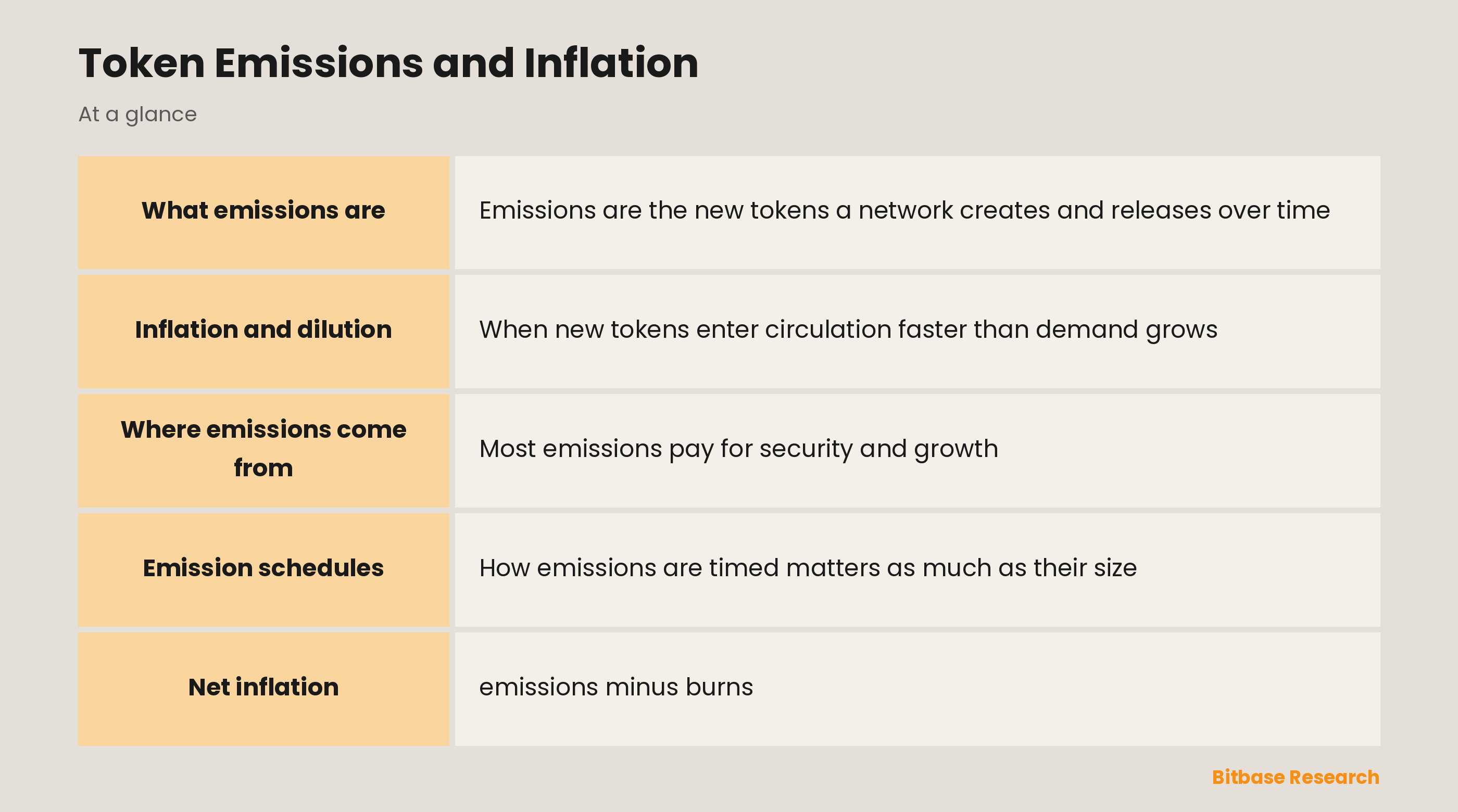
Emissions are the new tokens a network creates and releases over time, a little like a central bank printing money. They fund things a project needs: rewards for miners or validators, incentives for liquidity providers, and payouts to users. Every emission increases the circulating supply, so the same demand is now spread across more tokens.
Inflation and dilution
When new tokens enter circulation faster than demand grows, the result is inflation: each token represents a smaller slice of the whole. This is dilution — your holdings stay the same in number but shrink as a share of total supply. A token can have a great story and still bleed value if its emissions quietly flood the market year after year.
Where emissions come from
Most emissions pay for security and growth. Proof-of-stake networks issue new tokens as staking rewards to validators; DeFi protocols emit governance tokens to attract liquidity; and many projects release tokens on a schedule to fund development. None of this is inherently bad — emissions can bootstrap a network — but someone always pays for them through dilution.
Emission schedules
How emissions are timed matters as much as their size. Some tokens follow a fixed, decreasing schedule, like Bitcoin's halvings, which cut new issuance roughly every four years toward a hard cap. Others emit at a steady rate indefinitely, and some have no cap at all. A clear schedule that is front-loaded and slows over time is generally healthier than an endless, high-inflation drip.
Net inflation: emissions minus burns
The number that actually matters is net supply change — emissions minus any burns. A token issuing 5 percent new supply a year while burning 1 percent is inflating at roughly 4 percent; one that burns more than it issues is net deflationary. Headlines love to trumpet burns, but you have to weigh them against emissions to know which way supply is really moving.
The bottom line
Emissions are how networks pay for security and growth, but they dilute existing holders and can quietly erode a token's value if they outrun demand. Always look past the price to the emission schedule: how much new supply is coming, for how long, and whether burns offset it. A token's inflation rate is often a better guide to its future than any promise in the whitepaper.
Disclaimer: This article is educational content from Bitbase Academy, provided for informational purposes only. It is not investment, trading, tax, or financial advice. Written as of July 2026; rely on the latest official information.
References
[1] CoinGecko, "Token emission schedules explained" coingecko.com
[2] Messari, "Understanding token supply and inflation" messari.io