Listing gets the headlines, but delisting — when an exchange removes a token from trading — can quietly cost holders dearly. Knowing why it happens, what it does to your funds, and how to react is a piece of risk management most beginners never learn until it is too late.
What delisting means
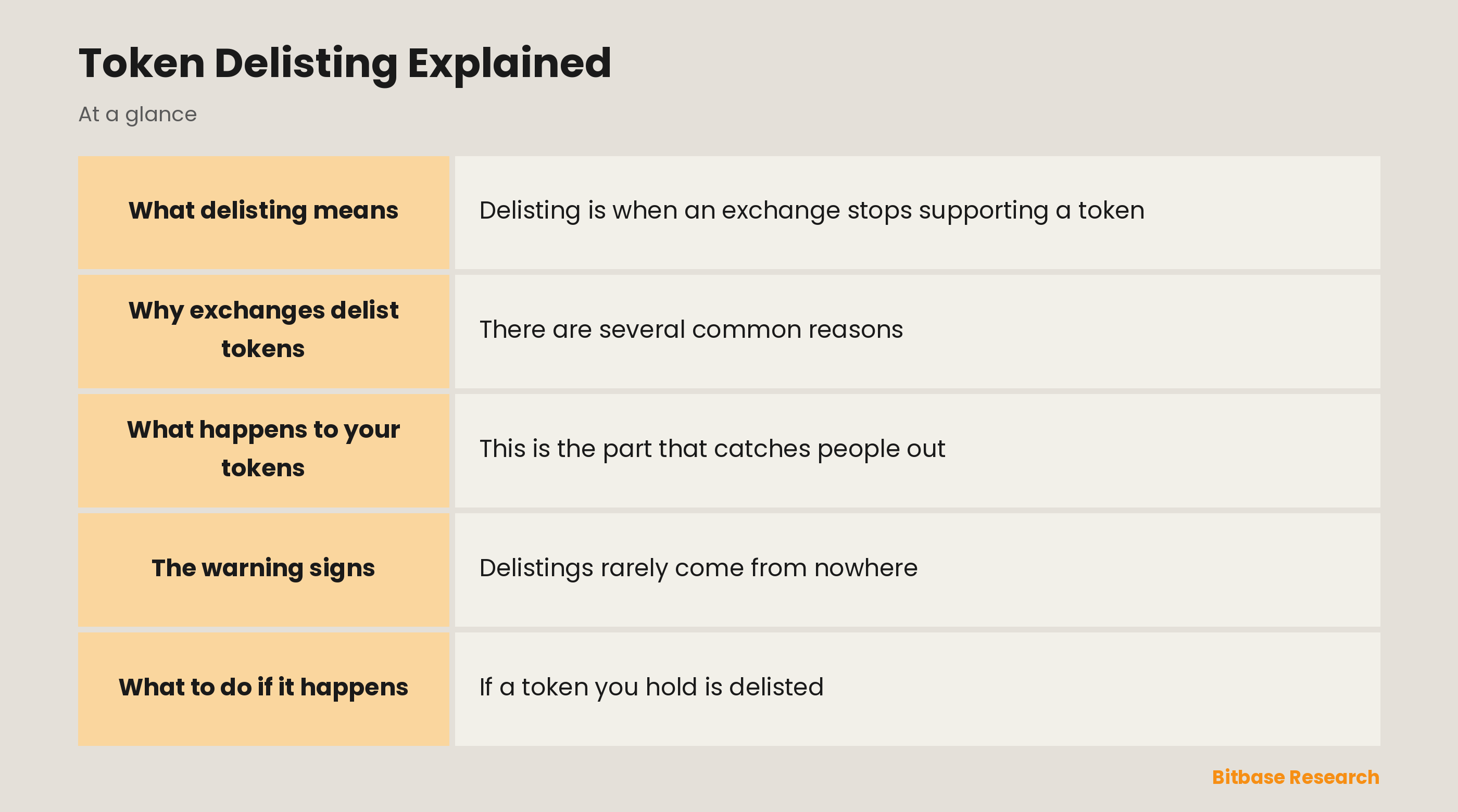
Delisting is when an exchange stops supporting a token: you can no longer trade it there, and eventually you may not be able to deposit or withdraw it either. The token itself still exists on its blockchain, but that particular exchange has closed the door on it. A delisting can be limited to one trading pair or remove the token entirely.
Why exchanges delist tokens
There are several common reasons. A token may be delisted for persistently low trading volume and liquidity, for failing to meet ongoing listing standards, for regulatory or legal concerns, for security problems, or because the project behind it has gone quiet or turned out to be a scam. Delisting is often the exchange protecting its users — but it can also simply reflect a project that has faded.
What happens to your tokens
This is the part that catches people out. When a token is delisted, the exchange typically gives notice and a window to sell or withdraw before trading and then withdrawals close. If you miss that window, your tokens can become stuck on the exchange or, at best, require a slow manual recovery. The blockchain still holds your balance if you self-custody, but on an exchange, timing matters enormously.
The warning signs
Delistings rarely come from nowhere. Falling volume, a project that stops shipping updates, missed communications, regulatory news, or a "monitoring" or warning tag applied by the exchange are all signals that a token may be at risk. Exchanges usually publish delisting notices in advance; following your exchange's announcements is the simplest way to never be caught off guard.
What to do if it happens
If a token you hold is delisted, act within the announced window: either sell it, or withdraw it to a self-custody wallet where you control it regardless of any exchange. If you still believe in the project, self-custody keeps your tokens usable on-chain and tradable elsewhere. The one thing you should not do is ignore the notice and hope it resolves itself.
The bottom line
Delisting is the quiet counterpart to listing: a token being removed for low volume, compliance, failure, or risk, with a limited window before your access closes. It is a reminder that holding on an exchange is a convenience, not a guarantee. Watch for warning tags, read delisting notices promptly, and when in doubt, move tokens you want to keep into your own custody.
Disclaimer: This article is educational content from Bitbase Academy, provided for informational purposes only. It is not investment, trading, tax, or financial advice. Written as of July 2026; rely on the latest official information.
References
[1] CoinDesk, "What happens when a token is delisted" coindesk.com
[2] KuCoin, "Token delisting explained" kucoin.com