
Before a token even lists, people are already trading it — and arguing over what it should be worth. Pre-market trading and launch valuation are where some of the biggest gains and worst losses in crypto are set, often at prices with little to anchor them. Here is how to read them.
What pre-market trading is
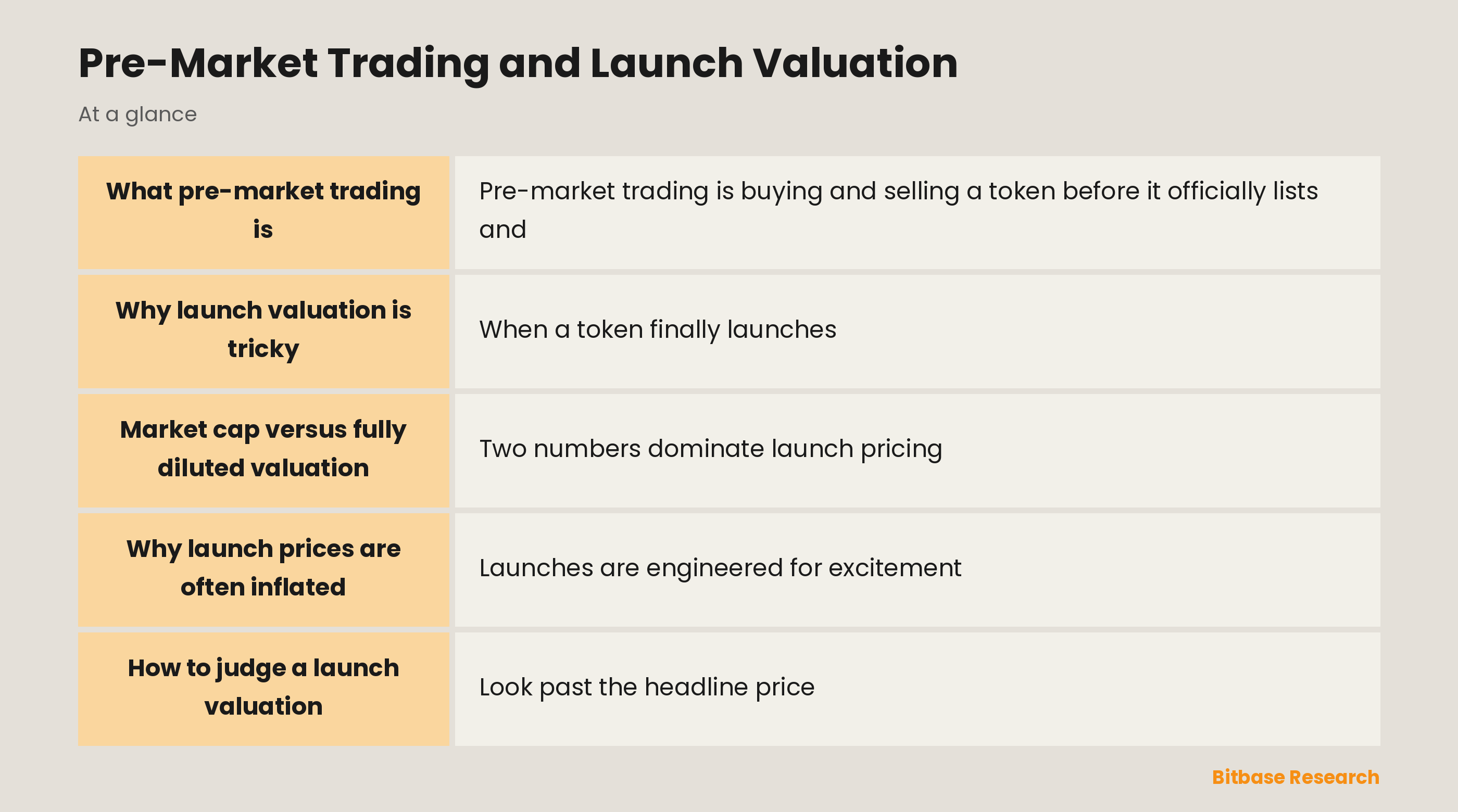
Pre-market trading is buying and selling a token before it officially lists and can be traded normally. It happens through over-the-counter deals, points systems, or dedicated pre-market venues on some exchanges, letting early buyers speculate on a token that does not fully exist yet. Prices here are thin and volatile, driven more by hype and expectation than by any real market.
Why launch valuation is tricky
When a token finally launches, the market has to price something with almost no trading history. Early valuation is often set by the project and its backers, seeded by private-sale prices and marketing rather than open demand. This means a launch price can be an anchor someone chose, not a value the market discovered — a crucial difference for anyone buying in.
Market cap versus fully diluted valuation
Two numbers dominate launch pricing, and confusing them is costly. Market cap counts only the tokens circulating now; fully diluted valuation, or FDV, values every token that will ever exist as if it were already out. A token can look cheap by market cap while its FDV is enormous, because most of the supply is locked and waiting to be released. Low float and high FDV is one of the most common traps at launch.
Why launch prices are often inflated
Launches are engineered for excitement. A small circulating supply, heavy marketing, and a wave of buyers who fear missing out can push the opening price far above what the fundamentals justify. Insiders and early investors who bought far cheaper are often ready to sell into that enthusiasm, which is why many tokens peak near launch and drift down as locked supply unlocks.
How to judge a launch valuation
Look past the headline price. Check the FDV, not just market cap; find out how much supply is locked and when it unlocks; and compare the valuation to real usage or revenue, if any exists. Ask who is selling to you at this price and what they paid. A launch valuation that only makes sense if everything goes perfectly is a valuation to be very careful with.
The bottom line
Pre-market trading and launch valuation are the wild, thinly-priced opening act of a token's public life, where hype, private-sale anchors, and low float can set prices far from fundamentals. Understanding FDV, unlock schedules, and who is selling into the launch is what separates informed early buyers from exit liquidity. Treat launch-day prices as a starting negotiation, not a settled truth.
Disclaimer: This article is educational content from Bitbase Academy, provided for informational purposes only. It is not investment, trading, tax, or financial advice. Written as of July 2026; rely on the latest official information.
References
[1] CoinGecko, "Market cap vs fully diluted valuation" coingecko.com
[2] Token Terminal, "Valuing crypto: FDV, revenue and multiples" tokenterminal.com