When a blockchain gets busy, fees spike and transactions crawl — that is congestion. The flip side is throughput: how many transactions a network can handle per second. These two ideas explain most of what you feel as a user, from a cheap instant transfer to a stuck one that costs a fortune.
What throughput means
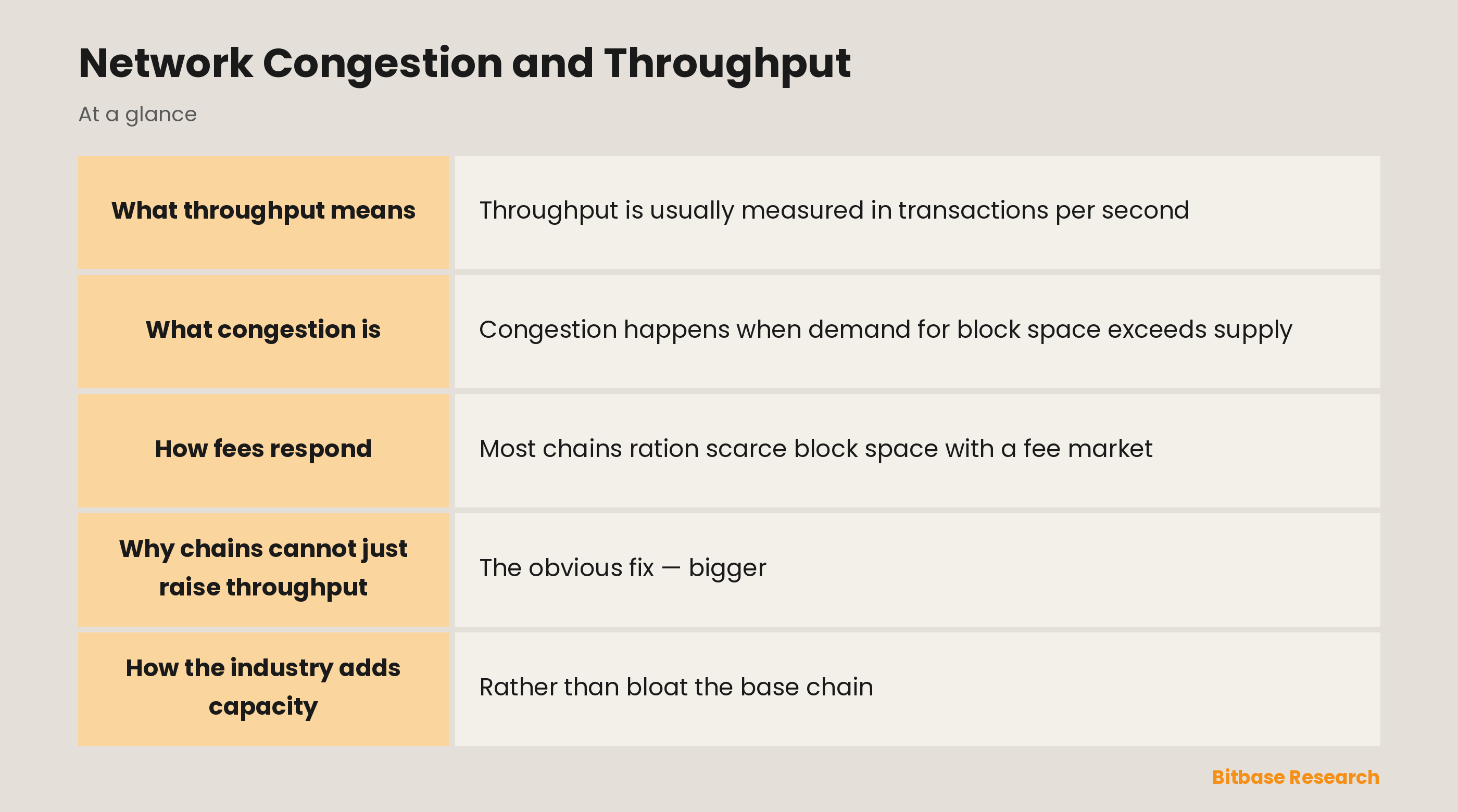
Throughput is usually measured in transactions per second, or TPS — the rate at which a network can confirm transactions. A chain's TPS is capped by how much data fits in a block and how often blocks are produced. Bitcoin handles only a handful of transactions per second by design; Ethereum's base layer does a few dozen; some newer chains claim thousands. Higher TPS means more room, but the number alone never tells the full story.
What congestion is
Congestion happens when demand for block space exceeds supply. Pending transactions pile up in a waiting area called the mempool, and because block space is limited, they cannot all be included at once. It is the blockchain version of rush-hour traffic: the road has a fixed number of lanes, and when too many cars arrive, everyone slows down.
How fees respond
Most chains ration scarce block space with a fee market: users attach a fee, and block producers include the highest bidders first. When the network is congested, users raise their fees to jump the queue, so costs climb exactly when everyone wants in. This is why a transfer that costs cents on a quiet day can cost far more during a popular launch or a market panic.
Why chains cannot just raise throughput
The obvious fix — bigger, faster blocks — has a catch. Every extra bit of throughput asks each node to store and process more, which makes running a node harder and hands the network to a few powerful machines. That is the scalability trilemma: pushing hard on scale tends to cost either decentralization or security. Raw TPS numbers often quietly trade one of those away.
How the industry adds capacity
Rather than bloat the base chain, Ethereum pushes activity onto rollups and gives them cheap data space through blobs, multiplying capacity without overloading every node. Other designs chase high throughput with powerful hardware and parallel execution, accepting heavier node requirements. Both are real answers to congestion; they just place the trade-off in different spots.
The bottom line
Throughput is a network's capacity, and congestion is what happens when demand outruns it — with fees as the pressure gauge in between. A high TPS headline is meaningless without asking what it cost in decentralization or security. When you weigh a chain, look at how it stays cheap under load, not just how fast it runs when empty.
Disclaimer: This article is educational content from Bitbase Academy, provided for informational purposes only. It is not investment, trading, tax, or financial advice. Written as of July 2026; rely on the latest official information.
References
[1] Chainlink, "Blockchain Scalability: The Trilemma" chain.link
[2] Hacken, "Impact of EIP-4844 on Ethereum" hacken.io