What if a wallet had no single private key to steal — one that could be split among several parties so no one alone could sign, yet together they could? That is the idea behind MPC and threshold wallets, a technology reshaping how exchanges and institutions secure billions. Here is how it works.
The single-key problem
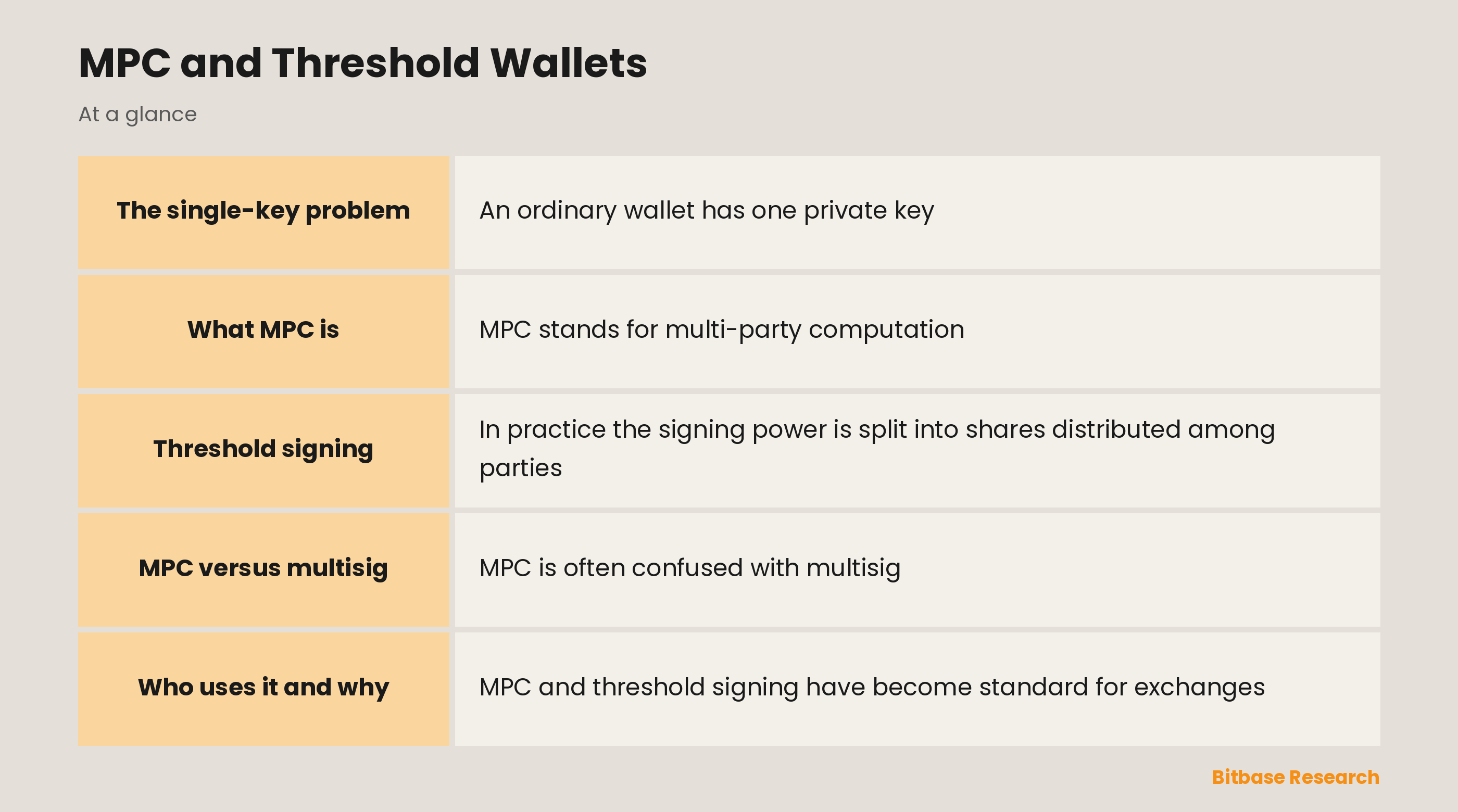
An ordinary wallet has one private key, and that key is a single point of failure. Whoever obtains it controls the funds completely, whether through a hack, a leaked backup, or a stolen device. For an individual this is a manageable risk, but for an exchange holding billions, a single stealable secret is an unacceptable target — so a different approach was needed.
What MPC is
MPC stands for multi-party computation, a branch of cryptography that lets several parties jointly compute a result without any of them revealing their private input. Applied to wallets, it lets multiple parties cooperate to produce a valid signature while none of them ever holds the complete private key. The key, in its full form, simply never exists in one place — not even for an instant.
Threshold signing
In practice the signing power is split into shares distributed among parties, and a threshold defines how many are needed to sign. A "two-of-three" setup, for example, means any two of three shareholders can jointly authorize a transaction, but no single share can. Because a valid signature only forms when the threshold cooperates, and the full key is never assembled, there is no single secret an attacker can grab.
MPC versus multisig
MPC is often confused with multisig, but they work differently. A multisig wallet uses several distinct on-chain keys and records the multiple approvals on the blockchain, which ties it to a specific chain's features. MPC produces a single ordinary-looking signature from a split key using off-chain math, so it works across any chain, keeps the arrangement private, and often costs less in fees.
Who uses it and why
MPC and threshold signing have become standard for exchanges, custodians, and institutions that cannot risk one stolen key, often through providers that add policy controls on who can approve what. The same technology now reaches consumers too, powering "keyless" wallets that split your key between your device and a service, enabling recovery without a traditional seed phrase. Convenience and security both improve — but you rely on the provider's design.
The bottom line
MPC and threshold wallets remove the single stealable private key by splitting signing power across multiple parties, so funds stay safe even if one share is compromised. It is powerful protection for institutions and increasingly for everyday users, but it shifts your trust to the implementation and the parties involved. As always, understand exactly who holds what before trusting any wallet with your money.
Disclaimer: This article is educational content from Bitbase Academy, provided for informational purposes only. It is not investment, trading, tax, or financial advice. Written as of July 2026; rely on the latest official information.
References
[1] Fireblocks, "What is MPC and MPC wallets" fireblocks.com
[2] Zengo, "MPC wallets and keyless security" zengo.com