Restaking lets already-staked ETH do a second job: securing other services for extra yield. It is one of the most talked-about ideas in crypto, and one of the riskiest. Knowing how it works and where the danger lies is essential before chasing the returns.
What restaking is
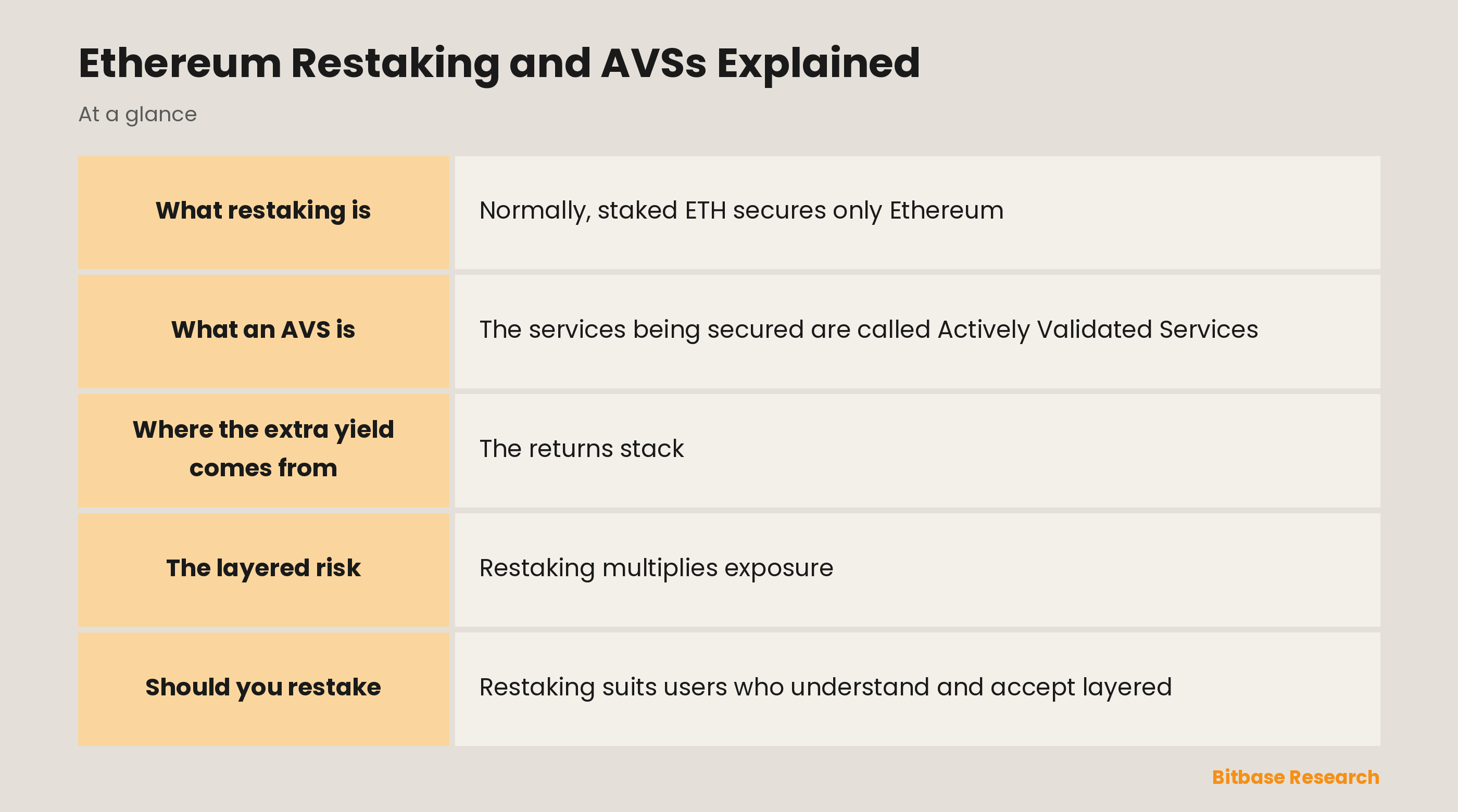
Normally, staked ETH secures only Ethereum. Restaking, pioneered by EigenLayer, lets you take that staked ETH, or a liquid staking token like stETH, and pledge it a second time to help secure additional applications. Your capital backs two things at once, and you earn rewards from both. It reuses Ethereum's security rather than building new security from scratch.
What an AVS is
The services being secured are called Actively Validated Services, or AVSs. These are systems that need their own cryptoeconomic security but do not want to bootstrap a whole validator set: oracle networks, data availability layers, cross-chain bridges, and similar infrastructure. They pay restakers for the security guarantee, and that payment is the extra yield.
Where the extra yield comes from
The returns stack. You keep your base Ethereum staking reward and add fees paid by each AVS you help secure. In enthusiastic markets, yield-stacking figures of 10% to 15% have been quoted. But that number combines several income streams, each with its own risk, so it is not comparable to a plain staking rate.
The layered risk
Restaking multiplies exposure. Your stake can now be slashed not only for Ethereum faults but for failing the rules of every AVS it backs. You also inherit smart-contract risk from the restaking protocol and from the liquid staking token, if you use one. Losses can cascade: one bad AVS or one bug can put capital that is doing several jobs at risk all at once.
Should you restake
Restaking suits users who understand and accept layered, correlated risk in exchange for higher yield. For most people, a plain staking reward with one clear risk is the sounder choice. If you do restake, favor established protocols, spread across AVSs cautiously, and never assume the stacked yield is free; it is payment for taking on more ways to lose.
Disclaimer: This article is educational content from Bitbase Academy, provided for information only. It does not constitute investment, trading, tax, or financial advice. Written as of July 2026; refer to the latest official information.
References
[1] EarnifyHub, "EigenLayer Restaking 2026: Restaking ETH, AVS Rewards" earnifyhub.com
[2] DEXTools, "Ethereum Yield Evolution: Liquid Staking vs Restaking" dextools.io