
DeFi's exchanges do not use traditional order books — they run on pools of assets supplied by ordinary users. Providing that liquidity can earn you fees, but it comes with a strange, often-misunderstood risk called impermanent loss. Understanding both is essential before you deposit into any pool.
What a liquidity pool is
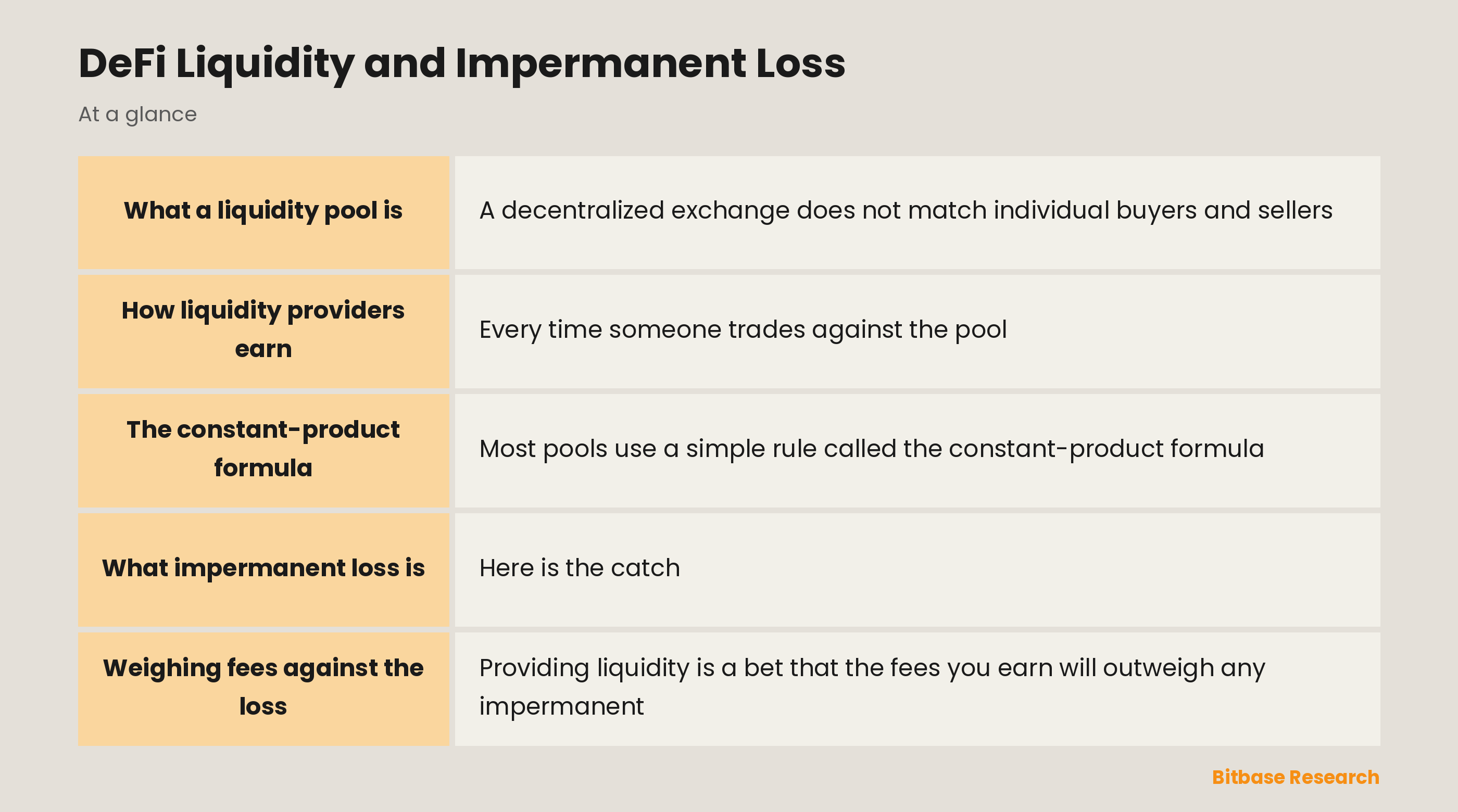
A decentralized exchange does not match individual buyers and sellers. Instead it uses a liquidity pool: a shared pot holding two assets, say ETH and a stablecoin, that traders swap against. The prices are set automatically by a formula, and the pool is filled not by the exchange but by liquidity providers — everyday users who deposit their own assets to make trading possible.
How liquidity providers earn
Every time someone trades against the pool, they pay a small fee, and that fee is shared among the liquidity providers in proportion to their stake in the pool. Supply more of the pool and you earn a bigger slice of its trading fees. On a busy pool, these fees can add up to a meaningful yield — which is why providing liquidity is one of DeFi's core ways to put idle assets to work.
The constant-product formula
Most pools use a simple rule called the constant-product formula, often written as x times y equals k. The two assets' amounts multiplied together must stay constant, so as traders buy one asset the price automatically rises and the other falls. This elegant mechanism, pioneered by Uniswap, means a pool can quote a price for any trade size without ever needing a buyer to match a seller.
What impermanent loss is
Here is the catch. When the two assets' prices move apart, the automatic rebalancing leaves a liquidity provider with less value than if they had simply held the two assets in their wallet. That gap is impermanent loss. It is called "impermanent" because it shrinks if the prices return to their starting ratio — but if you withdraw while prices have diverged, the loss becomes very real and permanent.
Weighing fees against the loss
Providing liquidity is a bet that the fees you earn will outweigh any impermanent loss you suffer. High-volume pools with stable, closely-correlated assets — like two stablecoins — earn steady fees with little divergence, so IL is minimal. Volatile, unequal pairs can generate big fees but also large impermanent loss, and a sharp price move can leave you worse off than if you had done nothing at all.
The bottom line
Liquidity pools power decentralized trading, and providing liquidity earns you a share of real trading fees — but impermanent loss is the hidden cost that can quietly eat those gains when prices swing. Before depositing, understand which pair you are providing, how volatile it is, and whether the fees can realistically outpace the loss. Liquidity provision is genuine yield, not free money.
Disclaimer: This article is educational content from Bitbase Academy, provided for informational purposes only. It is not investment, trading, tax, or financial advice. Written as of July 2026; rely on the latest official information.
References
[1] Uniswap Docs, "Liquidity pools and the constant product formula" uniswap.org
[2] Chainlink, "What is impermanent loss in DeFi" chain.link