
One of the most common and costly misunderstandings in crypto is assuming tax only applies when you cash out to your bank. In many systems, swapping one token for another or spending crypto on a coffee can be just as taxable. Knowing which actions trigger tax, and how gains and income are treated, is essential — though this is general education, not tax advice, and rules vary by country.
What a taxable event is
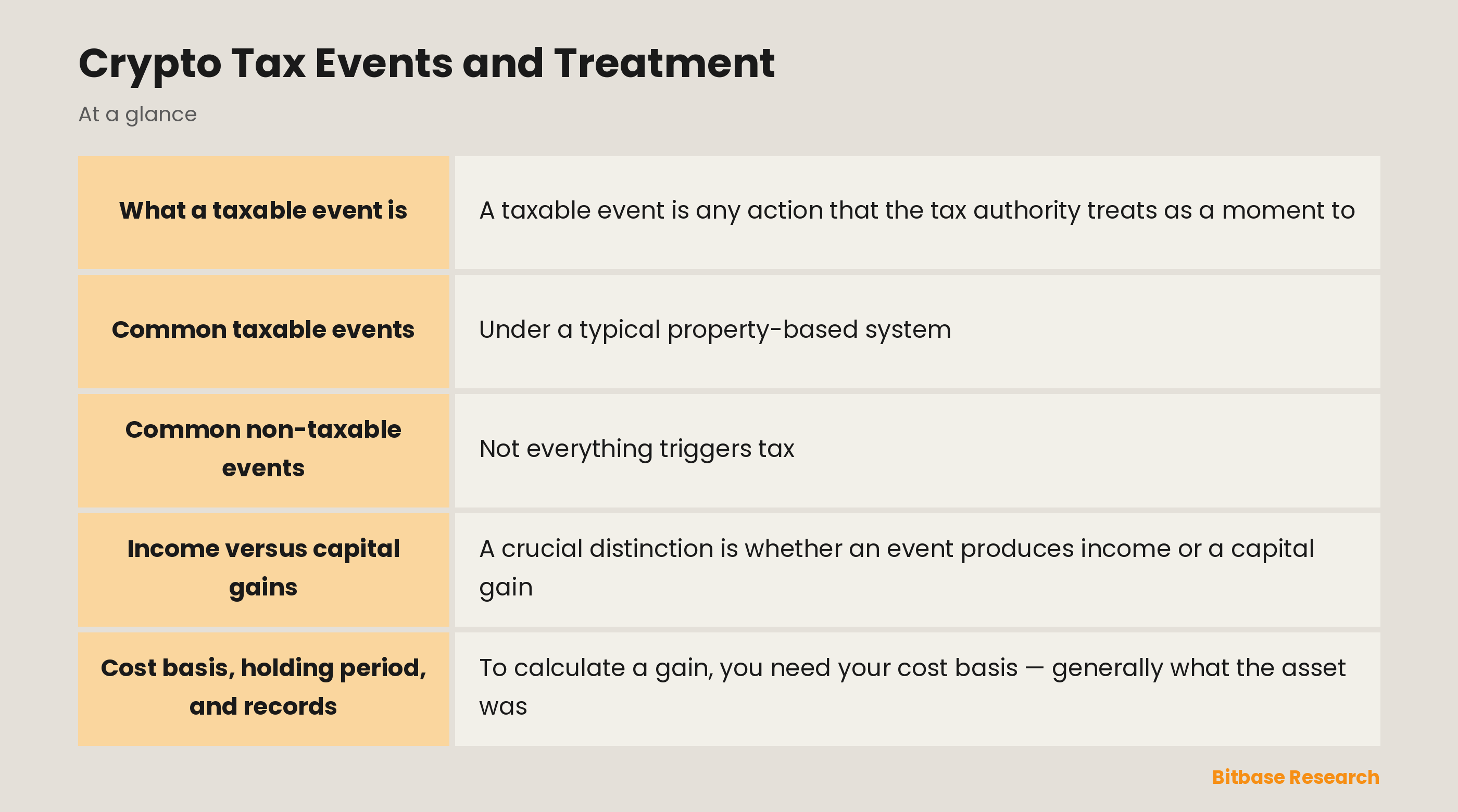
A taxable event is any action that the tax authority treats as a moment to calculate tax. The key insight is that many jurisdictions treat crypto as property, so tax can arise not only when you convert to traditional money but whenever you dispose of a crypto asset in almost any way. Understanding the line between events that trigger tax and those that do not is the foundation of staying compliant, because it determines when you must measure a gain or record income.
Common taxable events
Under a typical property-based system, several everyday actions can be taxable. Selling crypto for fiat currency is the obvious one, but trading one cryptocurrency for another is also frequently a disposal, taxed on any gain even though no traditional money changed hands. Spending crypto to buy goods or services can likewise count as a disposal. And earning crypto — through staking, mining, interest, a salary paid in tokens, or an airdrop — is often taxed as income at the moment you receive it, based on its value then.
Common non-taxable events
Not everything triggers tax, and knowing the exceptions prevents needless worry. In many systems, simply buying crypto with traditional money and holding it is not a taxable event; nothing is owed until you dispose of it. Moving your own crypto between wallets you control is generally not taxable, since ownership has not changed. Depending on the jurisdiction, gifts below certain thresholds or donations may also be treated differently. But these categories vary, so never assume an action is exempt without checking local rules.
Income versus capital gains
A crucial distinction is whether an event produces income or a capital gain, because they are often taxed differently. Crypto you earn is typically income, valued and taxed when received, much like wages. Crypto you already hold and later dispose of produces a capital gain or loss — the difference between its value when you got it and when you let it go. Many events involve both: an airdrop may be income when received, and then produce a separate capital gain or loss when you eventually sell it.
Cost basis, holding period, and records
To calculate a gain, you need your cost basis — generally what the asset was worth when you acquired it — and its value at disposal. The holding period, how long you owned it, can also change the rate you pay in systems that treat long-term and short-term gains differently. All of this depends on accurate records: the date, value, and nature of every acquisition and disposal across every wallet and exchange. Because crypto activity fragments across many places, reliable record-keeping is the practical heart of compliance.
The bottom line
Crypto tax turns on events: disposals like selling, swapping, or spending often trigger capital gains, earning crypto usually triggers income, and simply buying, holding, or moving your own funds usually does not. Gains and income are frequently taxed differently, and accurate cost-basis records are essential to getting it right. Because the specifics differ sharply by country and change over time, use this as a framework for understanding, keep meticulous records, and consult a qualified tax professional for your own situation.
Disclaimer: This article is educational content from Bitbase Academy, provided for informational purposes only. It is not investment, trading, tax, or legal advice, and tax rules vary by country and change over time. Written as of July 2026; rely on the latest official information and consult a qualified tax professional.
References
[1] IRS, "Digital assets" irs.gov
[2] CoinTracker, "Crypto taxable events explained" cointracker.io