
Owning crypto is one thing; owing tax on it is another, and the rules change dramatically depending on where you live. Some countries tax nearly every crypto move, others exempt long-term holders entirely, and reporting is tightening almost everywhere. This is a general overview of how crypto taxation varies internationally — strictly educational, not tax advice, and no substitute for a qualified professional in your jurisdiction.
Why crypto tax differs by country
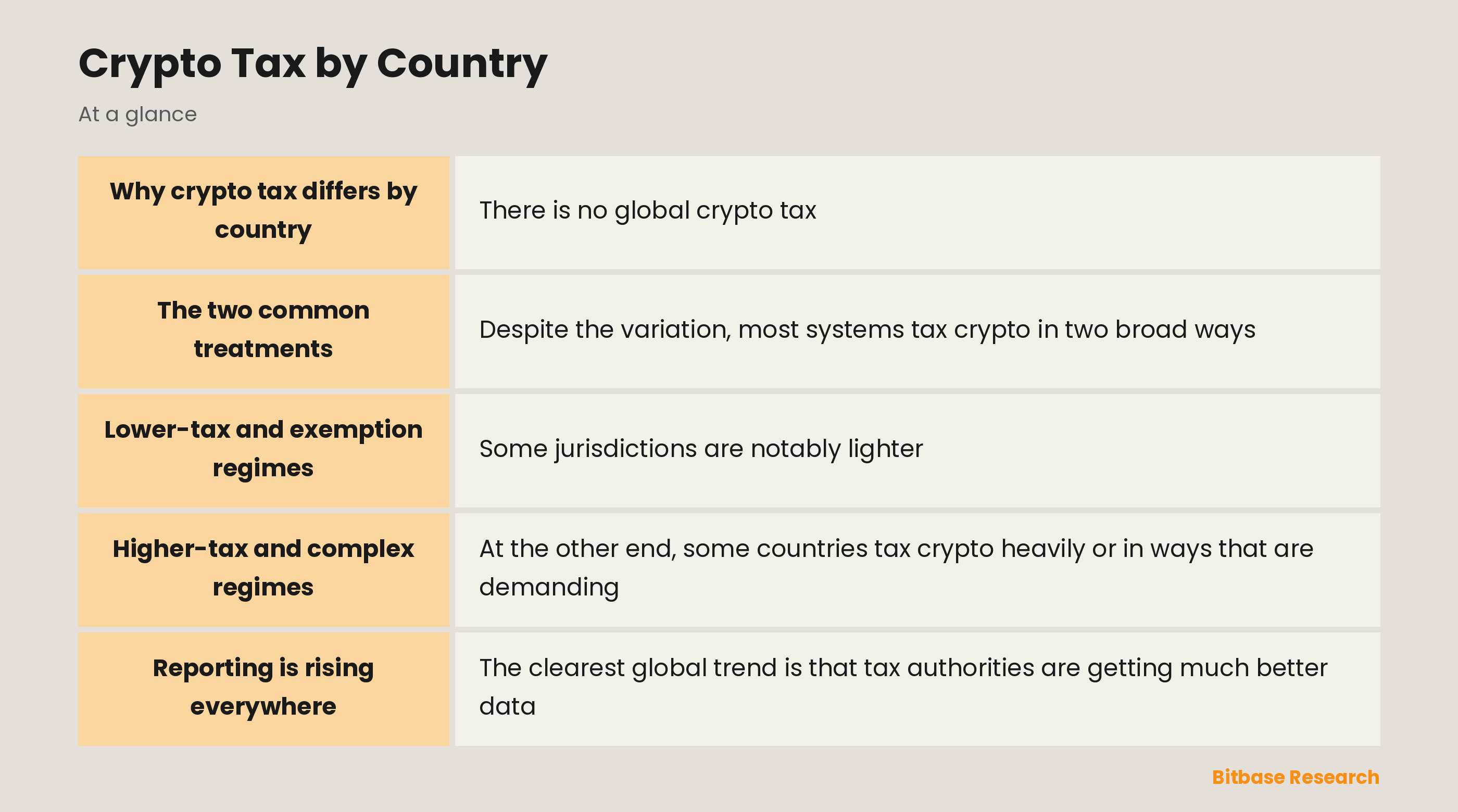
There is no global crypto tax; each country applies its own tax law to a new kind of asset. Governments must decide what crypto even is for tax purposes — property, a currency, an investment, or something new — and that classification drives everything that follows. Combined with different rates, exemptions, and definitions of what counts as income, the outcome is enormous variation. Two people doing the identical trade can face completely different tax bills simply because they live under different systems.
The two common treatments
Despite the variation, most systems tax crypto in two broad ways. The first is a capital gains approach: when you dispose of crypto — selling it, swapping it, or spending it — you may owe tax on the gain since you acquired it, often at rates that depend on how long you held it. The second is income treatment: crypto you earn, such as from staking, mining, or an airdrop, is frequently taxed as ordinary income at the value when you received it. Many countries apply both, at different moments.
Lower-tax and exemption regimes
Some jurisdictions are notably lighter. A number of countries apply no capital gains tax to long-term holdings, so crypto held beyond a set period can be sold tax-free, while short-term trading may still be taxed. Others have historically offered broad exemptions for individual investors or specific carve-outs designed to attract crypto activity. These regimes can look attractive, but they usually come with conditions and can change, so a favourable headline rarely tells the full story of your obligations.
Higher-tax and complex regimes
At the other end, some countries tax crypto heavily or in ways that are demanding to comply with. Every crypto-to-crypto swap may be a taxable event, gains can be taxed at high ordinary-income rates, and even small transactions must be tracked and reported. In these systems the burden is often less about the headline rate and more about record-keeping: reconstructing the cost basis and date of every acquisition and disposal across wallets and exchanges can be genuinely difficult, which is why specialised tools exist.
Reporting is rising everywhere
The clearest global trend is that tax authorities are getting much better data. New rules increasingly require exchanges to report users' transactions directly to tax agencies, similar to how brokers report stock sales, and international agreements are pushing cross-border sharing of crypto account information. The era of assuming crypto is invisible to tax authorities is ending. Whatever your country's rules, the practical reality is that transactions are increasingly traceable and expected to be declared.
The bottom line
Crypto taxation is a patchwork: most countries tax gains on disposal and income when earned, some exempt long-term holdings, others tax aggressively, and reporting is tightening worldwide. Because the rules are country-specific, complex, and changing, nothing here is advice for your situation. Keep detailed records of every transaction, understand your local classification and rates, and consult a qualified tax professional before filing. Treat crypto's tax obligations as seriously as any other part of your finances.
Disclaimer: This article is educational content from Bitbase Academy, provided for informational purposes only. It is not investment, trading, tax, or legal advice, and tax rules vary by country and change over time. Written as of July 2026; rely on the latest official information and consult a qualified tax professional.
References
[1] Koinly, "Crypto tax guide" koinly.io
[2] PwC, "Global crypto tax report" pwc.com