
Ethereum was built for smart contracts; Bitcoin was not. Yet a growing movement — often called BTCfi — is bringing lending, trading, and programmable money to the world's largest crypto asset. Understanding how means understanding both Bitcoin's deliberate limits and the clever ways builders work around them.
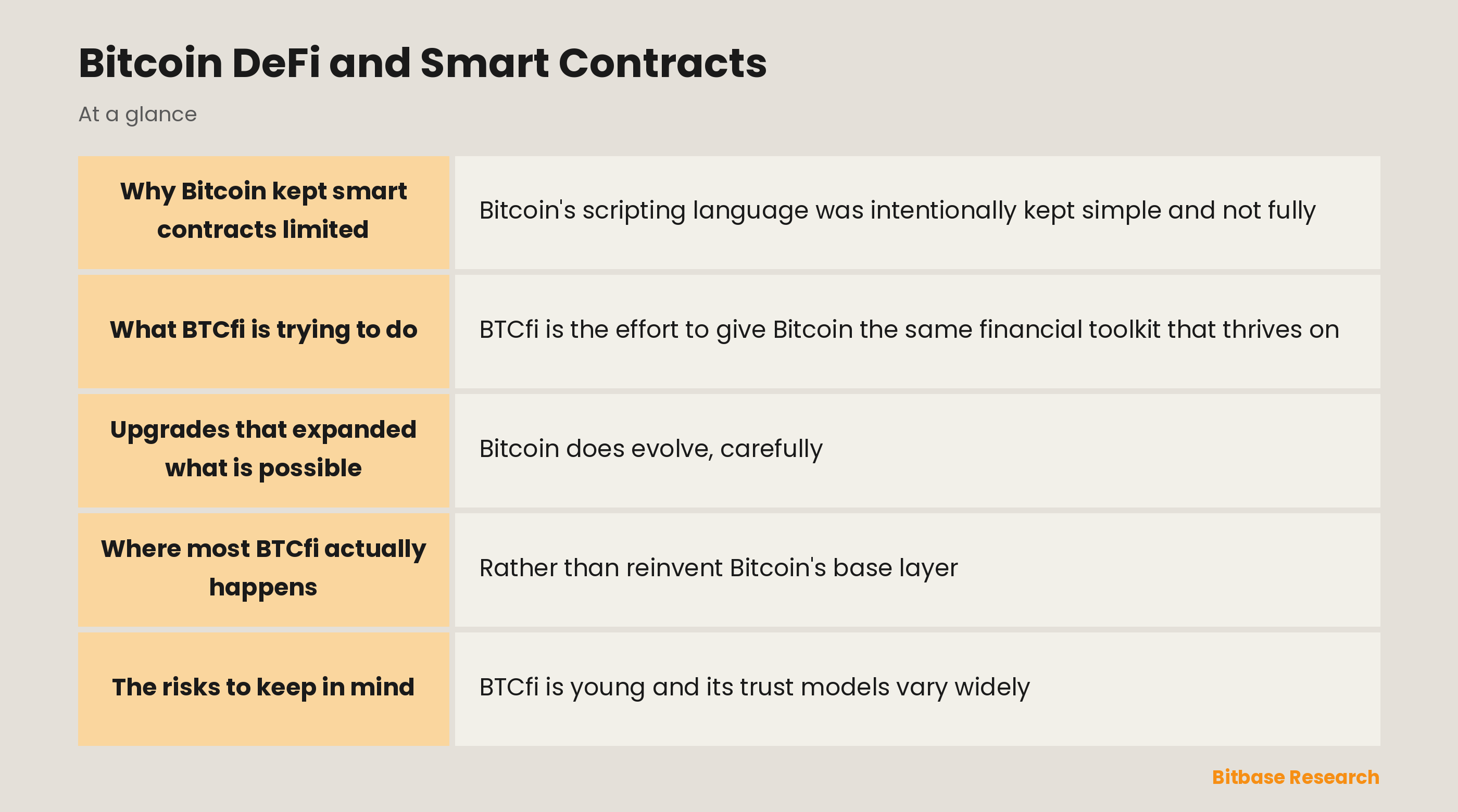
Why Bitcoin kept smart contracts limited
Bitcoin's scripting language was intentionally kept simple and not fully programmable, prizing security and predictability over flexibility. You can set basic spending conditions, but you cannot run the rich, arbitrary programs that power Ethereum's DeFi. That conservatism is a feature — it keeps Bitcoin hard to break — but it long left BTC on the sidelines of decentralized finance.
What BTCfi is trying to do
BTCfi is the effort to give Bitcoin the same financial toolkit that thrives on other chains: lending and borrowing, decentralized exchanges, stablecoins, and yield. The prize is huge, because Bitcoin is by far the largest pool of crypto capital, most of which just sits idle. The challenge is doing this without weakening the very security that makes Bitcoin valuable in the first place.
Upgrades that expanded what is possible
Bitcoin does evolve, carefully. The Taproot upgrade in 2021 made its scripts more capable and private, laying groundwork for more complex conditions. A newer breakthrough called BitVM shows how sophisticated computations can be verified against Bitcoin without changing its core rules, moving from research paper toward early real use. A future "covenant" soft fork, if the community agrees on one, could unlock even more.
Where most BTCfi actually happens
Rather than reinvent Bitcoin's base layer, most BTCfi runs on connected layers. Stacks brings smart contracts written in a language called Clarity, and launched sBTC — a programmable, 1:1 Bitcoin-backed asset — at the end of 2024. Rootstock offers Ethereum-style contracts on a sidechain merge-mined by Bitcoin miners. These layers let BTC flow into apps while anchoring back toward Bitcoin.
The risks to keep in mind
BTCfi is young and its trust models vary widely. Moving BTC into a smart-contract layer usually means relying on a bridge, a federation, or a separate chain's security — not Bitcoin's own. That risk is real: Bitcoin DeFi's total value locked actually shrank sharply during 2026 as enthusiasm cooled and some designs proved fragile. Treat BTCfi as experimental, and understand exactly what secures your coins.
The bottom line
Bitcoin was not designed for DeFi, but upgrades like Taproot and tools like BitVM, plus layers like Stacks and Rootstock, are steadily changing that. The upside — putting the largest crypto asset to work — is enormous, and so is the range of security trade-offs involved. For now, BTCfi is a promising frontier best approached with caution and clear eyes about what you are trusting.
Disclaimer: This article is educational content from Bitbase Academy, provided for informational purposes only. It is not investment, trading, tax, or financial advice. Written as of July 2026; rely on the latest official information.
References
[1] Spark, "BTCFi in 2026: Why Bitcoin DeFi TVL Shrank 74%" spark.money
[2] Nadcab, "Bitcoin Smart Contracts: The Rise of BTC DeFi" nadcab.com