
Publication Date: May 15, 2026
Preface
On May 22, 2010, Laszlo Hanyecz traded 10,000 BTC for two pizzas. The day became known as Bitcoin Pizza Day, commemorated each year by the crypto community in a specific ritual: multiplying the original 10,000 BTC by the current fiat price to produce a striking-contrast figure, framed as "the most expensive pizza in history."
This piece does not do that math.
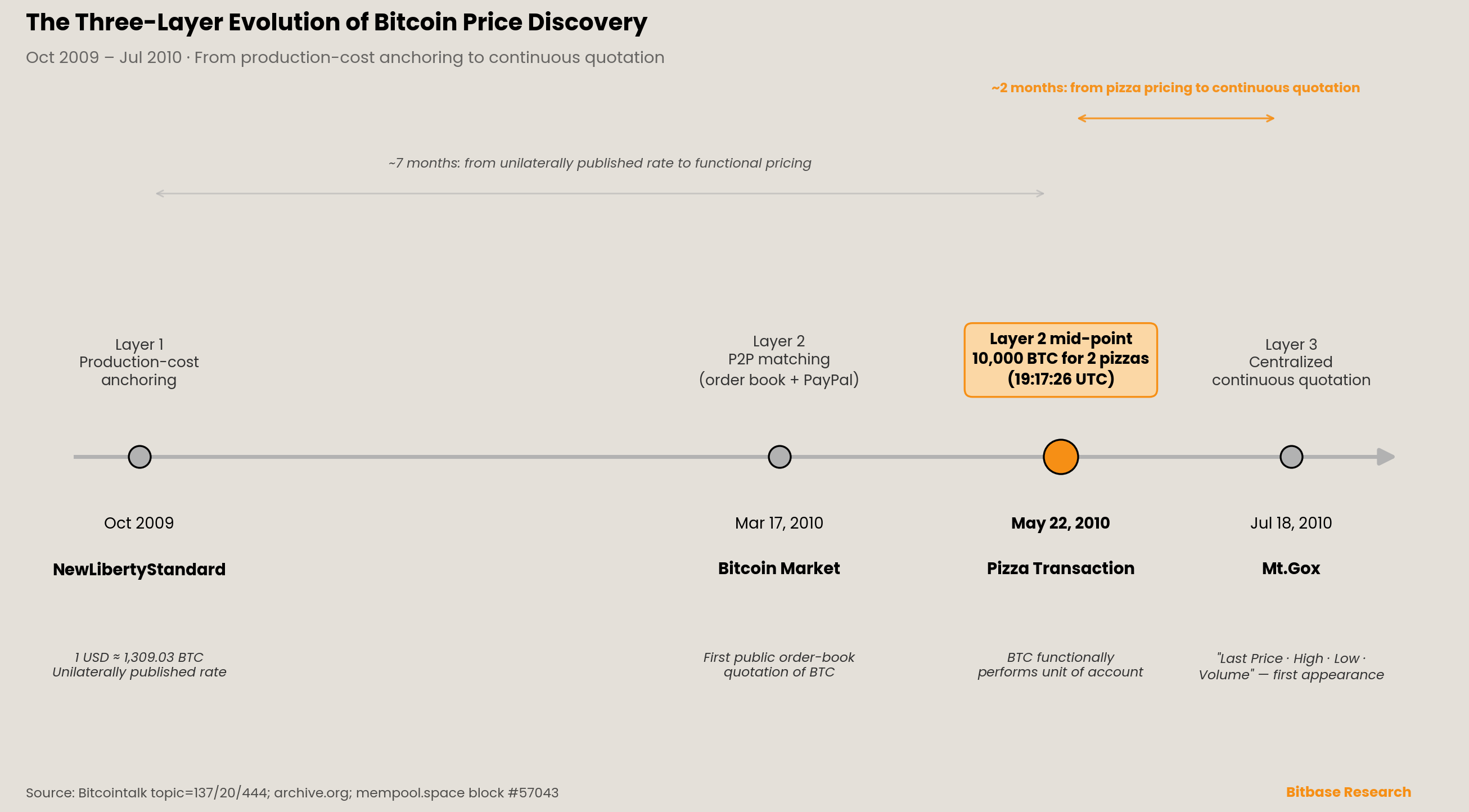
This piece is about something else. On May 22, 2010, bitcoin (BTC) was used—for the first time, in a real transaction—as the unit by which another good was priced. This was the first traceable moment in which BTC functionally took on the role of a unit of account, one of the three monetary functions (medium of exchange, unit of account, store of value). The moment sits at the middle of a longer mechanism timeline: from production-cost anchoring (NewLibertyStandard), to peer-to-peer matching (Bitcoin Market), to centralized continuous quotation (Mt.Gox). Bitbase Research reconstructs this nine-month prehistory, alongside its structural parallels to the price-discovery evolution paths of multiple historical asset classes.
Chapter 1 · What Is "Price"—The Birth of a Unit of Account
1.1 The Three Functions of Money and the Conceptual Boundary of "Price"
Financial economics textbooks give the functions of money a standard definition. In Chapter 3 of The Economics of Money, Banking, and Financial Markets (13th Global Edition), Frederic Mishkin identifies three [1]: medium of exchange, unit of account, and store of value. John Hicks, in the opening of Critical Essays in Monetary Theory (Oxford, 1967), captures it more concisely—"money is what money does." Money, in this reading, is defined by its function, not by its physical form [2].
This distinction carries specific methodological implications. Having an exchange rate is not the same as having a price. An exchange rate can be unilaterally published. A third-party observer can compute and post a conversion ratio between two assets without requiring market participants to settle trades at that ratio, and without requiring others to use it to price their own goods. A price is different. A price is the outcome of market clearing. It requires at least two parties, at a specific moment, to reach a conversion ratio in a specific trade—a ratio that can subsequently be identified, cited, and reused by a third party.
By this distinction, BTC before May 22, 2010 sat in a particular semantic state: it had exchange rates, but it did not have a price in the market sense.
1.2 The Functional Performance of "Unit of Account"
Among the three monetary functions, medium of exchange and unit of account are often conflated in intuition, but the two are not identical. The former describes "using this thing as a transaction intermediary"—as long as both parties agree, almost anything can take on this role. The latter describes "using this thing as the unit by which other goods are priced." A good used as payment in a single transaction has not necessarily taken on the function of pricing that good.
On May 18, 2010, Laszlo Hanyecz posted on Bitcointalk topic=137: "I'll pay 10,000 bitcoins for a couple of pizzas," explicitly authorizing the counterparty to order Papa John's [3]. The entire opening post contains no US dollar (USD) figure. Hanyecz did not say "pizzas worth a certain dollar amount." He said "10,000 bitcoins for two pizzas." When the trade was reported complete at 19:17:26 UTC on May 22 [4], something occurred at the functional layer: two pizzas had been priced in units of "10,000 BTC."
This is the first traceable moment in which BTC took on the function of a unit of account. Functional performance and full satisfaction of the monetary-economics definition are two different things. The latter requires the unit to be used persistently across multiple trader groups as a pricing label—a condition only partially met after Mt.Gox introduced continuous quotation. May 22 is when this function first appeared in a real trade.
Worth noting: the figure "about USD 25" does not appear in the May 18 opening post. Hanyecz first gave this fiat anchor 21 days later, in a follow-up reply on the same thread at 20:14:44 UTC on June 12, 2010 [5]. BTC took on the role of pricing pizzas in a trade first; bilateral semantic anchoring between BTC and USD followed 21 days later. The sequence carries methodological weight: BTC's functional performance as a unit of account preceded the establishment of bilateral labeling between BTC and USD.
Chapter 2 · The Mechanism Timeline
This chapter reconstructs, in chronological order, the three-layer mechanism evolution from October 2009 to July 2010. Each section provides primary-source timestamps, primary-source post IDs, and a description of the mechanism itself.
2.1 Layer One · Production-Cost Anchoring (from October 2009)
NewLibertyStandard (hereafter NLS) published a BTC-to-USD exchange-rate formula on its own page, newlibertystandard.wetpaint.com, in October 2009. The site has since gone offline. As of May 14, 2026, the earliest archive.org capture on record is the Wayback snapshot timestamped 2009-12-29 13:26:10 UTC [6].
The formula anchors BTC value to the marginal production cost of running a mining rig—electricity cost divided by BTC output per unit time. It is, in essence, the classical labor-energy theory of value extended into digital assets: BTC had no market and was priced by the electricity meter. This is a "unilaterally published exchange rate," not a market-cleared price.
The first published NLS rate of 1 USD ≈ 1,309.03 BTC has been widely reused in secondary accounts, yet no original post by NLS publishing this figure exists on the Bitcointalk forum [7]. This research adopts the data from the archive snapshot and notes plainly that, as of May 14, 2026, this specific figure can be primary-sourced only from that snapshot.
Outside NLS, the earliest BTC-to-USD transaction on record was executed by Bitcoin's early core contributor Martti Malmi. On October 12, 2009, Malmi transferred 5,050 BTC to NLS and received USD 5.02 via PayPal, confirming the trade in a tweet on January 15, 2014 [8].
2.2 Layer Two · Peer-to-Peer Matching (from March 2010)
The second-layer mechanism was initiated by dwdollar (real name Dustin Dollar). At 09:42:18 UTC on January 15, 2010, dwdollar filed the motion in Bitcointalk topic=20 msg=100 [9]: "I'm in the process of building an exchange. … It will be a real market where people will be able to buy and sell Bitcoins with each other."
The platform Bitcoin Market went live on March 17, 2010. dwdollar's update post that day reads: "Looks like we had our first real trade around noon!" This was the first BTC-to-USD trade matched through a quasi-public order book.
Bitcoin Market's matching mechanism warrants accurate description: it was not a complete order-book system. dwdollar described it himself in msg=265 at 22:37:44 UTC on February 6, 2010 [10]: "ONLY the limit orders work. Market orders will come later." The platform supported limit orders only; market orders were not implemented. Settlement relied on PayPal as intermediary, not pure on-chain clearing. Even so, Bitcoin Market was the first platform to publicly display BTC quotations in order-book form, and the format itself carries mechanism significance.
Running parallel to Bitcoin Market during the same period was peer-to-peer physical matching on Bitcointalk. Hanyecz's pizza event is the representative case of this format. The two paths coexisted between March and July 2010. The dwdollar path proved BTC could be matched against USD into a quotation; the Hanyecz path proved BTC could be matched against physical goods into a quotation.
2.3 Middle Point · The Pizza Transaction (May 22, 2010)
The pizza transaction sits at the middle of Layer Two on the mechanism timeline. Reconstructed in UTC chronological order:
-
2010-05-18 00:35:20 UTC: Hanyecz opened the offer in Bitcointalk topic=137 msg=1141 [3]. Hanyecz was then in Jacksonville, Florida (EDT, UTC−4), corresponding to local time 2010-05-17 20:35. The time-zone conversion explains why some secondary accounts record the opening date as May 17.
-
2010-05-22 18:16:31 UTC: txid a1075db55d416d3ca199f55b6084e2115b9345e16c5cf302fc80e9d5fbf5d48d was packaged into block #57043 [11].
-
2010-05-22 19:17:26 UTC: Hanyecz reported completion in msg=1195—"I just want to report that I successfully traded 10,000 bitcoins for pizza. Thanks jercos!" [4]
The on-chain block time and the Bitcointalk confirmation post differ by about 61 minutes, consistent with a "post-confirmation after pizza delivery" narrative. The time difference also independently confirms that the timestamps shown by the Bitcointalk forum to anonymous visitors are in UTC, not US Eastern Time.
The identity and location of the counterparty jercos are frequently misstated in secondary accounts. jercos is Jeremy Sturdivant. In a written interview with Bitcoin Who's Who on January 30, 2016, Sturdivant stated [12]: "I have yet to travel outside of the US, and am living on the west coast, near Santa Cruz, California." By his own account, Sturdivant is American, lives near Santa Cruz, California, was 19 years old on May 22, 2010, and has never left the United States. The "19-year-old British man" description circulating online does not match the primary record.
Hanyecz withdrew the open offer at 17:51:05 UTC on June 4, 2010 [13], citing that "any more would be unaffordable." Eight days later, on June 12, he reopened the offer in msg=1526 and gave the USD anchor for the first time: two pizzas at about USD 25, possibly USD 30 with tip [5].
2.4 Layer Three · Centralized Continuous Quotation (from July 2010)
At 01:57:19 UTC on July 18, 2010, the username mtgox posted in Bitcointalk topic=444 msg=3866: "Hi Everyone, I just put up a new bitcoin exchange." [14] The operator behind this account was Jed McCaleb, founder of eDonkey and the original holder of the mtgox.com domain (an acronym for Magic: The Gathering Online eXchange). The earliest Wayback Machine capture of mtgox.com is dated August 17, 2007 [15], roughly 17 months before the BTC genesis block; the domain was repurposed as a BTC exchange in July 2010.
In msg=3873 of the same thread (2010-07-18 02:15:09 UTC), McCaleb described the platform's quotation architecture [14]: "Last Price ... High ... Low ... Volume ... Current Lowest Buy Price; Current Highest Sell Price ... All trades are between users." "Last Price," "24-hour high and low," "volume," "best bid and ask"—these terms appeared in the Bitcoin context for the first time, marking the moment when BTC acquired a standardized format for continuous quotation. The mechanism difference is structural: matching between users rather than intermediary settlement, an order book running continuously, and 24-hour accessibility.
From this moment, BTC gained external citability along the unit-of-account dimension. Others could say "my thing is worth X BTC," and X BTC had an uninterrupted USD label. McCaleb announced the transfer of Mt.Gox to MagicalTux (later Mark Karpelès) on March 6, 2011 [16]. What followed is a separate timeline and lies outside the scope of this piece.
Chapter 3 · Structural Parallels—The Same Curve Across Three Centuries
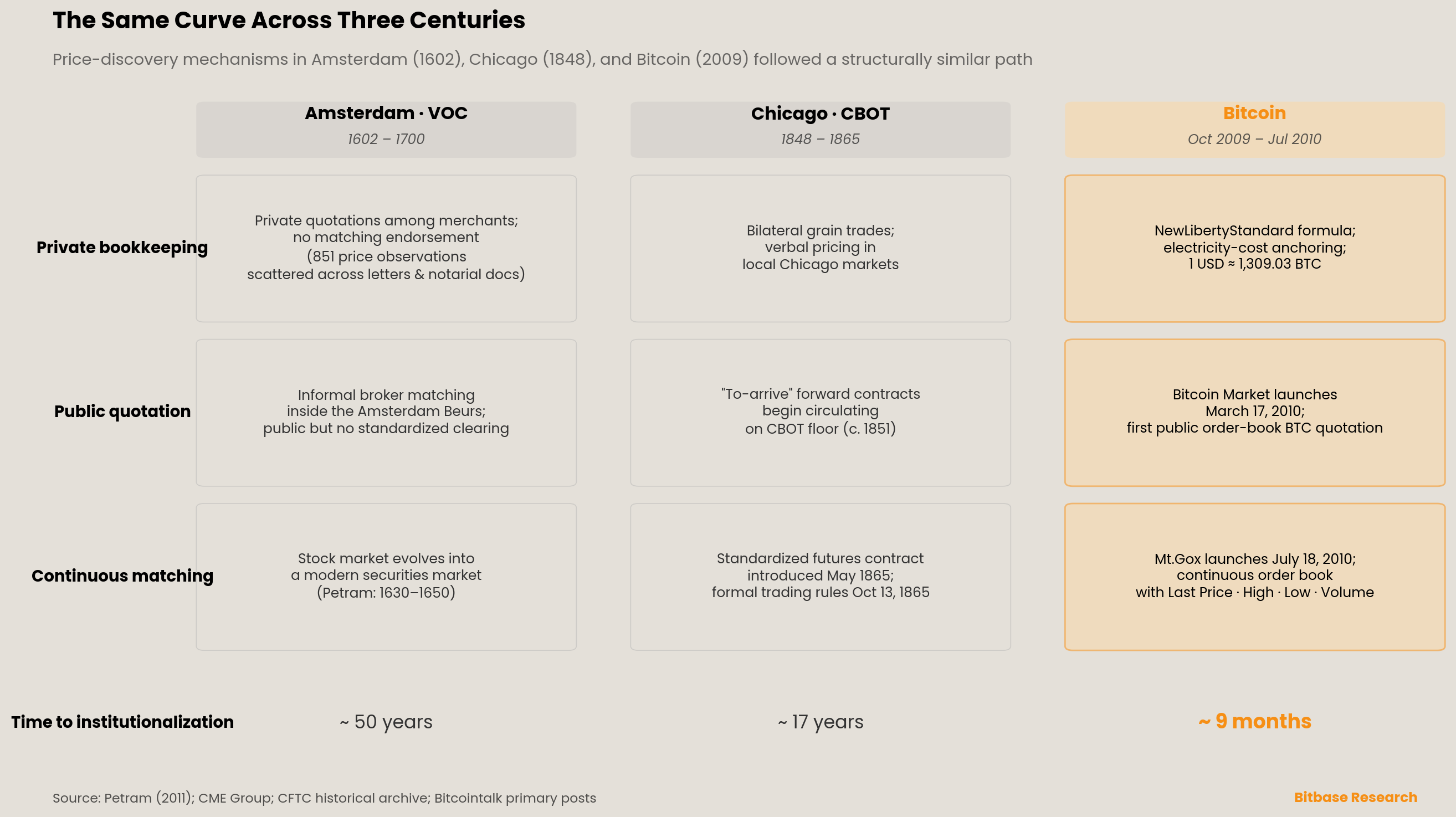
The thesis of this chapter: the three-layer mechanism evolution BTC completed between October 2009 and July 2010—production-cost anchoring → peer-to-peer matching → centralized continuous quotation—has structural parallels with the evolution paths of multiple historical asset classes. This chapter offers two structural comparisons, without constructing a quantifiable cross-asset comparison model.
3.1 Amsterdam · The 17th-Century VOC Secondary Market
The Dutch East India Company (Vereenigde Oost-Indische Compagnie, VOC) was established in 1602, with shares issued to 1,143 initial subscribers. Share transfers had to be registered in person by company bookkeepers at East India House [17]. This is generally regarded as the earliest identifiable scenario of a stock secondary market [17].
The maturation of price-discovery mechanisms came about half a century later. Lodewijk Petram, in his 2011 PhD dissertation at the University of Amsterdam, The world's first stock exchange, states that the stock market "evolved into a modern securities market" in the period 1630 to 1650, during which "a constant process of price discovery took place" [17]. Petram's judgment is based on 851 price observations from the 17th century. These observations did not come from official exchange records—neither the VOC nor the exchange systematically recorded prices—but were scattered across merchant correspondence, notarial documents, and occasional newspapers. The "dataset" of 17th-century VOC stock prices itself grew out of private bookkeeping and verbal exchange rates.
The structural parallel with the early BTC path is specific. The NLS formula is to BTC what 17th-century VOC quotations privately circulated among merchants were to VOC shares: unilaterally published, privately recorded, lacking matching endorsement. Bitcoin Market is to BTC what informal broker matching inside the Amsterdam Beurs was to VOC shares: public but lacking standardized clearing. Mt.Gox is, for BTC, the starting point of institutionalized continuous quotation—not the endpoint.
3.2 Chicago · The 19th-Century CBOT Standardized Futures Contract
The second comparison comes from the 19th-century American grain trade. The Chicago Board of Trade (CBOT) was founded in 1848, initially as a cash market for bulk commodities [18]. Around 1851, "to-arrive" forward contracts began circulating on the CBOT floor; traders committed to deliver grain on a future date at a specified price [18].
The critical institutionalization date for price discovery is 1865. The CME Group historical archive and the official history of the US Commodity Futures Trading Commission (CFTC) both record [18][19] that CBOT introduced standardized futures contracts in May 1865 and instituted formal trading rules on October 13, 1865. Academic debate exists on this point—one view holds that mature futures trading did not emerge until around 1874 [18]. This research adopts 1865 as the starting point and acknowledges the dating dispute.
The structural parallel between the CBOT path and the BTC path lies here: the institutionalization curve from scattered bilateral forward contracts to standardized, transferable futures contracts with margin and delivery rules is the same price-discovery institutionalization curve. Chicago took 17 years. Bitcoin took 9 months. The difference in time scale does not dissolve the structural similarity. The price discovery of every market does not begin at the exchange—it grows out of repeated bilateral transactions, verbal exchange rates, and private bookkeeping.
3.3 The Explanatory Reach and Limits of Structural Parallels
Placing the early BTC path within the three-century Amsterdam–Chicago–Bitcoin sequence yields a mechanism-level judgment, not a quantitative model. Three assets, three institutional environments, three technological conditions—yet price discovery in all three followed the same coarse-grained path: private bookkeeping → public quotation → continuous matching. Put differently, crypto derivatives infrastructure was not invented in a vacuum; it sits within a centuries-long line of financial institutional evolution.
The argument is not causal. It does not claim that "BTC necessarily walked the same path as VOC or grain futures," nor that "all future digital assets will follow the same curve." What it claims is this: when an observer faces a new asset class, "the prehistory of price-discovery mechanisms" is a more durable research object than "asset-price trajectories."
Chapter 4 · Acknowledged Limits and Open Space
This piece does not unpack the comparative analysis of contemporary price-discovery mechanisms. ETF flows, CME open interest, Perpetual Futures funding rates, on-chain market making—these are the current form of this 16-year path, but the length and methodology required to unpack them are reserved for subsequent research.
The reverse signals for the core thesis are three. First, if academic or on-chain archaeological research reveals a valid published exchange-rate agent earlier than NewLibertyStandard, the position of "first publicly disclosed exchange rate" must be revised. Second, if the timestamps of the three core Bitcointalk threads (topic=20, topic=137, topic=444) are falsified at the archive layer, the event anchors must be reset. Third, if the framework of "the semantic transition into unit of account" is replaced by a more precise theory of monetary-function evolution, the core thesis must be revised.
This piece acknowledges the following boundaries. First, "BTC functionally performing the role of unit of account for the first time" is an interpretive proposition, not a full establishment of the function by the monetary-economics definition. Second, calling Bitcoin Market "peer-to-peer matching" is a simplification. Third, the Amsterdam–Chicago structural parallels are mechanism-level comparisons, not a quantifiable cross-asset comparison model. This piece does not predict BTC price trajectories and makes no statement on BTC as a single asset for investment purposes.
Methodology and Disclosures
Research scope and limits. This short report focuses on the three-layer evolution of BTC's early price-discovery mechanisms within the nine-month observation window from October 2009 to July 2010. It does not cover: the full on-chain evidence chain of BTC's drift from "peer-to-peer cash" toward "store of value"; the structural analysis of contemporary BTC price-discovery mechanisms; or a quantifiable cross-asset comparison model between Amsterdam and Chicago. Each of the above should be a standalone research topic.
Data timeliness. The Bitcointalk primary-source posts, archive.org captures, and on-chain block data cited in this report are based on publicly available information as of May 14, 2026.
Research independence. This report is independently authored by Bitbase Research. Its analytical conclusions are based on publicly available primary sources and the independent judgment of the research team. The "three-layer mechanism evolution" framework adopted in this report is a research construct, not the official classification of any regulatory or standard-setting body. The specific persons and projects mentioned in this report (including Laszlo Hanyecz, Jeremy Sturdivant, Jed McCaleb, Martti Malmi, Mark Karpelès, Dustin Dollar, NewLibertyStandard, Bitcoin Market, Mt.Gox, CBOT, CME Group, VOC, Bitcointalk) are cited solely as objective points of reference for describing the structure of the prehistory. Inclusion does not constitute endorsement; non-inclusion does not constitute negative signal.
Conflict of interest disclosure. Bitbase operates a centralized exchange and may offer BTC spot and Perpetual Futures products that fall within the scope of this report. Readers should take this fact into account when interpreting this report's analysis of early price-discovery mechanisms. The arguments of this report apply symmetrically across all subjects of study.
Tools and generative assistance. This report used large language models as research-assistance tools for source retrieval, cross-source fact-checking, structured argumentation, and first-draft drafting. All Bitcointalk post IDs, UTC timestamps, archive.org snapshot URLs, on-chain txids and block numbers, and academic ISBNs and page numbers have been manually verified against primary sources by human researchers. Thesis and core judgments are made independently by the Bitbase Research team; reverse self-audit paragraphs are written by humans.
Not investment advice. This report does not constitute investment advice, nor a recommendation to buy, sell, or hold any financial instrument. The early price-discovery mechanisms described in this report are historical structures; no statement is made regarding the expected returns, risks, or suitability of any current or future crypto asset. Before acting on any information in this report, readers should consult independent, licensed financial, legal, and tax advisors.
Forward-looking statement risks. Chapter 4's references to contemporary crypto price-discovery mechanisms (ETF flows, CME open interest, Perpetual Futures funding rates, on-chain market making) are forward-looking and carry uncertainty. Regulatory structure, institutional infrastructure, and on-chain behavior all depend on the evolution of multiple independent variables, none of which is under the control of any single party. Readers should treat forward-looking statements as judgments conditional on publicly available information as of May 14, 2026; conclusions may be revised.
Research continuity. This short report serves as the prefatory foundation for the May 22, 2026 Bitcoin Pizza Day content series. The structural analysis of contemporary crypto price-discovery mechanisms (ETFs, CME, Perpetual Futures, on-chain market making) will be carried by subsequent research.
References
[1] Frederic S. Mishkin, The Economics of Money, Banking, and Financial Markets, 13th Global Edition, Harlow: Pearson, 2021. ISBN 978-1-292-40948-1. Chapter 3 "What Is Money?", pp. 97 ff. (the "Functions of Money" section covering Medium of Exchange, Unit of Account, and Store of Value).
[2] John R. Hicks, Critical Essays in Monetary Theory, Oxford: Clarendon Press, 1967. p. 1. Internet Archive full-text borrowable copy: https://archive.org/details/criticalessaysin0000hick
[3] Laszlo Hanyecz (username: laszlo), "Pizza for bitcoins?" (opening post), Bitcointalk topic=137 msg=1141, 2010-05-18 00:35:20 UTC. https://bitcointalk.org/index.php?topic=137.msg1141\#msg1141
[4] Laszlo Hanyecz, "Re: Pizza for bitcoins?" (delivery-confirmation post), Bitcointalk topic=137 msg=1195, 2010-05-22 19:17:26 UTC. https://bitcointalk.org/index.php?topic=137.msg1195\#msg1195
[5] Laszlo Hanyecz, "Re: Pizza for bitcoins?" (USD anchor and open offer), Bitcointalk topic=137 msg=1526, 2010-06-12 20:14:44 UTC. https://bitcointalk.org/index.php?topic=137.msg1526\#msg1526
[6] NewLibertyStandard, "2009 Exchange Rate," original wetpaint site offline; earliest Wayback Machine snapshot on record as of May 14, 2026: 2009-12-29 13:26:10 UTC. https://web.archive.org/web/20091229132610/http://newlibertystandard.wetpaint.com/page/Exchange+Rate
[7] Bitbo Calendar, "What Was the First Valuation Given to Bitcoin?"—this research adopts the page's verification that "the primary source of 1 USD = 1,309.03 BTC is available only in the archive snapshot; there is no original post by NLS publishing this figure on the Bitcointalk forum." https://bitbo.io/calendar/first-valuation/
[8] Martti Malmi (@marttimalmi), "Found the first known bitcoin to USD transaction from my email backups. I sold 5,050 BTC for $5,02 on 2009-10-12.", X (formerly Twitter), 2014-01-15. https://x.com/marttimalmi/status/423455561703624704
[9] dwdollar (Dustin Dollar), "New exchange (Bitcoin Market)," Bitcointalk topic=20 msg=100, 2010-01-15 09:42:18 UTC. https://bitcointalk.org/index.php?topic=20.msg100\#msg100
[10] dwdollar, "Re: New exchange (Bitcoin Market)" (matching-mechanism description), Bitcointalk topic=20 msg=265, 2010-02-06 22:37:44 UTC. https://bitcointalk.org/index.php?topic=20.msg265\#msg265
[11] Bitcoin Block #57043, block hash 00000000152340ca42227603908689183edc47355204e7aca59383b0aaac1fd8; pizza-transaction txid a1075db55d416d3ca199f55b6084e2115b9345e16c5cf302fc80e9d5fbf5d48d; block timestamp 2010-05-22 18:16:31 UTC (ISO 8601 read directly from mempool.space). https://mempool.space/block/00000000152340ca42227603908689183edc47355204e7aca59383b0aaac1fd8
[12] Jeremy Sturdivant (username: jercos), written interview, Bitcoin Who's Who Blog, 2016-01-30. https://www.bitcoinwhoswho.com/blog/2016/01/30/a-living-currency-an-interview-with-jercos-party-to-first-bitcoin-pizza-transaction/
[13] Laszlo Hanyecz, "Re: Pizza for bitcoins?" (withdrawal of open offer), Bitcointalk topic=137 msg=7544, 2010-06-04 17:51:05 UTC. https://bitcointalk.org/index.php?topic=137.msg7544\#msg7544
[14] mtgox (Jed McCaleb), "New Bitcoin Exchange (mtgox.com)," Bitcointalk topic=444 msg=3866, 2010-07-18 01:57:19 UTC; same thread msg=3873 (matching-mechanism description) 2010-07-18 02:15:09 UTC. https://bitcointalk.org/index.php?topic=444.msg3866\#msg3866
[15] Wayback Machine earliest capture of mtgox.com, 2007-08-17 17:06:06 UTC. https://web.archive.org/web/20070817170606/http://mtgox.com
[16] Jed McCaleb, "Mtgox is changing owners" (transfer-of-ownership announcement to MagicalTux / Mark Karpelès), Bitcointalk topic=4187 msg=60610, 2011-03-06. https://bitcointalk.org/index.php?topic=4187.0
[17] Lodewijk O. Petram, The world's first stock exchange: How the Amsterdam market for Dutch East India Company shares became a modern securities market, 1602–1700, PhD dissertation, University of Amsterdam, 2011 (covering 1602 VOC initial subscription of 1,143 subscribers, the East India House in-person registration mechanism, the 1602–1700 evolution into a modern securities market, and the dataset of 851 price observations from the 17th century; key argument: "The market evolved into a modern securities market in the period 1630–1650 ... a constant process of price discovery took place"). English translation: Lodewijk Petram, The World's First Stock Exchange, trans. Lynne Richards, New York: Columbia University Press, 2014. ISBN 978-0-231-16378-1. Dataset introduction: https://www.worldsfirststockexchange.com/
[18] CME Group, Midwest Grain Trade: History of Futures Exchanges—records CBOT founded in 1848, to-arrive forward contracts emerging around 1851, and standardized futures contracts introduced in 1865; the academic debate on the starting point of "true futures trading" (1865 vs. 1874 vs. 1877) is reviewed in the EH.net survey referenced therein. https://www.cmegroup.com/education/courses/introduction-to-futures/midwest-grain-trade-history-of-futures-exchanges
[19] U.S. Commodity Futures Trading Commission (CFTC), History of the CFTC: pre-CFTC—records "October 13, 1865 – Formal trading rules are instituted at the CBOT, particularly concerning margin and delivery procedures." https://www.cftc.gov/About/HistoryoftheCFTC/history\_precftc.html