UTXO stands for Unspent Transaction Output, and it is how Bitcoin keeps track of who owns what. Bitcoin has no account balances in the way a bank does; instead it holds a set of discrete unspent outputs, and your wallet adds them up to show a balance. Here is what a UTXO is, the cash analogy that makes it click, and how a transaction really works.
What a UTXO is
When you receive bitcoin, the network does not add a number to a balance. It creates an output — a chunk of value locked to your address — that sits on the blockchain until you spend it. That is an Unspent Transaction Output. You might hold several of them of different sizes, and your wallet balance is simply the total of all the UTXOs you control. There is no single “balance” number stored anywhere; it is always a sum.
The cash analogy
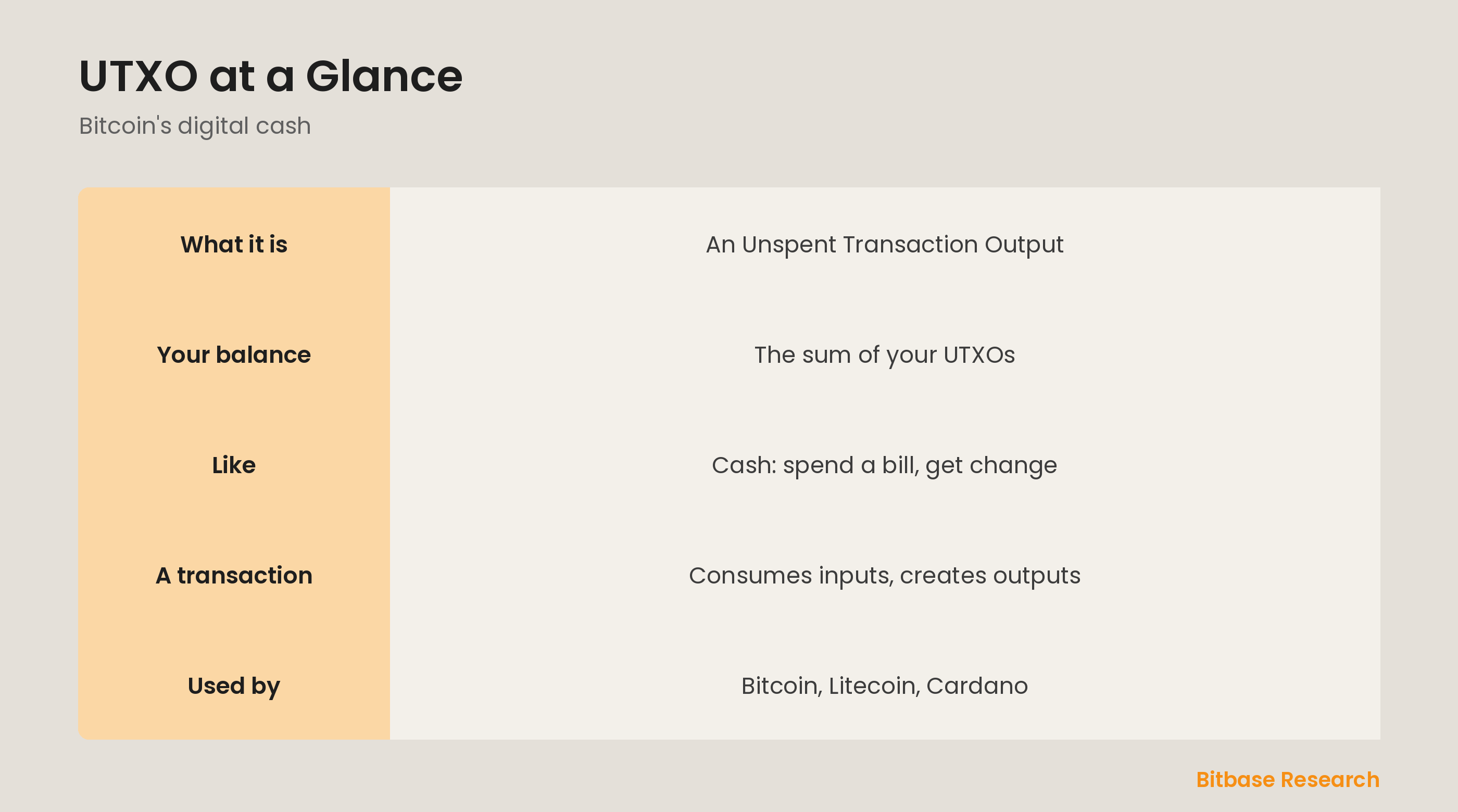
UTXOs behave much like physical cash. If you have a $20 bill and want to pay $7, you cannot tear off exactly seven dollars — you hand over the whole $20 and receive $13 in change. A UTXO works the same way: it must be spent in full. Your wallet takes one or more UTXOs as inputs, sends the amount to the recipient, and creates a new UTXO for the change, which comes back to a fresh address you control.
How a transaction works
A Bitcoin transaction is a list of inputs and outputs. The inputs are UTXOs you already own, which are consumed entirely and can never be spent again. The outputs are new UTXOs: one to the person you are paying, and usually one back to yourself as change. This is why a simple payment can involve amounts that look odd — the numbers reflect which coins were combined and what change was returned, not a running balance.
Why Bitcoin uses it
The model has real advantages. A node only needs the current set of unspent outputs to check a new transaction, not the entire history, which keeps validation efficient. Using a new address for each change output improves privacy, and independent UTXOs can be processed in parallel. The trade-offs are that wallets must track many outputs to show one balance, and the model is harder to build complex smart contracts on — which is why other chains chose a different approach.
The bottom line
A UTXO is a piece of unspent bitcoin locked to an address, and Bitcoin is really just a giant set of them. Think of your holdings as a wallet full of digital cash rather than a bank balance: you spend whole pieces and get change back. Understanding UTXOs explains Bitcoin's privacy model, its fees, and why it works so differently from an account-based chain like Ethereum. To keep learning the fundamentals, follow more from Bitbase Academy.
Disclaimer: This article is educational content from Bitbase Academy, provided for information only. It does not constitute investment, trading, tax, or financial advice. Crypto assets are volatile; assess your own risk. Written as of June 2026; refer to the latest official information.
References
[1] Investopedia, "Unspent Transaction Output (UTXO): Definition and Uses" investopedia.com
[2] Bitcoin Developer Reference, "Transactions" developer.bitcoin.org
[3] Investopedia, "How Bitcoin Works" investopedia.com