Stablecoin redemption is the act of exchanging a stablecoin back for the asset it represents — turning one USDC, say, back into one US dollar. That right to redeem is what makes a stablecoin more than an IOU: it is the promise that anchors the peg. Here is what redemption is, how it works, and why it is the feature that matters most.
What redemption is
A collateralized stablecoin is a claim on reserves, and redemption is how you cash that claim in. The issuer commits to buy the coin back at its target value — one dollar for one coin — handing over real money and removing the coin from circulation. Because holders can, in principle, always exit at a dollar, they are willing to treat the coin as a dollar in the first place. Redeemability is the quiet foundation the whole system stands on.
Primary vs secondary market
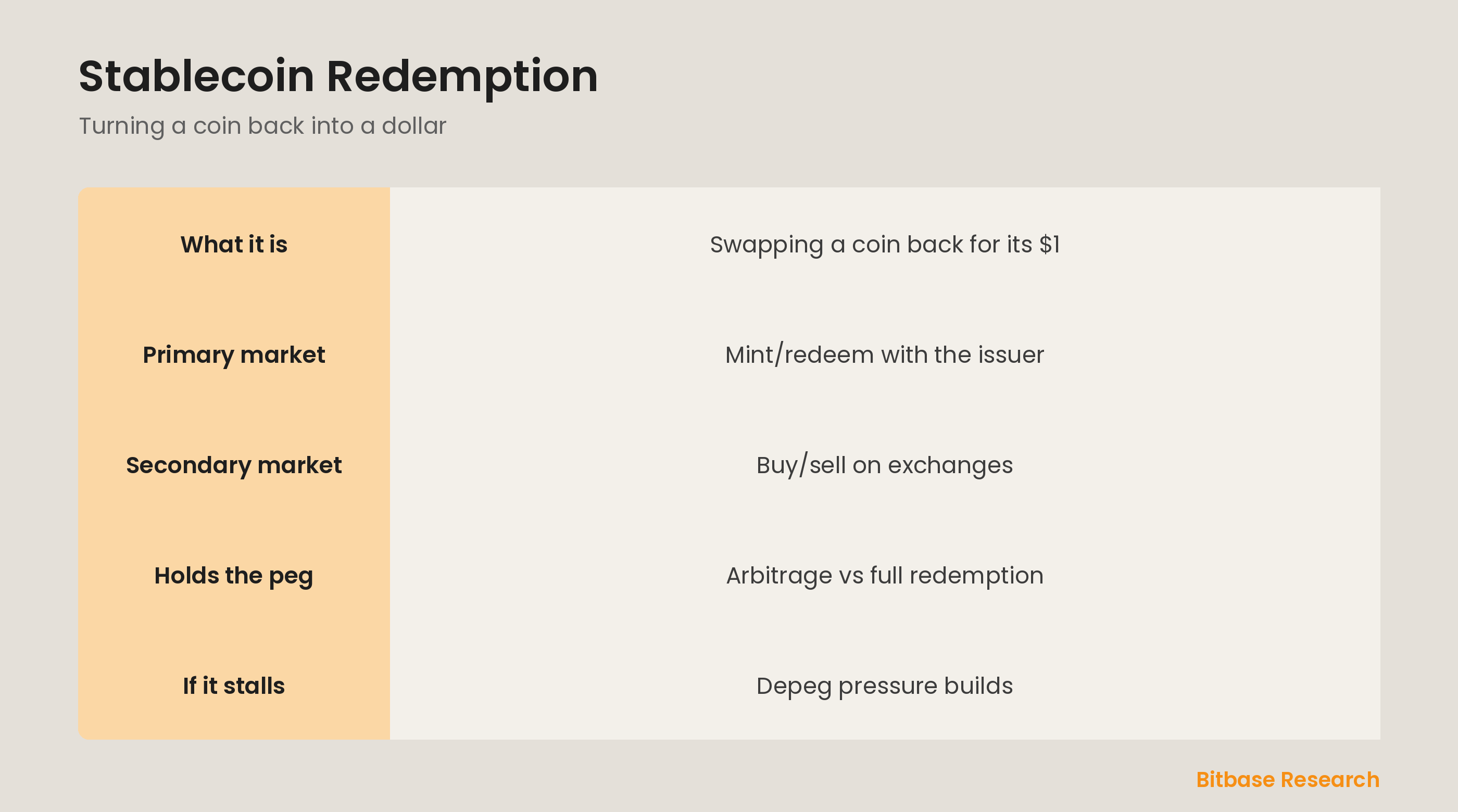
There are two ways to move in and out of a stablecoin. The primary market is direct with the issuer: approved parties mint new coins by paying in reserves and redeem coins for reserves, usually with identity checks and minimum sizes. The secondary market is everyday trading on exchanges, where anyone buys and sells at the going price. Most users only ever touch the secondary market, while the primary market's redemptions are what keep that price near a dollar.
How redemption holds the peg
Redemption enforces the peg through arbitrage. If the coin trades below a dollar on exchanges, traders can buy it cheap and redeem it with the issuer for a full dollar of reserves, pocketing the gap — and their buying lifts the market price back toward the peg. The credible ability to redeem for a dollar acts as a floor under the price. A stablecoin that cannot be redeemed for real assets, like an algorithmic one, has no such floor.
When redemption breaks down
The peg is only as reliable as redemption is. If an issuer pauses redemptions, limits them, or is slow to pay, the floor weakens and the coin can slip below a dollar — this is part of what happened to USDC over the March 2023 weekend, when primary redemptions were interrupted. Fees, minimums, and access limits also matter: a coin that is hard or costly to redeem in practice is more fragile than its “$1” label suggests.
The bottom line
Redemption is the promise that a stablecoin can always be turned back into the dollar it tracks, and that promise is what keeps the peg honest through arbitrage. When you assess a stablecoin, look past the price and ask how, how quickly, and how reliably it can be redeemed for real reserves. Strong, credible redemption is the difference between a digital dollar and a token that merely hopes to be one. To keep learning the fundamentals, follow more from Bitbase Academy.
Disclaimer: This article is educational content from Bitbase Academy, provided for information only. It does not constitute investment, trading, tax, or financial advice. Crypto assets are volatile; assess your own risk. Written as of June 2026; refer to the latest official information.
References
[1] Federal Reserve, "Primary and Secondary Markets for Stablecoins" federalreserve.gov
[2] Investopedia, "Stablecoin: Definition, How They Work, and Types" investopedia.com
[3] Federal Reserve, "In the Shadow of Bank Runs: Lessons from the Silicon Valley Bank Failure" federalreserve.gov