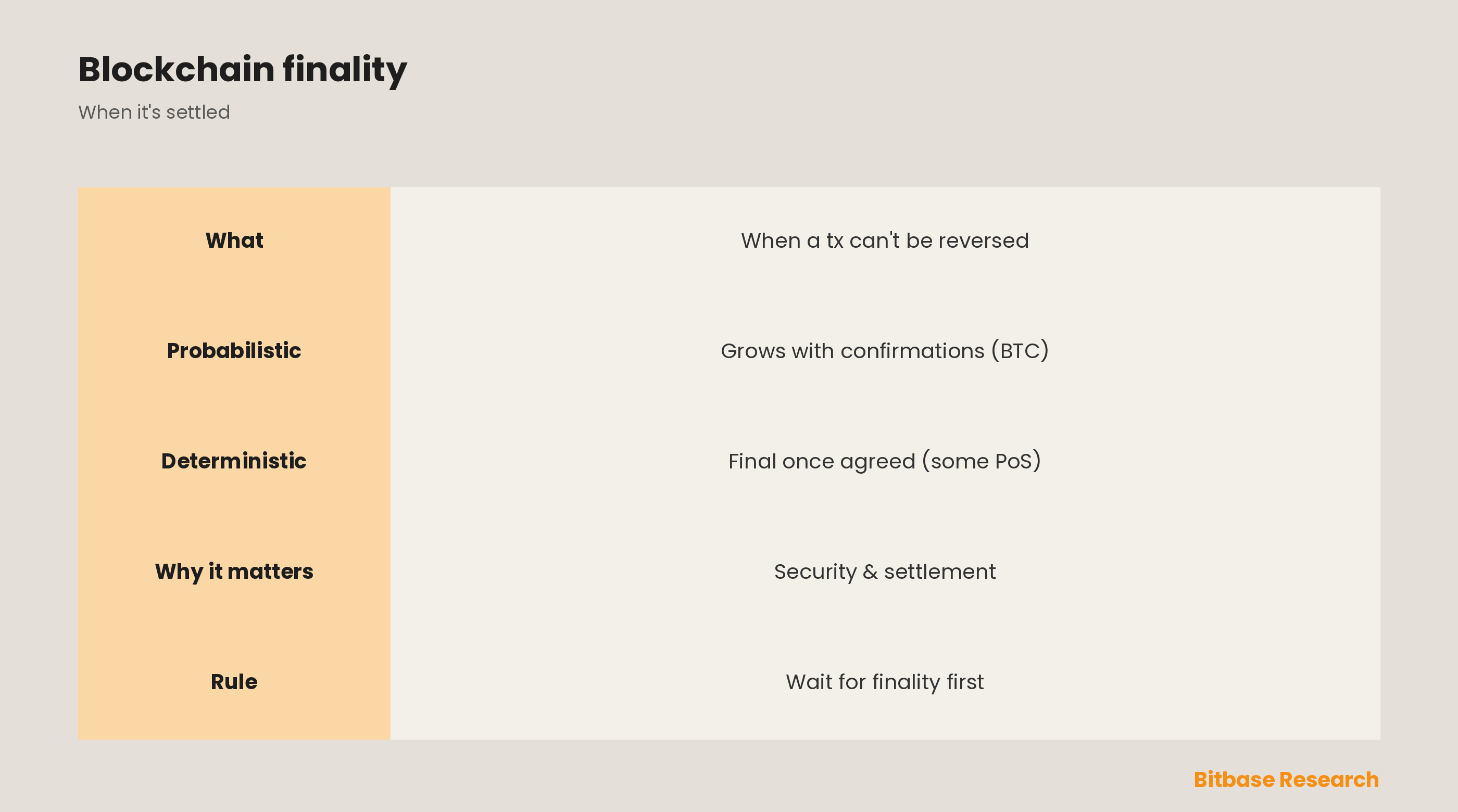
Finality is the point at which a transaction is settled for good and can no longer be reversed or changed. Different blockchains reach it in different ways and at different speeds. This guide explains what finality means and why it matters.
Two kinds of finality
Some networks have probabilistic finality: a transaction becomes ever harder to reverse as more blocks pile on top, but it's never mathematically "done" — Bitcoin works this way, which is why people wait for several confirmations [1].
Others have deterministic finality: once validators formally agree, the transaction is final and cannot be undone, as in many Proof of Stake systems [2].
Why finality matters
The bottom line
Finality tells you when a payment is truly settled. With probabilistic finality you wait for confirmations to be confident; with deterministic finality it's settled once the network agrees. Either way, the practical rule is the same: wait for finality before treating a transaction as complete. To keep learning the fundamentals, follow more from Bitbase Academy.
Disclaimer: This article is educational content from Bitbase Academy, provided for information only. It does not constitute investment, trading, tax, or financial advice. Crypto assets are volatile; assess your own risk. Written as of June 2026; refer to the latest official information.
References
[1] Coinbase, "What is a blockchain?" https://www.coinbase.com/learn/crypto-basics/what-is-a-blockchain
[2] Ethereum.org, "Transaction finality." https://ethereum.org/en/developers/docs/consensus-mechanisms/pos/