
An algorithmic stablecoin tries to hold a fixed price using code rather than reserves. Instead of backing each coin with a dollar of assets, it runs a mechanism that expands or shrinks the supply to nudge the price toward its target. It sounds elegant — and it has failed spectacularly. Here is how it works, why it is fragile, and what Terra taught the market.
What algorithmic means
A collateralized stablecoin holds reserves; an algorithmic one mostly does not. It aims to stay at $1 through rules written into smart contracts that automatically change how many coins exist. The idea is that supply and demand can be balanced by software: if the price drifts, the algorithm creates or removes coins to push it back. There is little or nothing to redeem the coin for, so its stability rests on the mechanism working — and on people believing it will.
The mint-and-burn mechanism
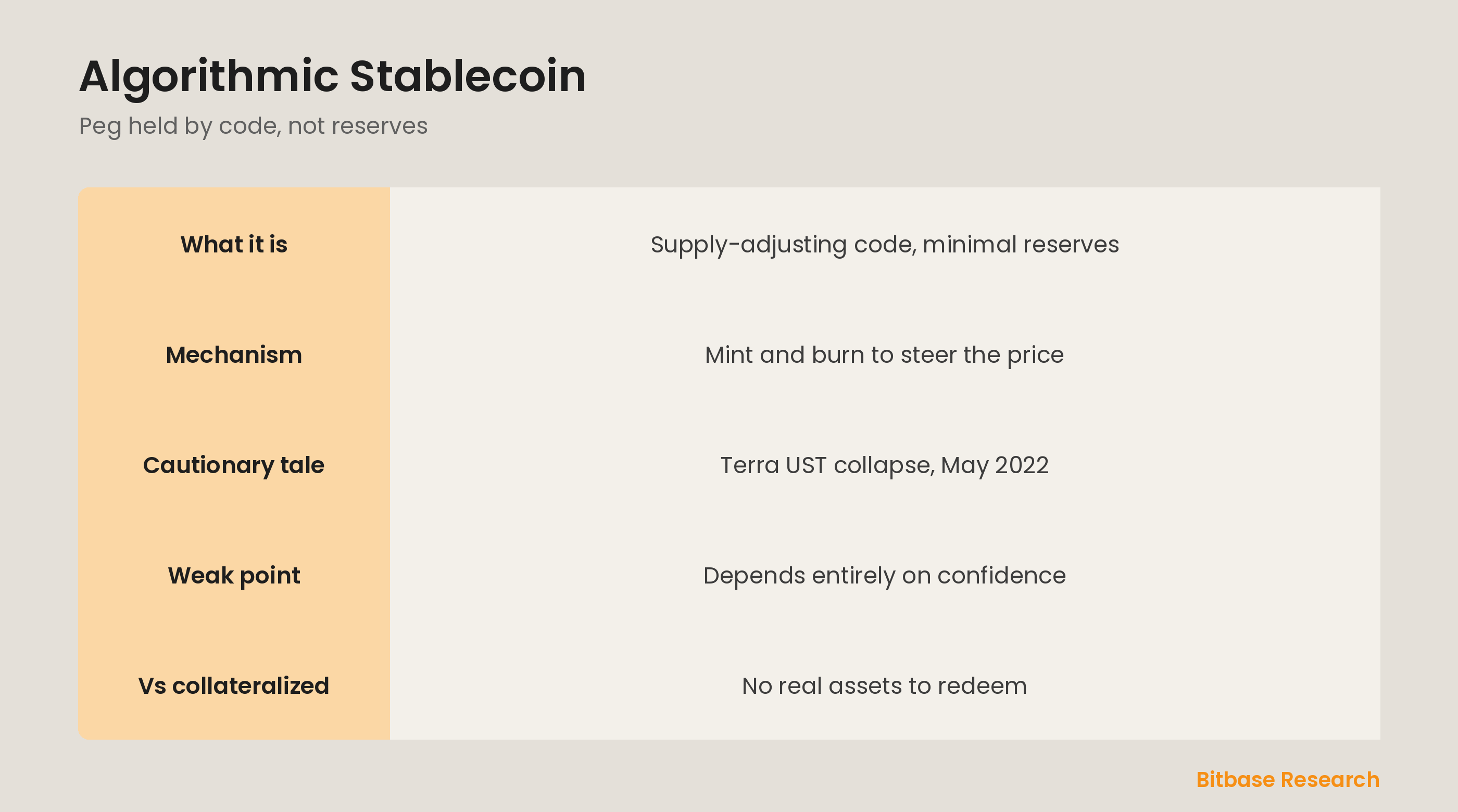
The best-known design pairs the stablecoin with a second, floating token and lets users swap between them at a fixed value. Terra's UST worked this way with its sister token LUNA: you could always burn one dollar of LUNA to mint one UST, or burn one UST to mint a dollar of LUNA. If UST fell below $1, arbitragers were meant to buy it, redeem it for a dollar of LUNA, and sell — shrinking UST supply and lifting the price back toward the peg.
Why they are fragile
The flaw is circularity: UST was propped up by LUNA, but LUNA's value came largely from demand for UST. When confidence cracked in May 2022, the mechanism ran in reverse. Falling UST minted ever more LUNA, LUNA's price collapsed as supply exploded, and that destroyed the very backstop meant to save UST — a “death spiral.” Within days both tokens were nearly worthless and tens of billions of dollars had evaporated.
The takeaway
Terra's collapse became the defining lesson: a stablecoin with no real assets behind it holds only as long as everyone believes it will, and belief can vanish fast. Most purely algorithmic designs have since failed or faded, and regulators treat them with deep suspicion. The practical rule is to know what actually backs a stablecoin — if the honest answer is “an algorithm and a companion token,” its dollar is far less certain than a reserve-backed one.
The bottom line
An algorithmic stablecoin swaps reserves for a clever supply mechanism, and that trade has repeatedly proven unstable under stress. It is not the same animal as a collateralized coin like USDC, even though both quote a dollar. When you see a stablecoin, the question that matters is what stands behind the peg — and “code and confidence,” as Terra showed, can stand behind nothing at all. To keep learning the fundamentals, follow more from Bitbase Academy.
Disclaimer: This article is educational content from Bitbase Academy, provided for information only. It does not constitute investment, trading, tax, or financial advice. Crypto assets are volatile; assess your own risk. Written as of June 2026; refer to the latest official information.
References
[1] Federal Reserve Bank of Richmond, "Why Stablecoins Fail: An Economist's Post-Mortem on Terra" richmondfed.org
[2] Chainalysis, "How TerraUSD (UST) Collapsed" chainalysis.com
[3] Investopedia, "Stablecoin: Definition, How They Work, and Types" investopedia.com