
A nonce is a “number used once,” and in a proof-of-work blockchain it is the single value miners keep changing as they race to build a block. Everything else in the block stays fixed while the nonce is tried over and over until the block's hash meets the network's rule. Here is what a nonce is, how mining uses it, and why the same word means something else on account chains.
What a nonce is
A nonce is just a number included in the data a miner is hashing, meant to be used once and then changed. On its own it does nothing special; its whole purpose is to be the one adjustable knob in an otherwise fixed block. By running through different nonces, a miner produces a different hash each time without altering any of the actual transactions — which is exactly what proof of work needs.
How mining uses the nonce
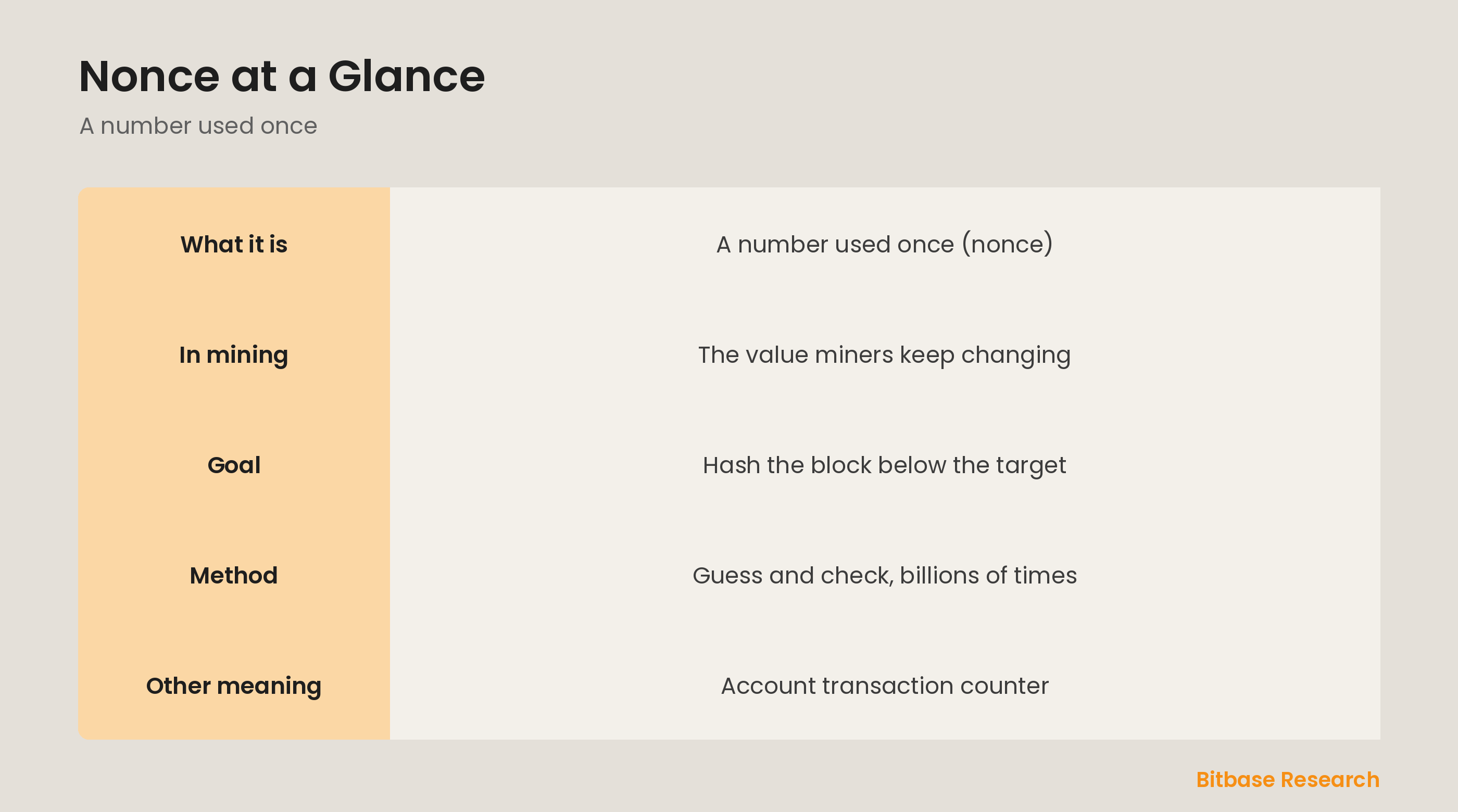
To add a block, a miner assembles its transactions and header, then hashes the whole thing. The network requires that hash to be below a certain target — in effect, to start with a run of zeros. There is no way to calculate a nonce that produces such a hash, so the miner simply changes the nonce and hashes again, billions of times per second, until one attempt lands below the target. That lucky nonce is the proof that work was done.
Why it takes work
Hash functions are unpredictable: change the input by one number and the output looks completely different, with no shortcut to a low result. So finding a valid nonce is pure trial and error, and how low the target sits — the difficulty — decides how many attempts it takes on average. Bitcoin adjusts that difficulty so that, across the whole network, a winning nonce turns up about once every ten minutes no matter how much mining power is online.
A second meaning
Confusingly, “nonce” also names something different on account-based chains like Ethereum. There, each account has a nonce that simply counts how many transactions it has sent, incrementing by one each time. Its job is to order those transactions and stop the same one from being replayed. It has nothing to do with mining — same word, borrowed for a different “used once” idea, so it is worth knowing which nonce a text means.
The bottom line
In mining, the nonce is the number a miner spins through to search for a valid block hash, and it is the visible fingerprint of proof of work: real energy spent guessing until the rules are met. On account chains, a nonce instead counts an account's transactions. Either way the theme is the same — a value used once — but only the mining nonce is what makes a proof-of-work block hard to produce and easy to verify. To keep learning the fundamentals, follow more from Bitbase Academy.
Disclaimer: This article is educational content from Bitbase Academy, provided for information only. It does not constitute investment, trading, tax, or financial advice. Crypto assets are volatile; assess your own risk. Written as of June 2026; refer to the latest official information.
References
[1] Investopedia, "Nonce: What It Means and How It's Used in Blockchain" investopedia.com
[2] Bitcoin.com, "What Is Proof of Work (PoW)?" bitcoin.com
[3] Ethereum.org, "Ethereum Accounts" ethereum.org