A crypto token is a digital asset created on top of an existing blockchain, rather than having a blockchain of its own. Tokens cover everything from stablecoins to governance rights, and they all follow shared rule sets called token standards. Here is what a token is, how it differs from a coin, and why standards matter.
Token vs coin
The two words are often used loosely, but they mean different things. A coin is the native asset of its own blockchain — Bitcoin on the Bitcoin network, Ether on Ethereum — and is used to pay that network's fees. A token is issued on top of an existing chain through a smart contract, and relies on that chain for security and settlement. USDT and most project tokens are tokens, not coins, even though people casually call everything a “coin.”
What a token standard is
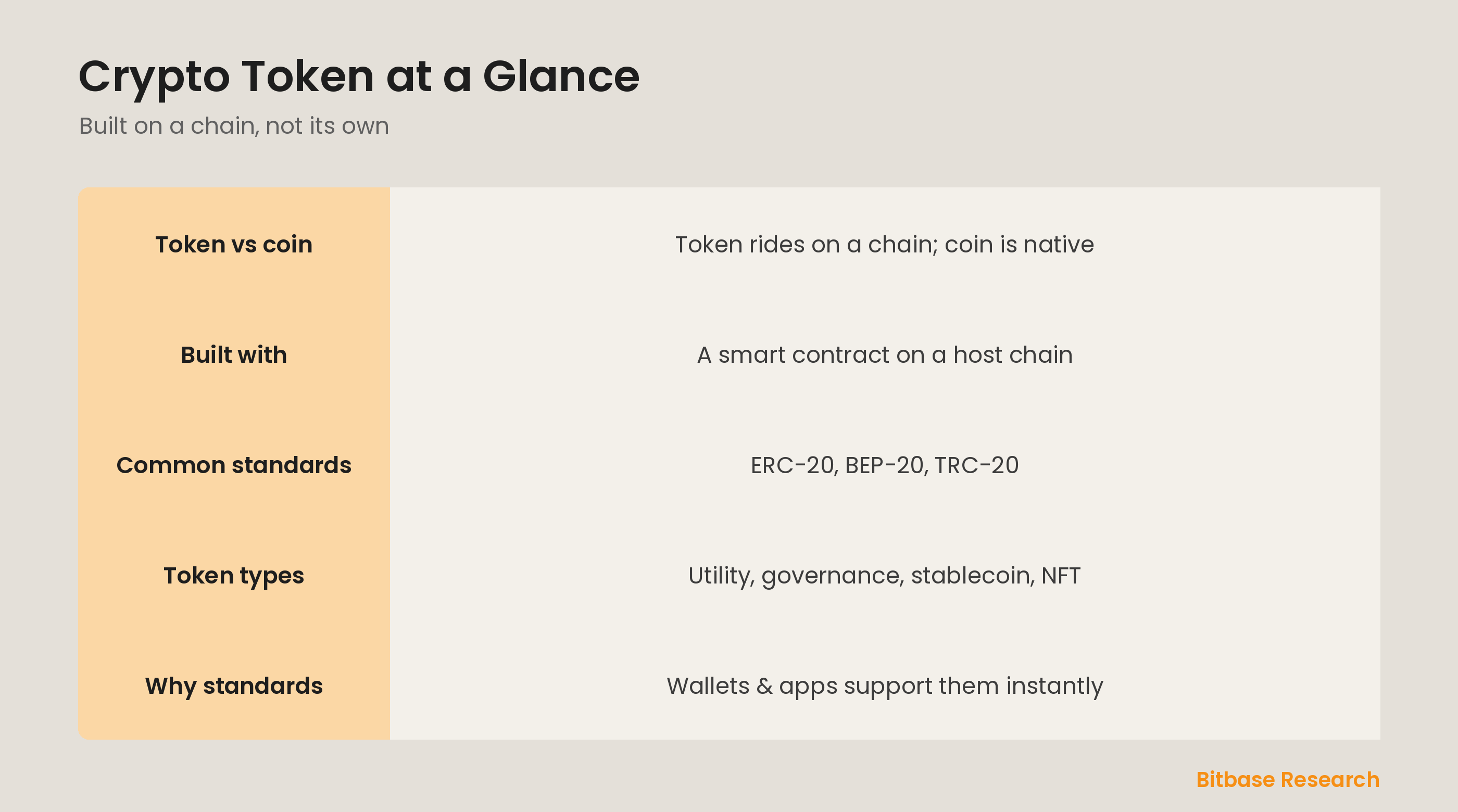
For a wallet or exchange to handle a token, it needs to know how that token behaves — how to read a balance, how to transfer it, how to approve a spend. A token standard is a shared template that spells out those functions, so any compatible app can support the token without custom code. The best-known standards are ERC-20 on Ethereum, BEP-20 on BNB Smart Chain, and TRC-20 on Tron; all three describe fungible tokens and are broadly similar.
Types of tokens
Tokens are not all the same. Utility tokens give access to a product or service; governance tokens grant voting rights in a protocol; stablecoins track the value of a currency such as the US dollar; and non-fungible tokens (NFTs) represent unique items rather than interchangeable units. What they all share is that they live on a host blockchain and follow its token standard.
Why standards matter
Standards are what make tokens useful. Because thousands of tokens follow the same ERC-20 template, a single wallet or exchange can list them all, and they can plug into DeFi apps interchangeably. It also lets the same asset exist on several chains — dollar stablecoins issued as ERC-20, BEP-20, and TRC-20 versions — with the standard, not the token, deciding the fees and speed of a transfer.
The bottom line
A token is a digital asset built on someone else's blockchain and governed by a shared standard. Remember the split: coins are native to their chain and pay its fees, while tokens ride on top and follow a standard like ERC-20. Knowing which standard a token uses tells you which network it moves on — and what a transfer is likely to cost. To keep learning the fundamentals, follow more from Bitbase Academy.
Disclaimer: This article is educational content from Bitbase Academy, provided for information only. It does not constitute investment, trading, tax, or financial advice. Crypto assets are volatile; assess your own risk. Written as of June 2026; refer to the latest official information.
References
[1] Investopedia, "Crypto Token: Definition, Examples, and How They Work" investopedia.com
[2] Ethereum.org, "ERC-20 Token Standard" ethereum.org
[3] Investopedia, "Cryptocurrency Explained With Pros and Cons for Investment" investopedia.com