
VWAP, the volume-weighted average price, is a favorite of professional traders because it answers a practical question: what is the fair average price today, weighting for where the real volume traded? It blends price and volume into a single line that serves as both a benchmark for execution and a dynamic support or resistance level. Here is what VWAP is, how it differs from a plain average, and how traders put it to use.
What VWAP is
VWAP is the average price of an asset over a period, weighted by the volume traded at each price. Unlike a simple average that treats every price equally, VWAP gives more weight to prices where more volume changed hands. This means it reflects where the bulk of trading actually happened, not just where price wandered on thin activity. The result is a single line that represents the volume-weighted fair value of the asset for the period.
How VWAP is calculated and resets
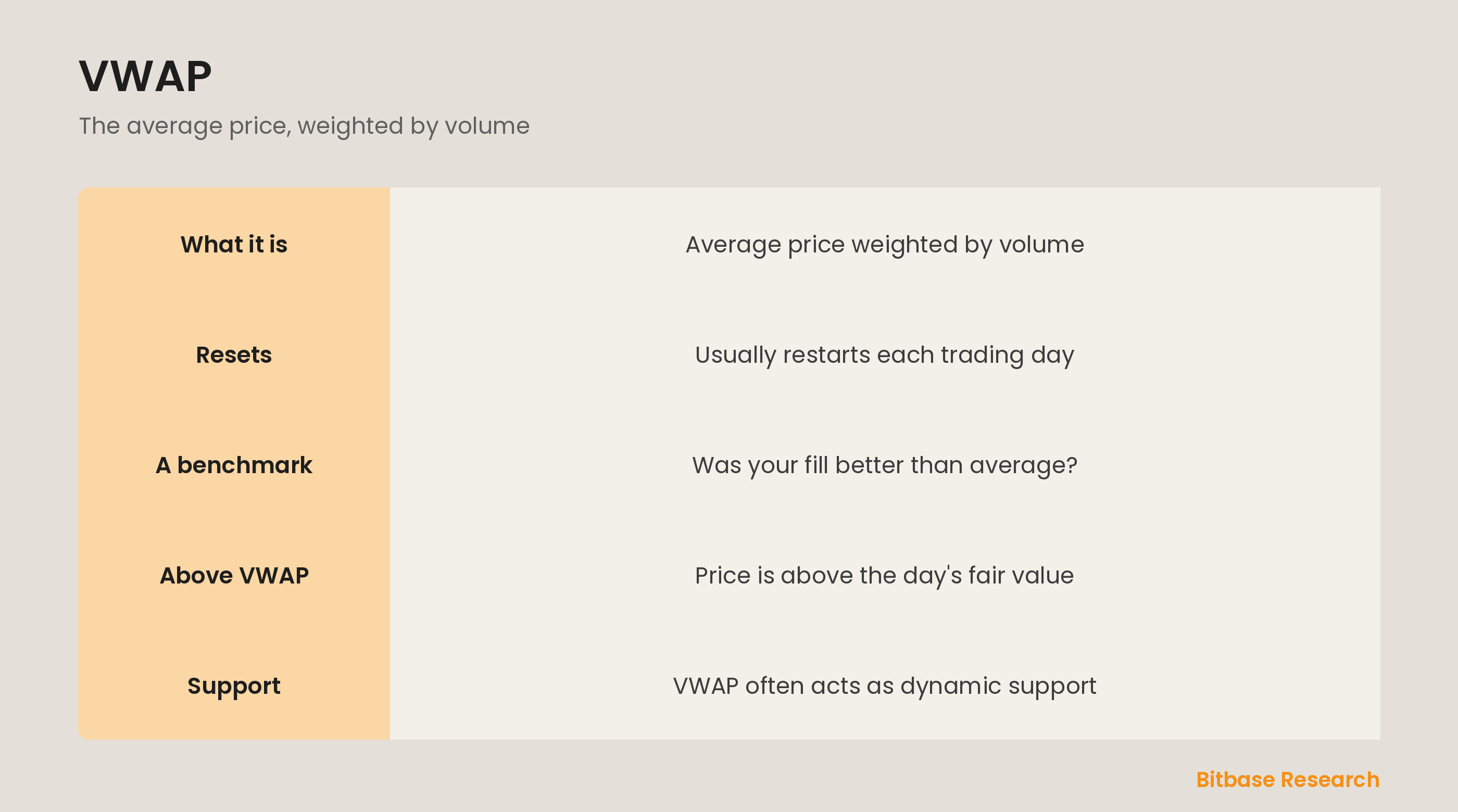
VWAP is built cumulatively through the trading session: it continuously totals price times volume and divides by total volume, updating with each trade. Because it accumulates from a starting point, VWAP is almost always reset at the beginning of each trading day, so the line reflects only that day's activity. This daily reset is important; VWAP is primarily an intraday tool, most meaningful within a single session rather than across many days.
VWAP as an execution benchmark
VWAP's original purpose is as a benchmark for execution quality. Large traders judge their fills against it: buying below VWAP means you did better than the day's average price, while buying above means worse. Institutions often aim to execute large orders at or better than VWAP, and it remains the standard yardstick for whether a fill was good. For any trader, comparing your entry to VWAP is a simple check on execution quality.
VWAP as support and resistance
Beyond benchmarking, traders watch VWAP as a dynamic level. Because so many participants reference it, price often reacts around VWAP: in an uptrend, pullbacks to VWAP can act as support, and in a downtrend, rallies to VWAP can act as resistance. Whether price is above or below VWAP also signals the day's bias, above suggests buyers are in control, below suggests sellers. This makes VWAP a practical intraday map of fair value.
The bottom line
VWAP is the average price weighted by the volume traded at each level, giving a single line that represents the day's volume-weighted fair value, and it usually resets each trading day as an intraday tool. Its original use is as an execution benchmark, judging whether a fill beat the day's average, and traders also watch it as dynamic support or resistance and a read on the session's bias. It blends price and volume into one practical reference. To keep learning the fundamentals, follow more from Bitbase Academy.
Disclaimer: This article is educational content from Bitbase Academy, provided for information only. It does not constitute investment, trading, tax, or financial advice. Crypto assets are volatile; assess your own risk. Written as of June 2026; refer to the latest official information.
References
[1] Investopedia, "Volume-Weighted Average Price (VWAP): Definition and Calculation" investopedia.com
[2] Investopedia, "Volume: Definition in Trading and How To Use It" investopedia.com
[3] Investopedia, "Technical Analysis: What It Is and How to Use It" investopedia.com