Not all tokens are the same kind of thing. Some are tickets to use a service, some are votes, and some are effectively investments in disguise — and that last category is where regulators pay close attention. Understanding utility, security, and governance tokens helps you see what a token is actually for, and what rules may apply to it.
Why token type matters
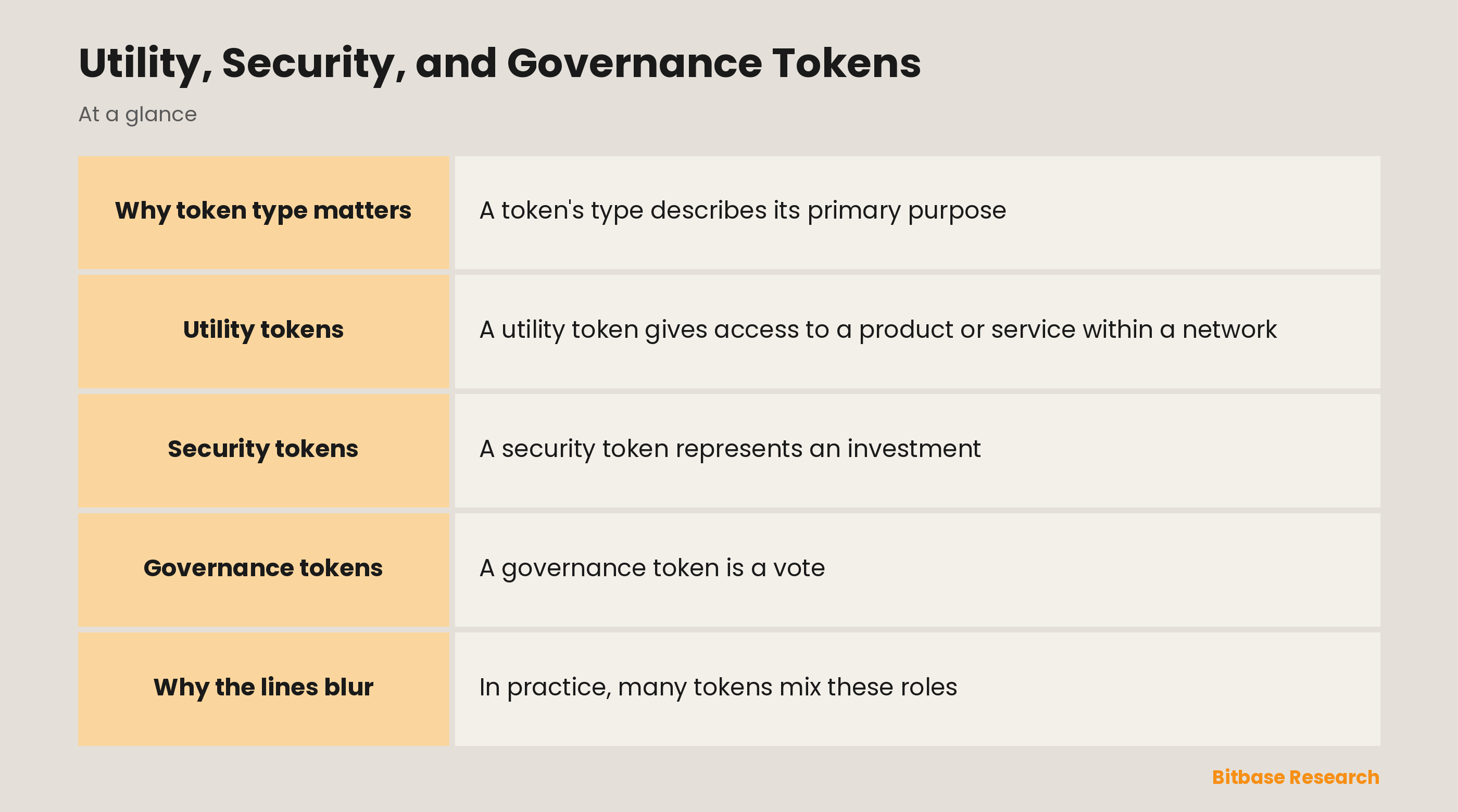
A token's type describes its primary purpose, and that purpose affects how it is used, valued, and regulated. The same technology — a token on a blockchain — can play very different roles, and mislabeling one can have real consequences, especially legal ones. Knowing the categories is the first step to judging what a token is really offering.
Utility tokens
A utility token gives access to a product or service within a network. It is like an arcade token: you use it to do something — pay fees, access features, buy compute or storage — rather than as a claim on profits. A genuine utility token's value comes from demand to actually use the network, not from expecting someone else to pay more for it later.
Security tokens
A security token represents an investment, much like a share, a bond, or a stake in an enterprise, where you expect profit from the efforts of others. Regulators use tests like the U.S. Howey test to decide whether a token counts as a security, and if it does, it falls under strict securities laws. Many tokens marketed as "utility" have been judged to be securities in disguise, which is where much crypto regulation and enforcement focuses.
Governance tokens
A governance token is a vote. Holding it lets you propose and decide on changes to a protocol — how funds are spent, what parameters change, what the project does next — usually within a DAO. Governance tokens distribute control to a community, but their value and their fairness depend on how much power they really carry and how widely they are held.
Why the lines blur
In practice, many tokens mix these roles: a governance token that also captures fees, or a "utility" token that trades mainly as a speculative investment. This blurring is exactly why regulation is contested — a token's marketing label does not determine its legal status; how it actually functions and is sold does. Treat the category a project claims as a starting point, not a verdict.
The bottom line
Utility tokens are for using a network, governance tokens are for steering it, and security tokens are investments that carry real legal obligations — and many tokens straddle these lines. Knowing which kind you hold tells you where its value should come from and what rules may govern it. When a token's function does not match its label, that mismatch is a signal worth taking seriously.
Disclaimer: This article is educational content from Bitbase Academy, provided for informational purposes only. It is not investment, trading, tax, legal, or financial advice. Written as of July 2026; rely on the latest official information.
References
[1] Investopedia, "The Howey Test and security tokens" investopedia.com
[2] Consensys, "Utility, security and governance tokens" consensys.io