
Before choosing any strategy, a trader needs to answer one question: what state is the market in right now? Markets spend their time in just a few conditions, and the two most important are trending and ranging, with breakouts marking the transition between them. Reading which state you are in is more fundamental than any indicator, because it decides what actually works. Here are the three states and how to tell them apart.
A trending market
A trend is when price moves persistently in one direction over time, making a series of higher highs and higher lows in an uptrend, or lower highs and lower lows in a downtrend. In a trend, momentum favors one side, and the market keeps pushing that way with pullbacks that do not fully reverse it. Trending conditions reward strategies that go with the direction, riding the move rather than fighting it, because the path of least resistance is clear.
A ranging market
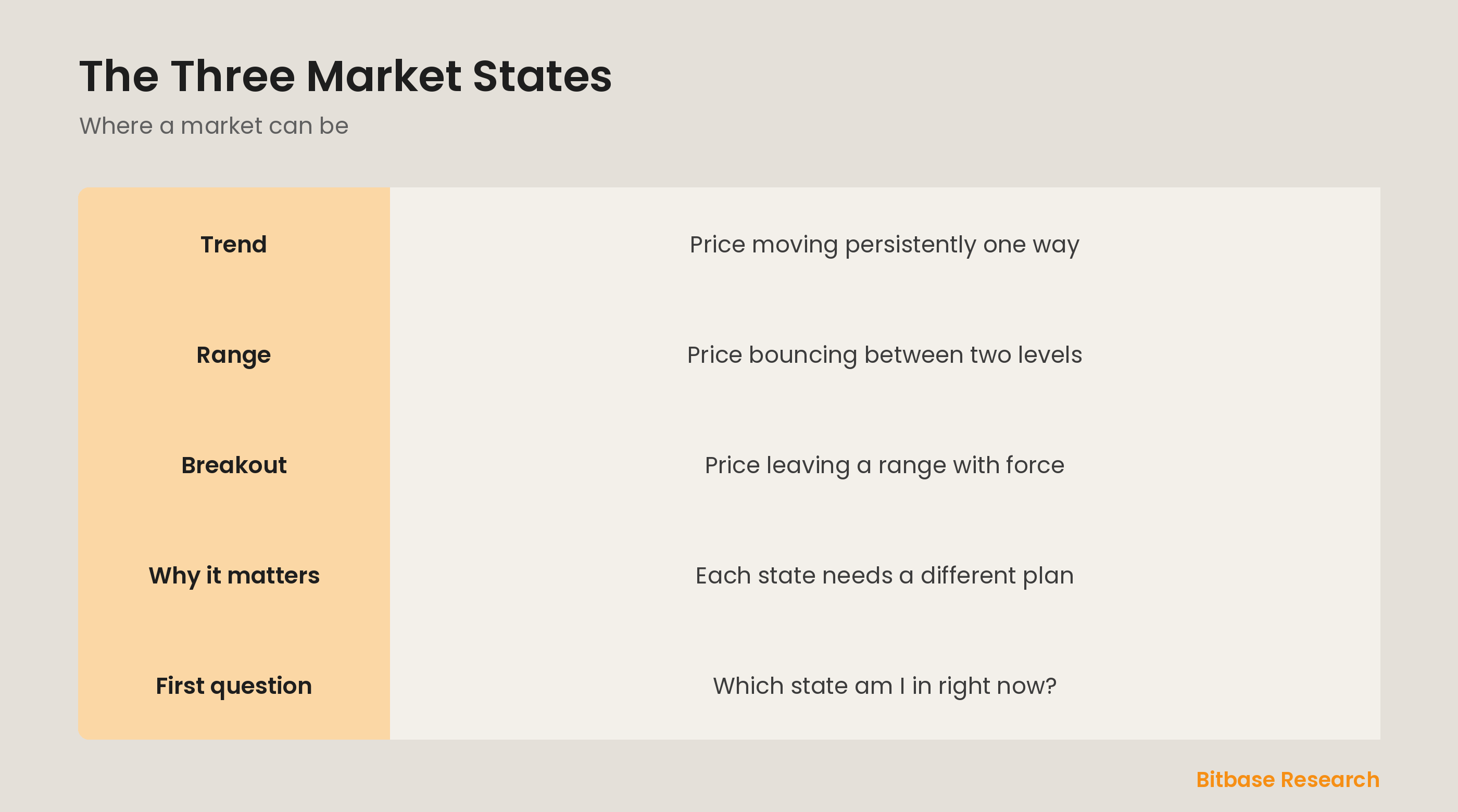
A range is when price moves sideways, bouncing between a support level below and a resistance level above without establishing a clear direction. Neither buyers nor sellers are in control; the market is in balance, oscillating within a band. Ranging conditions reward the opposite approach from trends: buying near support and selling near resistance, fading the extremes back toward the middle, since price keeps returning within the band rather than breaking away.
The breakout between states
A breakout is the moment a range ends and a new trend may begin: price pushes decisively out of the band, through support or resistance, with force. Breakouts are the transitions between the two states, where a balanced market tips into a directional one. They are watched closely because a genuine breakout can start a powerful new trend, but they are also tricky, since not every push out of a range holds, as the next tools in this series explore.
Why the state shapes strategy
The reason identifying the state matters is that a strategy suited to one fails in the other. Buying dips and selling rips works in a range but gets run over in a strong trend. Riding momentum works in a trend but gets chopped up in a range, where price keeps reversing. Many losing trades come from applying a range strategy to a trending market or vice versa. So the first step is always to read the state, then choose the approach that fits it.
The bottom line
Markets move in three states: a trend, where price persistently makes higher highs or lower lows; a range, where price bounces between support and resistance without direction; and a breakout, the forceful transition out of a range that can begin a new trend. Each state rewards a different approach, going with a trend but fading a range, so the most important first step in any trade is to identify which state the market is in. To keep learning the fundamentals, follow more from Bitbase Academy.
Disclaimer: This article is educational content from Bitbase Academy, provided for information only. It does not constitute investment, trading, tax, or financial advice. Crypto assets are volatile; assess your own risk. Written as of June 2026; refer to the latest official information.
References
[1] Investopedia, "Trend: Definition, Types, Examples, and Uses in Trading" investopedia.com
[2] Investopedia, "Range-Bound Trading: Definition and How Strategy Works" investopedia.com
[3] Investopedia, "Breakout: What It Means, Examples, and How To Trade" investopedia.com