When you press send, your transaction does not go straight into the blockchain. It travels through a hidden waiting room called the mempool, competes for a place in a block, and only then becomes part of the permanent record. Understanding this journey demystifies why transactions wait, why fees matter, and how a shadowy corner of crypto can quietly work against you.
The journey of a transaction
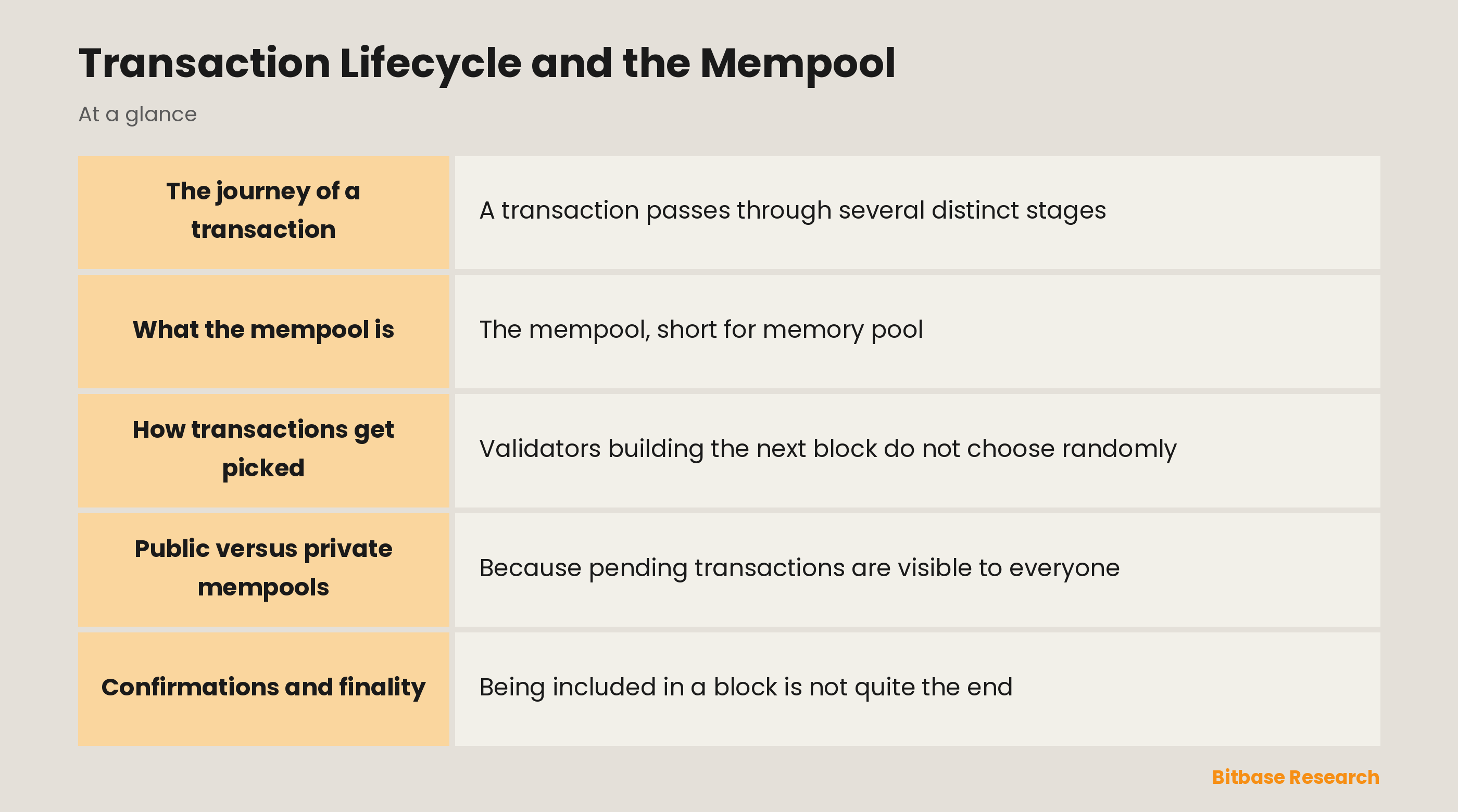
A transaction passes through several distinct stages. First you create and sign it with your private key, proving you authorise it. Then your wallet broadcasts it to the network, where it lands in the mempool as pending. A validator eventually selects it, includes it in a block, and publishes that block. From there it gathers confirmations as more blocks stack on top, until it is considered final and practically irreversible. Every delay you experience happens somewhere along this pipeline.
What the mempool is
The mempool, short for memory pool, is the network's waiting room for unconfirmed transactions. When you broadcast, your transaction is relayed between nodes and held in their mempools until a validator picks it up. It is not one central queue but a loosely shared pool that each node maintains, which is why a pending transaction is visible across the network before it is confirmed. The mempool is where transactions live in limbo — announced to the world, but not yet settled.
How transactions get picked
Validators building the next block do not choose randomly; they generally maximise their reward by favouring transactions offering the highest effective fee. In busy periods this becomes an auction, and low-fee transactions wait until demand cools. Two constraints shape the ordering: fee level determines priority, while each account's nonce forces its own transactions to be processed strictly in sequence. This is why a well-paid transaction can still wait behind a cheaper earlier one from the same wallet.
Public versus private mempools
Because pending transactions are visible to everyone, sophisticated actors can exploit them. This is the world of maximal extractable value, where bots reorder, insert, or surround your transaction to profit — most notoriously the sandwich attack, which front-runs and back-runs a large swap to skim value from it. To defend against this, some users and wallets route transactions through a private mempool or private orderflow, submitting directly to block builders so the transaction stays hidden until it is included.
Confirmations and finality
Being included in a block is not quite the end. A transaction gains confirmations as each subsequent block builds on the one containing it, and more confirmations mean it is exponentially harder to reverse. On some networks a recent block can still be replaced in a brief reorganisation, so exchanges and applications wait for a number of confirmations, or for explicit finality, before treating a transfer as done. Only then is the transaction truly permanent.
The bottom line
A transaction is not instant; it is signed, broadcast into the mempool, auctioned into a block by fee and nonce order, and then hardened by confirmations into finality. The mempool is a public waiting room that both explains delays and exposes you to predatory bots, which private orderflow can help avoid. Knowing this lifecycle helps you set fees wisely, understand why something is pending, and appreciate why finality — not mere inclusion — is what really counts.
Disclaimer: This article is educational content from Bitbase Academy, provided for informational purposes only. It is not investment, trading, tax, or financial advice. Written as of July 2026; rely on the latest official information.
References
[1] Alchemy, "What is the mempool?" alchemy.com
[2] Flashbots, "MEV and the transaction supply chain" flashbots.net