
Price tells you where a market went, but volume tells you how much force was behind the move. Volume is one of the most underused pieces of information on a chart, yet it adds crucial context to everything price does. A move backed by heavy volume means something different from the same move on light volume. Here is what trading volume is, what it reveals, and how to use it to confirm or question a trend.
What volume is
Trading volume is simply the amount of an asset that changed hands during a period, shown as bars beneath the price chart, one bar per candle. A tall volume bar means a lot was traded in that period; a short one means little. Every trade requires a buyer and a seller, so volume counts the activity, the total quantity that traded, regardless of direction. It is the clearest measure of how busy a market was.
Why volume matters
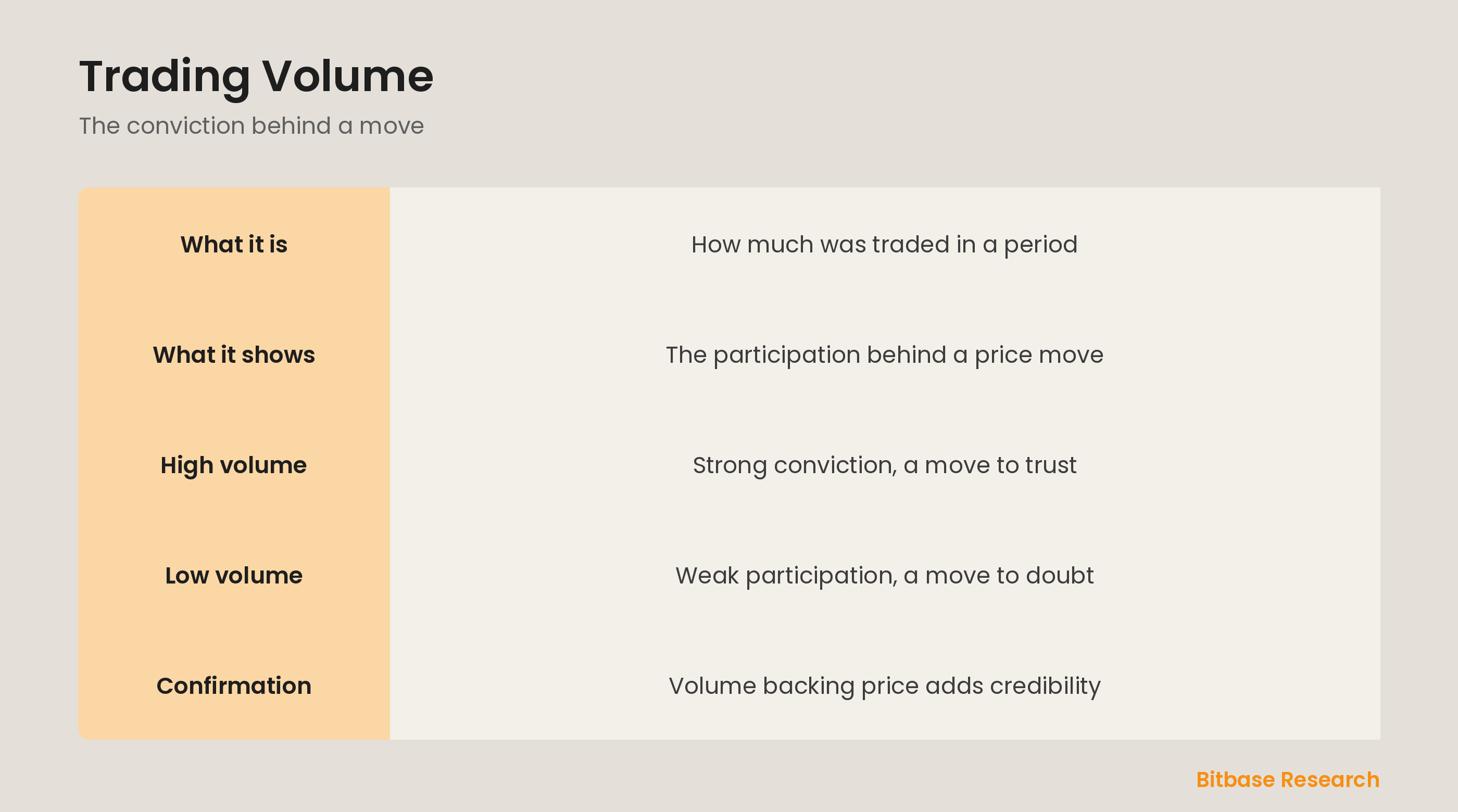
Volume matters because it measures participation, and participation reveals conviction. A price move on high volume means many traders were involved and agreed enough to act, giving the move weight and credibility. The same move on low volume means few participated, so it rests on thin conviction and may not hold. Price shows the direction; volume shows how many people stood behind it, which is often the difference between a real move and a fragile one.
Volume and trends
Healthy trends are usually accompanied by supportive volume. In a strong uptrend, volume tends to rise on the up moves and ease on the pullbacks, showing buyers are in control. If a trend keeps rising but volume steadily fades, it hints the move is running on fewer and fewer participants and may be losing steam. Watching whether volume expands with the trend or dries up is a simple way to judge a trend's underlying health.
Volume confirming a move
The most practical use of volume is confirmation. A breakout above resistance on strong volume is far more convincing than one on weak volume, which is more likely to fail and reverse. Big volume on a move suggests real commitment; light volume suggests hesitation. So before trusting a breakout, a trend, or a reversal, traders check whether volume backs it up, using volume as a second opinion on what price alone is suggesting.
The bottom line
Trading volume is how much of an asset traded in a period, and it measures the participation and conviction behind a price move. High volume gives a move weight and credibility, while low volume suggests weak commitment that may not last. Healthy trends tend to have supportive volume, and a breakout on strong volume is far more trustworthy than one on light volume. Used as confirmation, volume turns price alone into a much fuller picture. To keep learning the fundamentals, follow more from Bitbase Academy.
Disclaimer: This article is educational content from Bitbase Academy, provided for information only. It does not constitute investment, trading, tax, or financial advice. Crypto assets are volatile; assess your own risk. Written as of June 2026; refer to the latest official information.
References
[1] Investopedia, "Volume: Definition in Trading and How To Use It" investopedia.com
[2] Investopedia, "Technical Analysis: What It Is and How to Use It" investopedia.com
[3] Investopedia, "Price Action: What It Is and How Stock Traders Use It" investopedia.com