
A stablecoin is only as trustworthy as the assets behind it. Almost every stablecoin holds its price near one dollar using one of three collateral models: fiat reserves, crypto collateral, or an algorithm. Knowing which model you hold tells you exactly where its risks lie.
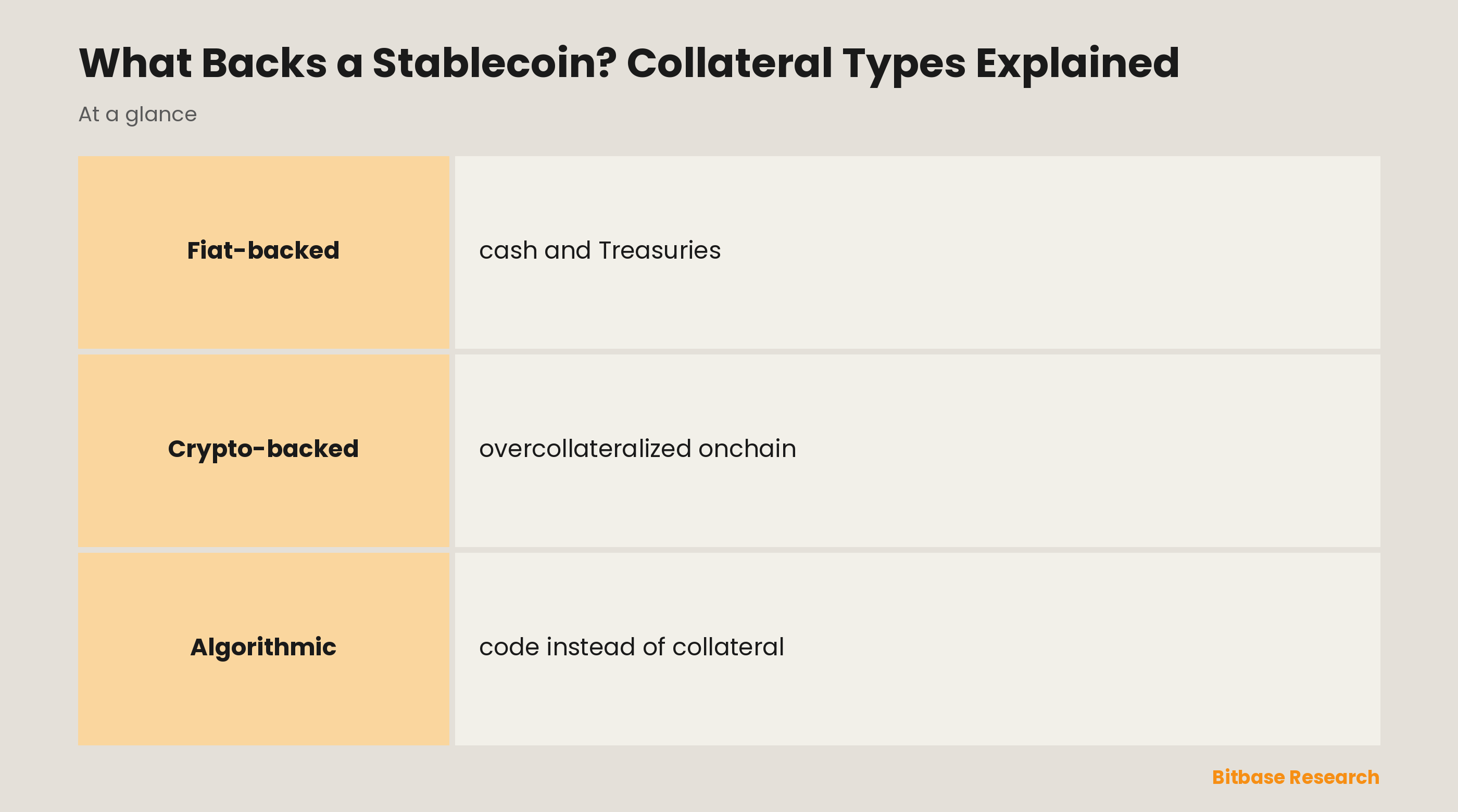
Fiat-backed: cash and Treasuries
The largest stablecoins are fiat-backed. For every token in circulation, the issuer holds a matching dollar of reserves in cash and short-term US Treasuries. USDT and USDC work this way, and fiat-backed coins make up roughly 93% of all stablecoin supply. As of July 2026, USDT is about 184 billion dollars and USDC about 73 billion, together around four-fifths of the market.
The model is simple, but it depends on the issuer actually holding what it claims. That is why reserve reports and third-party attestations matter: they let you check that reserves match or exceed the tokens outstanding, one to one.
Crypto-backed: overcollateralized onchain
Crypto-backed stablecoins hold their reserves in cryptocurrency instead of bank deposits. Because crypto prices swing, these systems demand more collateral than the stablecoins they mint. DAI and USDS from MakerDAO (now Sky) are the best-known examples: a user locks volatile assets such as Ether in a smart-contract vault and can mint only a smaller value of stablecoins, often needing 150 dollars of collateral for every 100 minted.
If the collateral falls too far, the position is automatically liquidated to keep the coin backed. The trade-off is transparency for volatility: anyone can verify the reserves onchain, but the backing itself can lose value fast.
Algorithmic: code instead of collateral
Algorithmic stablecoins hold little or no collateral. Instead, code expands or contracts the token supply to push the price back toward one dollar. In theory it is elegant; in practice it has been fragile. TerraUSD, the largest algorithmic stablecoin, lost its peg in May 2022 and erased tens of billions of dollars in days. Most algorithmic designs have failed the same way, so treat any coin that leans on this model with real caution.
What backs the biggest stablecoins today
Reserves differ even among the fiat-backed leaders. USDT holds roughly 64% of its reserves in US Treasuries. USDC keeps about a third in Treasuries with the rest in overnight repo and cash, including the Circle Reserve Fund, a money-market fund managed by BlackRock. Gemini's GUSD is backed entirely by bank deposits.
Regulation is now tightening this up. Under the US GENIUS Act, signed in July 2025, payment stablecoins must hold reserves of at least 100% in cash and short-term Treasuries and publish monthly disclosures, with enforcement phasing in through 2027. Comparable full-reserve rules already apply in the EU, the UK, Hong Kong, Singapore and Japan.
How to check what backs a stablecoin
Before trusting a stablecoin, read its reserve report. Look for three things: reserves that equal or exceed supply, a clear breakdown of what those reserves are, and a named auditor or monthly attestation. Regulated issuers that disclose often are safer than ones that stay vague. The same habit applies when you park funds on an exchange, where proof-of-reserves reporting shows whether your balance is genuinely backed.
The bottom line
Fiat-backed coins are the simplest but rely on the issuer's honesty and audits. Crypto-backed coins are transparent yet exposed to volatile collateral. Algorithmic coins have a poor track record and deserve skepticism. There is no single safest stablecoin, only models with different risks, so match the backing to how much risk you are willing to carry.
Disclaimer: This article is educational content from Bitbase Academy, provided for information only. It does not constitute investment, trading, tax, or financial advice. Written as of July 2026; refer to the latest official information.
References
[1] Congress.gov, "GENIUS Act (S.1582)" congress.gov
[2] The Block, "The different types of stablecoins explained" theblock.co
[3] CoinLaw, "Stablecoin Market Cap Statistics 2026" coinlaw.io