Getting the best possible price on a trade, and knowing afterward whether you did, is the discipline that separates careful traders from careless ones. Smart order routing hunts for the best price across venues, best execution is the goal it serves, and transaction cost analysis measures how well you actually did. These ideas come from professional trading but the logic helps anyone trading size. Here is how they fit together.
Smart order routing
Because crypto liquidity is spread across many exchanges, the best price for your order is often not all on one venue. Smart order routing is technology that automatically splits an order and sends the pieces to whichever venues offer the best prices at that moment, assembling a better overall fill than any single exchange could give. It does in milliseconds what a human never could: shop every book at once and take the best of each.
Best execution and splitting orders
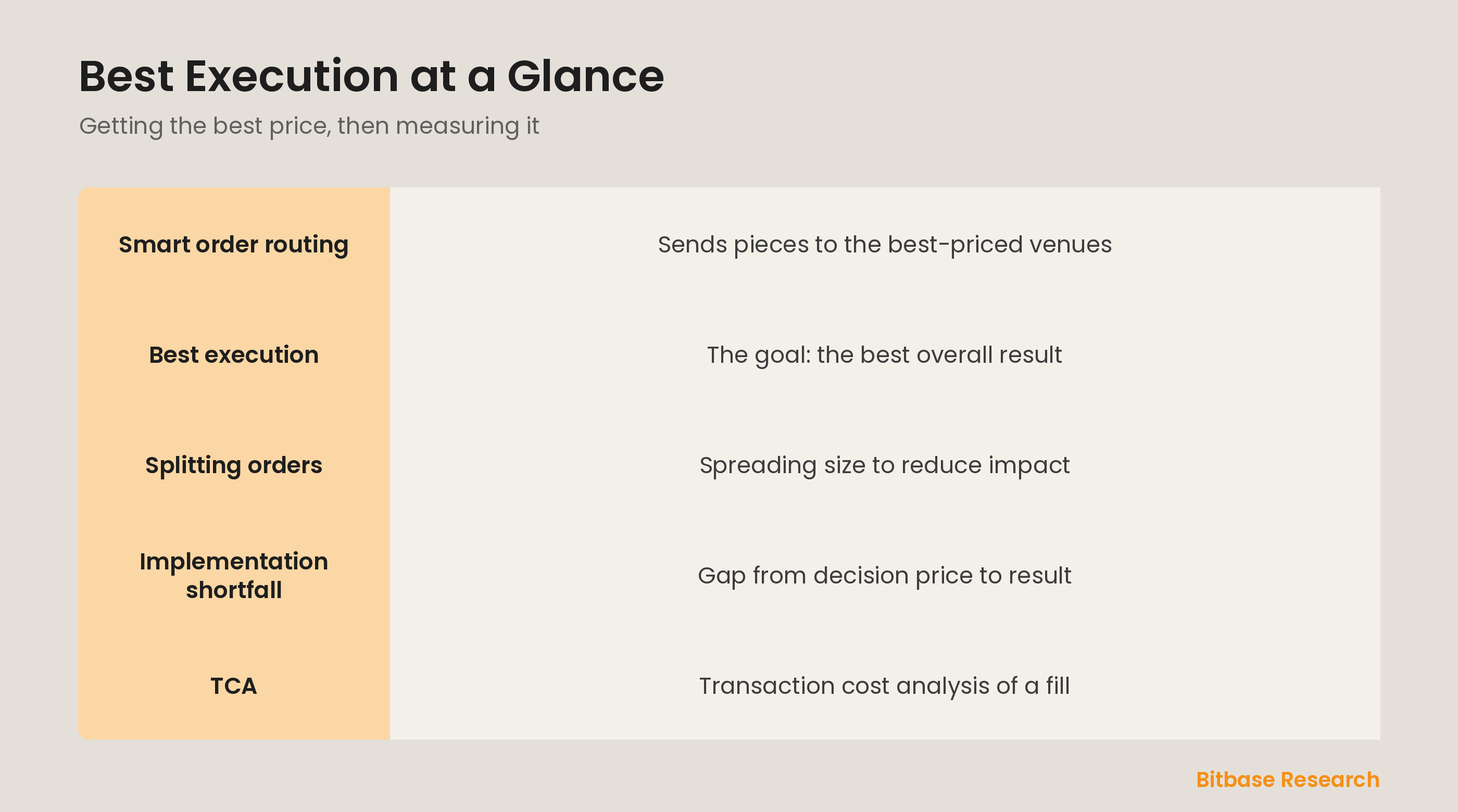
Best execution is the principle that a trade should be carried out to get the best overall result for the trader, weighing price, speed, and the likelihood of filling. Routing serves it, and so does splitting a large order into smaller pieces. A big order dumped at once eats through the book and pays heavy impact; the same order broken into parts, spread across time or venues, fills closer to the fair price. Best execution is the goal; splitting and routing are tools to reach it.
Implementation shortfall
Implementation shortfall measures the cost of turning a decision into a completed trade. It is the difference between the price when you decided to trade and the average price you actually achieved, including impact and any delay. If you decide to buy at one price but your order, by the time it fully fills, averaged higher, that gap is the shortfall. It captures the real, all-in cost of execution, not just the visible fee.
Transaction cost analysis
Transaction cost analysis, or TCA, is the practice of measuring how good an execution was after the fact. It compares your actual fill against benchmarks like the price when you decided, or the volume-weighted average price over the period, to reveal the true cost including slippage and impact. TCA is how professionals judge and improve their execution over time. For a serious trader, even a simple version, comparing your fills to a fair benchmark, turns execution from a guess into something you can measure and refine.
The bottom line
Smart order routing splits an order and sends the pieces to the best-priced venues, serving the goal of best execution: the best overall result across price, speed, and fill probability. Splitting large orders reduces impact. Implementation shortfall measures the gap between your decision price and your achieved price, and transaction cost analysis measures execution quality after the fact. Together they turn getting a good fill from luck into a process you can control and improve. To keep learning the fundamentals, follow more from Bitbase Academy.
Disclaimer: This article is educational content from Bitbase Academy, provided for information only. It does not constitute investment, trading, tax, or financial advice. Crypto assets are volatile; assess your own risk. Written as of June 2026; refer to the latest official information.
References
[1] Investopedia, "Best Execution: Meaning, Investment Types, Example" investopedia.com
[2] Investopedia, "Transaction Costs: Definition, How They Work, and Example" investopedia.com
[3] Investopedia, "Liquidity: Definition, Example, and How It Works" investopedia.com