Price tells you what the market did; two softer signals hint at what may come next. Sentiment measures the crowd's mood, and developer activity measures whether people are actually building. One is fast and emotional, the other slow and structural, and together they frame a market from both its psychology and its foundations. Here is how to read each.
Two kinds of soft signals
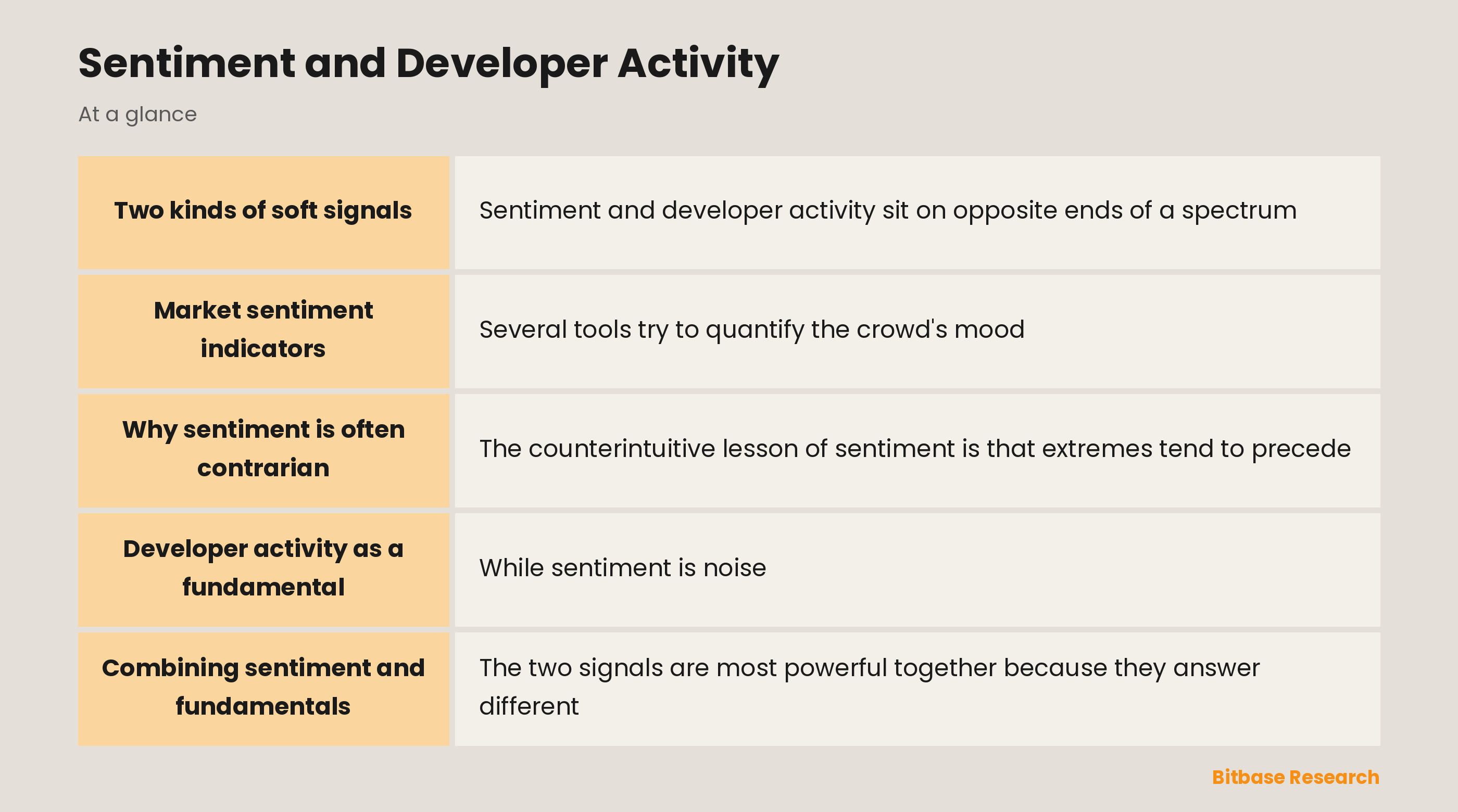
Sentiment and developer activity sit on opposite ends of a spectrum. Sentiment is a short-term, emotional gauge — how greedy or fearful traders feel right now — and it moves fast, often irrationally. Developer activity is a long-term, structural gauge — how much real building is happening on a network — and it moves slowly, reflecting genuine commitment. Neither predicts price directly, but each fills a gap that price and on-chain data leave open, one for mood and one for substance.
Market sentiment indicators
Several tools try to quantify the crowd's mood. The Fear and Greed Index blends volatility, momentum, volume, and social signals into a single score from extreme fear to extreme greed. Funding rates on perpetual futures reveal whether traders are aggressively long or short. Social volume and trending mentions capture attention, while the long/short ratio shows positioning. None is precise, but together they sketch whether the market is complacent, panicked, or somewhere in between.
Why sentiment is often contrarian
The counterintuitive lesson of sentiment is that extremes tend to precede reversals. When greed is maximal and everyone is euphoric, most buyers have already bought, leaving few left to push prices higher — a classic setup for a top. When fear is maximal and headlines are darkest, sellers are often exhausted, and the market is closer to a bottom than it feels. Seasoned participants therefore treat extreme sentiment as a contrarian caution, not a signal to follow the herd.
Developer activity as a fundamental
While sentiment is noise, developer activity is signal about long-term health. Reports such as Electric Capital's annual developer study count how many people are actually writing code across ecosystems. Ethereum has remained the largest developer ecosystem and a leader in attracting new developers, with other chains like Solana growing strongly behind it. Tellingly, after a market shakeout thinned the ranks of newcomers, the number of experienced developers — those with years of commitment, who write the bulk of the code — kept climbing to record highs.
Combining sentiment and fundamentals
The two signals are most powerful together because they answer different questions. Sentiment tells you how the crowd is positioned right now, useful for gauging short-term risk and spotting emotional extremes. Developer activity tells you whether a network is gaining or losing the builders who determine its future. A chain with rising development but fearful sentiment may be undervalued relative to its foundations; one with euphoric sentiment but shrinking development deserves real scepticism.
The bottom line
Sentiment and developer activity are the soft signals that bracket a market from mood to substance. Read sentiment indicators like the Fear and Greed Index as a contrarian gauge of emotional extremes, and read developer activity as a slow, honest measure of which networks are genuinely being built. Neither is a timing tool, but combined with price and on-chain data they round out a fuller, more grounded picture than any single number can give.
Disclaimer: This article is educational content from Bitbase Academy, provided for informational purposes only. It is not investment, trading, tax, or financial advice. Written as of July 2026; rely on the latest official information.
References
[1] Electric Capital, "Developer Report" developerreport.com
[2] Alternative.me, "Crypto Fear & Greed Index" alternative.me