We already have polls, bookmakers, and futures markets to tell us what might happen. So why do prediction markets keep drawing attention as something genuinely different? The answer lies in what each tool actually measures and how honestly it does so. Comparing prediction markets to the alternatives reveals both their unique strength and their real limits.
Different tools for the same question
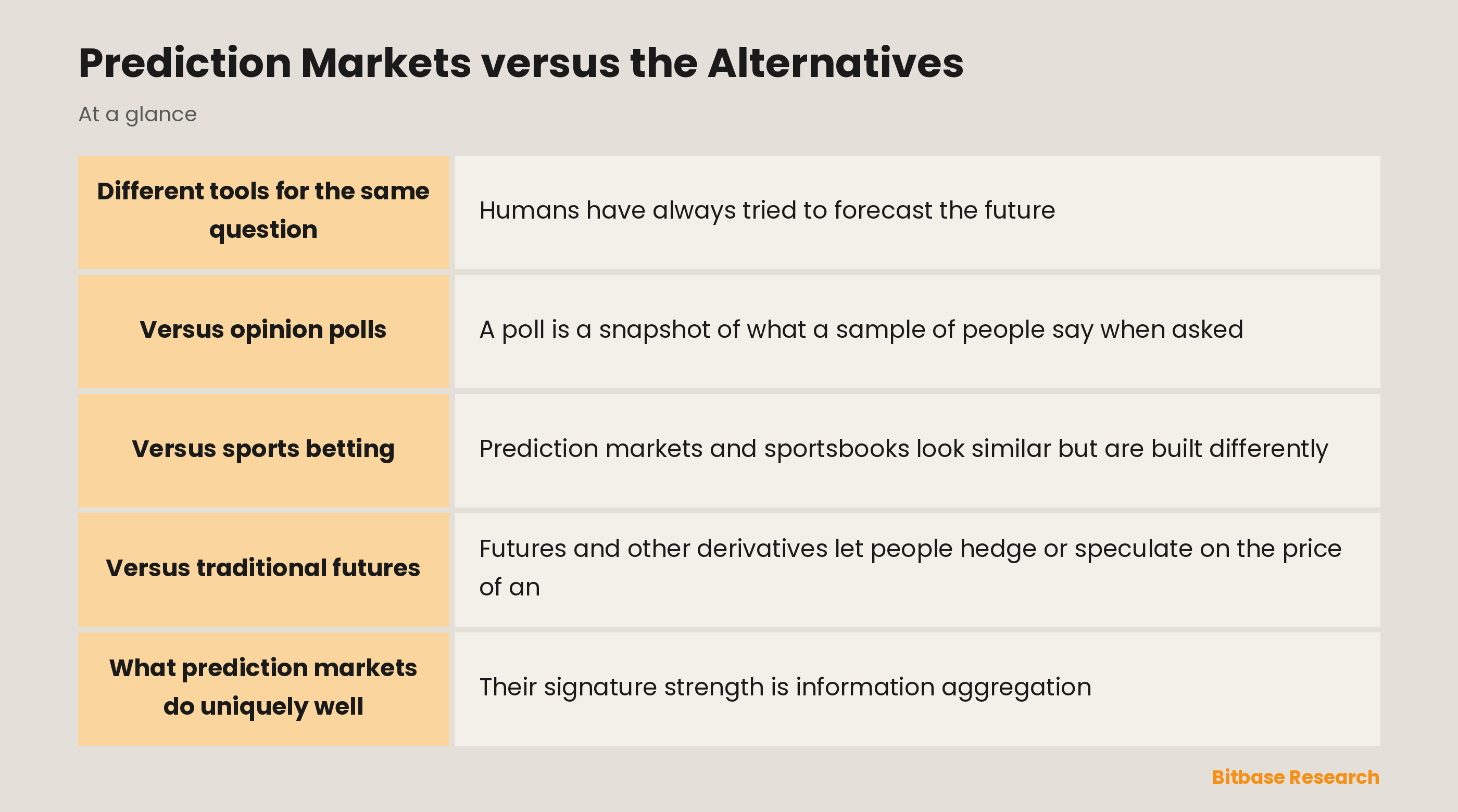
Humans have always tried to forecast the future, and several established tools do it: opinion polls sample what people say, bookmakers set odds for betting, and futures markets price expectations about assets. Prediction markets overlap with all of these but belong to none. They ask participants to put money directly on an outcome and let the resulting price stand as a probability. Understanding how they differ from each familiar tool is the clearest way to see what they add.
Versus opinion polls
A poll is a snapshot of what a sample of people say when asked, and it can be shaped by who was surveyed, how questions were worded, and whether respondents answer honestly. A prediction market instead reflects what people are willing to bet, updating continuously rather than once per survey. The crucial difference is skin in the game: talk is cheap, but a market forces participants to back opinions with money, which tends to filter out idle noise and reward genuine conviction.
Versus sports betting
Prediction markets and sportsbooks look similar but are built differently. A traditional bookmaker sets the odds, takes the other side of your bet, and bakes in a margin so the house profits over time. A prediction market is peer-to-peer: you trade against other participants at a price they collectively set, and the platform typically earns a smaller fee rather than an embedded edge. The result is that prediction-market prices tend to be cleaner probability estimates, less distorted by a built-in house advantage.
Versus traditional futures
Futures and other derivatives let people hedge or speculate on the price of an asset, such as oil, currencies, or an index. Prediction markets extend that same financial machinery to discrete events with yes-or-no outcomes rather than continuous prices. Both are contracts settled at a future date, and regulated prediction markets are often classified as event derivatives for this reason. The distinction is that a futures contract tracks how much something costs, while a prediction contract tracks whether something happens.
What prediction markets do uniquely well
Their signature strength is information aggregation. By combining the knowledge and incentives of many independent participants into a single price, prediction markets can distil dispersed, hard-to-survey information into one clean number, and they have often matched or beaten experts and polls. That same design has limits: thin markets can mislead, they need clear resolution, and they raise legal questions. But as a mechanism for turning collective belief into a measurable probability, nothing else works quite like them.
The bottom line
Prediction markets are not a replacement for polls, bookmakers, or futures but a distinct tool that borrows from each. They beat polls by demanding money behind opinions, differ from sportsbooks by pricing outcomes peer-to-peer without a house edge, and extend futures-style contracts to yes-or-no events. Their unique gift is aggregating scattered knowledge into an honest probability. Use them alongside other tools, aware that their accuracy depends on liquidity, clear rules, and the incentives that keep every participant honest.
Disclaimer: This article is educational content from Bitbase Academy, provided for informational purposes only. It is not investment, trading, tax, or financial advice. Written as of July 2026; rely on the latest official information.
References
[1] Built In, "What prediction markets are and how they compare" builtin.com
[2] Harvard Business Review, "The promise of prediction markets" hbr.org