A prediction market's headline odds only mean something if you can actually trade at them. Behind every price sits a question of liquidity — how much can be bought or sold without moving the market — and a mechanism that matches buyers with sellers. Understanding these mechanics separates traders who get the price they see from those who quietly lose money to a thin market.
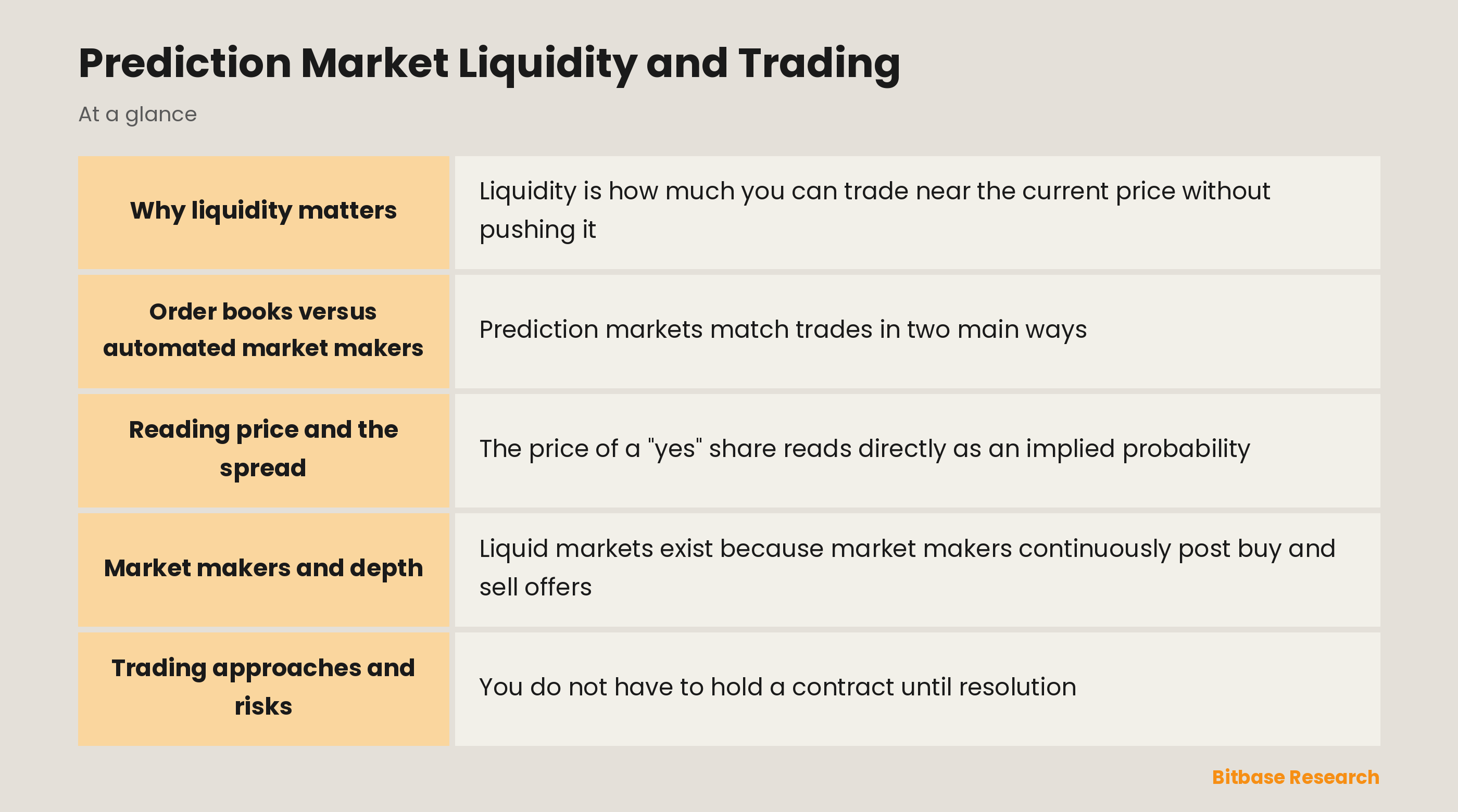
Why liquidity matters
Liquidity is how much you can trade near the current price without pushing it. In a deep, liquid market, your order fills close to the quoted odds and the price is a reliable signal. In a thin one, even a modest trade can swing the price several points, and the odds on screen may be more mirage than measurement. Liquidity determines both how trustworthy a market's probability is and how much your own entry and exit will really cost.
Order books versus automated market makers
Prediction markets match trades in two main ways. An order book, used by regulated exchanges, collects everyone's bids and asks and pairs them by price and time, just like a stock exchange. An automated market maker instead uses a pooled formula that always quotes a price, so you can trade instantly against the pool even when few humans are active. Order books can offer tighter prices in busy markets; automated makers guarantee you can always trade, which matters most in quieter ones.
Reading price and the spread
The price of a "yes" share reads directly as an implied probability, but the number you should watch is the spread — the gap between the best buy and sell prices. A tight spread means an efficient, liquid market where entering and exiting is cheap. A wide spread is a warning that liquidity is thin and that you will pay a real cost just to get in and out. Always look at the spread, not just the midpoint odds, before trading.
Market makers and depth
Liquid markets exist because market makers continuously post buy and sell offers, earning the spread in exchange for providing that liquidity. Depth describes how much size is available at each price level; deep markets absorb large orders with little movement, shallow ones lurch. In crypto prediction markets, some platforms reward users for supplying liquidity to bootstrap new questions. As a trader, checking depth tells you how big a position you can realistically take without moving the odds against yourself.
Trading approaches and risks
You do not have to hold a contract until resolution. Because prices move as events unfold, you can sell early to lock in a profit or cut a loss, treating the position like any other trade. But prediction markets carry distinctive risks: thin markets can be manipulated, prices can gap on news, and every position ultimately depends on the market resolving as expected. Sizing conservatively, favouring liquid markets, and reading the resolution rules protect you from the traps unique to this arena.
The bottom line
Liquidity is what turns a quoted probability into a price you can actually trade, and it is shaped by whether a market uses an order book or an automated maker, how tight its spread is, and how deep the book runs. Read the spread and depth before entering, remember you can exit early rather than wait for settlement, and respect the resolution and manipulation risks. Trade the liquid markets, size for the thin ones, and never assume the headline odds are the price you will get.
Disclaimer: This article is educational content from Bitbase Academy, provided for informational purposes only. It is not investment, trading, tax, or financial advice. Written as of July 2026; rely on the latest official information.
References
[1] MetaMask, "Prediction markets and trends" metamask.io
[2] Messari, "Prediction market liquidity" messari.io