Polymarket may be the biggest name in prediction markets, but it is far from the only one. Regulated exchanges, other crypto-native platforms, and play-money forecasting sites each offer a different balance of access, safety, and features. Knowing the alternatives — and how to compare them — helps you pick the venue that actually fits how and where you want to trade.
Why look beyond Polymarket
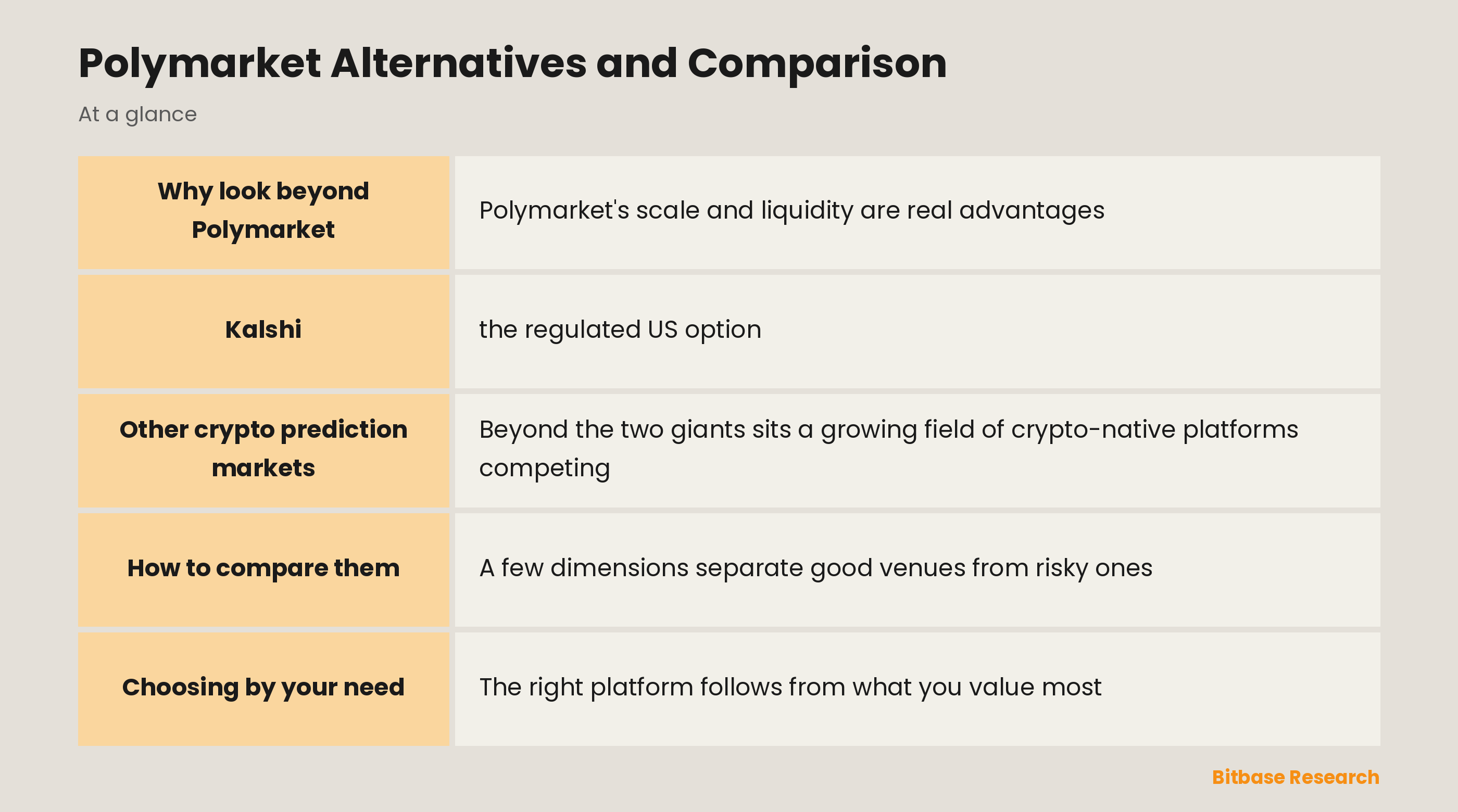
Polymarket's scale and liquidity are real advantages, but no single platform is right for everyone. Your location may restrict access, you might prefer regulated protection over on-chain openness, or you may want markets Polymarket does not offer. Prediction markets also differ sharply in how they custody your money, resolve outcomes, and charge fees. Treating Polymarket as one option among several, rather than the default, leads to better decisions about where your funds and forecasts belong.
Kalshi: the regulated US option
The most prominent alternative is Kalshi, a US exchange regulated by the federal commodities regulator. Where Polymarket is crypto-native and global, Kalshi is dollar-funded and operates fully onshore under formal oversight, holding customer money in segregated accounts and matching trades through an order book. For US users who value regulatory protection and familiar fiat rails over permissionless access and self-custody, Kalshi is the natural counterpart, trading openness for assurance.
Other crypto prediction markets
Beyond the two giants sits a growing field of crypto-native platforms competing on speed, fees, and niche markets. Newer venues on fast, low-cost networks aim to undercut Polymarket on trading costs or focus on specific themes such as sports or crypto-price outcomes. There are also play-money forecasting sites, where users predict with points rather than real stakes, and older decentralised protocols that pioneered the idea. Each experiments with different resolution and liquidity designs, so quality and reliability vary widely.
How to compare them
A few dimensions separate good venues from risky ones. Regulation and custody come first: does a platform hold your funds under oversight, or do you self-custody on-chain? Then liquidity and market depth, which determine whether prices are real and tradable. Next, the resolution mechanism — a trusted operator, an official source, or a decentralised oracle — since settlement integrity is everything. Finally, weigh fees, the range of available markets, and whether the platform legally serves your region at all.
Choosing by your need
The right platform follows from what you value most. If regulatory protection and dollar funding matter most, a licensed exchange like Kalshi fits. If you want global access, the deepest markets, and on-chain self-custody, Polymarket leads. If you are simply learning, a play-money site lets you practise risk-free. And if low fees or a specialised market are the priority, a newer crypto venue may suit — provided you have checked its liquidity and resolution carefully first.
The bottom line
Polymarket is a leader, not the whole field: Kalshi offers regulated, fiat-based trading, other crypto platforms compete on cost and niche, and play-money sites let you learn safely. Compare any venue on regulation and custody, liquidity, resolution integrity, fees, and whether it serves your region, then match it to what you actually need. The best prediction market is the one whose trade-offs align with your priorities, not merely the one with the loudest name.
Disclaimer: This article is educational content from Bitbase Academy, provided for informational purposes only. It is not investment, trading, tax, or financial advice. Written as of July 2026; rely on the latest official information.
References
[1] The Block, "Prediction market platforms compared" theblock.co
[2] Cointelegraph, "Polymarket vs Kalshi and rivals" cointelegraph.com