The order book can be gamed. Some large players place orders they never intend to fill, or push the price to hunt the stops of others, tricks designed to mislead. Spotting them protects you from being the one who reacts to a fake signal. This is not about becoming a manipulator; it is about recognizing manipulation so it does not cost you. Here are the main order book tricks and how to read them.
Spoofing and layering
Spoofing means placing large orders with no intention of letting them fill, to create a false impression of demand or supply, then cancelling them once other traders react. Layering is spoofing scaled up: stacking many fake orders at different prices to build a convincing wall. Both are forms of market manipulation and are illegal on regulated venues, but they still appear in crypto. A wall that repeatedly shows up and vanishes without trading is a classic sign.
Order book absorption
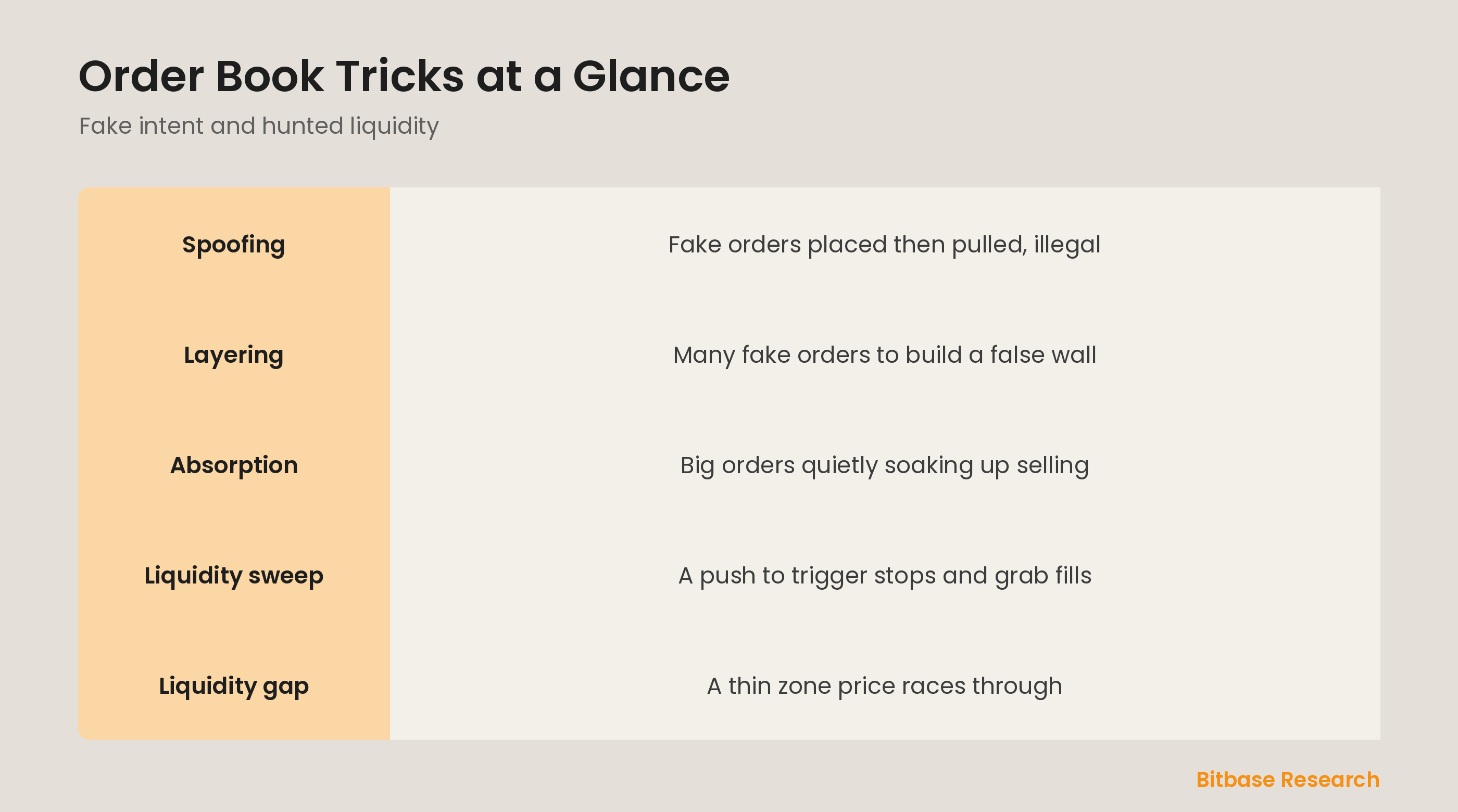
Absorption is the opposite of a flashy wall: it is quiet strength. It happens when a steady stream of selling hits the book but the price barely moves, because a large buyer is patiently soaking up every sell order at one level. On the tape it looks like heavy volume with little price change. Absorption can signal that a big participant is accumulating and that the level is stronger than it looks, often preceding a reversal.
Liquidity sweeps and gaps
A liquidity sweep is a sharp move engineered to reach a level where many stop orders sit, triggering them all at once to generate fills for someone taking the other side, before the price often snaps back. It is why price sometimes spikes just past an obvious support or resistance and then reverses. A liquidity gap is a price zone with almost no resting orders, so once price enters it, it races through quickly with little to slow it down.
How to protect yourself
You cannot stop manipulation, but you can avoid being its easy target. Do not place your stop-loss at the obvious round number where everyone else does, since that is exactly where sweeps aim. Be skeptical of walls that never fill. Watch for absorption as a sign of hidden strength. And remember that a single order book snapshot can lie; genuine intent shows over time, in what actually trades, not just in what is displayed.
The bottom line
Order book manipulation includes spoofing and layering, which use fake orders to fake demand or supply, absorption, where a big buyer quietly soaks up selling, and liquidity sweeps that spike price to trigger stops before reversing, often through thin liquidity gaps. You cannot prevent these, but you can avoid obvious stop levels, distrust walls that never trade, and judge intent by what actually executes rather than what is merely shown. To keep learning the fundamentals, follow more from Bitbase Academy.
Disclaimer: This article is educational content from Bitbase Academy, provided for information only. It does not constitute investment, trading, tax, or financial advice. Crypto assets are volatile; assess your own risk. Written as of June 2026; refer to the latest official information.
References
[1] Investopedia, "Spoofing: How Traders Manipulate Markets and Prices" investopedia.com
[2] Investopedia, "Order Book: Definition, How It Works, and Key Parts" investopedia.com
[3] CFTC, "Customer Advisory: Understand the Risks of Virtual Currency Trading" cftc.gov